
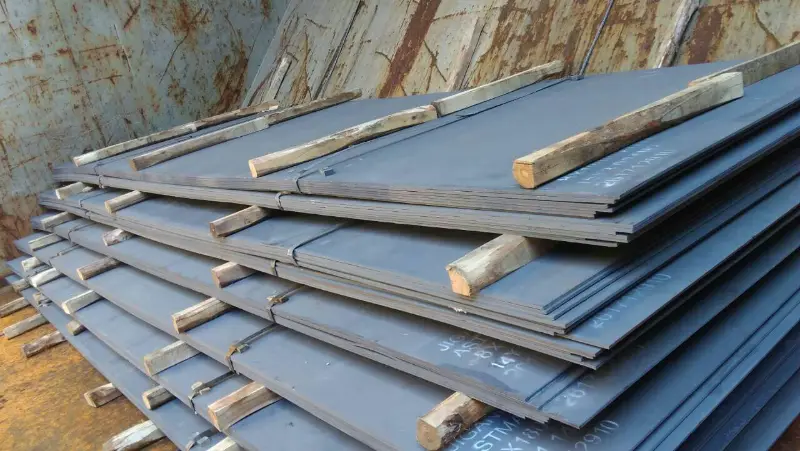
GB713 15CrMoR Pressure Vessel & Boiler Steel Plate
GB713 15CrMoR Pressure Vessel & Boiler Steel Plate - Comprehensive Technical Data
Comprehensive analysis of 15CrMoR steel plate under GB 713 standard, covering chemical composition, mechanical properties at room and elevated temperatures, physical properties, international equivalents, and application guidance.
Hot rolling followed by heat treatment: normalizing, normalizing + tempering, or as agreed. Further processing includes cutting, welding, cold forming, hot forming, and machining.
- Phone : +8618037372205
- Email : [email protected]
- WhatsApp: Contact via Whtsapp
- WeChat: +8618037372205
GB713 15CrMoR Pressure Vessel & Boiler Steel Plate Introduction
15CrMoR is a chromium-molybdenum alloy steel plate specifically designed for pressure vessels and boilers under Chinese standard GB 713-2014. It belongs to the group of heat-resistant low-alloy steels that provide an excellent combination of moderate high-temperature strength, good resistance to hydrogen attack, superior weldability, and reliable toughness. With a controlled carbon content (0.12–0.18%) and additions of Cr (0.80–1.20%) and Mo (0.30–0.60%), the material exhibits fine-grained structure and stable mechanical response through normalizing or normalizing + tempering heat treatment.
The steel plate is primarily employed in the fabrication of petrochemical reactors, boiler drums, heat exchangers, superheaters, and high-temperature separators. It can operate continuously at temperatures up to about 520°C while maintaining acceptable creep resistance and oxidation resistance. Due to its low sulfur (≤0.010%) and phosphorus (≤0.025%) limits, the steel possesses high cleanliness and improved toughness, which is essential for thick-walled pressure equipment.
15CrMoR is comparable to EN 10028-2 13CrMo4-5, ASTM A387 Gr.12 Cl.2, and JIS G4106 SCMV 2. It is normally supplied in the normalized condition, and depending on purchaser requirements, it may also be delivered after stress-relief annealing or quench-and-temper procedures. Its widespread acceptance in domestic and international engineering projects makes it a benchmark grade for medium-temperature pressure containment.
GB713 15CrMoR Pressure Vessel & Boiler Steel Plate Chemical Composition
The chemical composition of 15CrMoR is strictly governed by GB 713 to ensure repeatable mechanical properties, weldability, and resistance to hydrogen embrittlement. The elements Cr and Mo are added for high-temperature strength and corrosion resistance, while low P and S levels guarantee ductility and toughness in thick sections. Residual elements such as Ni and Cu are controlled to avoid temper embrittlement. The table lists all specified elements with their permissible ranges.
| Chemical Element | Standard Value (%) | Remarks |
|---|---|---|
| Carbon (C) | 0.12 – 0.18 | Provides strength and hardenability |
| Silicon (Si) | 0.15 – 0.40 | Deoxidizer, improves strength |
| Manganese (Mn) | 0.40 – 0.70 | Enhances hardenability and toughness |
| Phosphorus (P) | ≤0.025 | Control for grain boundary embrittlement |
| Sulfur (S) | ≤0.010 | Ultra-low to ensure impact toughness |
| Chromium (Cr) | 0.80 – 1.20 | Main alloying element for heat resistance |
| Molybdenum (Mo) | 0.30 – 0.60 | Improves creep strength and hardenability |
| Nickel (Ni) | ≤0.30 | Residual element, maximum limit |
| Copper (Cu) | ≤0.30 | Residual element, maximum limit |
| Ni+Cu+Cr+Mo | ≤... | Sum of elements not specifically controlled, but overall residuals kept low |
| Total Aluminum (Alt) | ≥0.020 | Grain refinement, as per standard requirement for killing |
GB713 15CrMoR Pressure Vessel & Boiler Steel Plate Thermal and Electrical Physical Properties
The following physical properties are typical for low-alloy Cr-Mo steel (1Cr–0.5Mo) in the normalized condition and should be used for engineering estimates. The data are derived from published material handbooks and industry databases, not from specific product testing. They exhibit temperature dependency; values at elevated temperatures are important for thermal–mechanical analysis of pressure equipment.
| Property | Typical Value | Unit | Test Condition |
|---|---|---|---|
| Density (ρ) | 7.85 | g/cm³ | At 20°C |
| Elastic Modulus (E) | 210 | GPa | At 20°C |
| Shear Modulus (G) | 81 | GPa | Calculated (E/(2(1+ν))) |
| Poisson's Ratio (ν) | 0.30 | — | At 20°C |
| Thermal Expansion (α) | 11.5 × 10⁻⁶ | 1/K | 20–100°C |
| Thermal Expansion (α) | 12.3 × 10⁻⁶ | 1/K | 20–200°C |
| Thermal Expansion (α) | 12.9 × 10⁻⁶ | 1/K | 20–300°C |
| Thermal Expansion (α) | 13.5 × 10⁻⁶ | 1/K | 20–400°C |
| Thermal Expansion (α) | 13.9 × 10⁻⁶ | 1/K | 20–500°C |
| Thermal Conductivity (λ) | 42 | W/(m·K) | At 20°C |
| Thermal Conductivity (λ) | 40 | W/(m·K) | At 200°C |
| Thermal Conductivity (λ) | 36 | W/(m·K) | At 400°C |
| Specific Heat (cₚ) | 460 | J/(kg·K) | At 20°C |
| Electrical Resistivity (ρₑ) | 0.22 × 10⁻⁶ | Ω·m | At 20°C |
GB713 15CrMoR Pressure Vessel & Boiler Steel Plate Mechanical Properties
Tensile and impact properties of 15CrMoR are determined on test pieces taken transverse to the rolling direction after final heat treatment. The standard specifies distinct yield strength (ReH) minima depending on plate thickness. Charpy V-notch impact energy is measured at 20°C to verify ductile behaviour. Additionally, the standard provides elevated temperature yield strength (Rp0.2) values to support design calculations at service temperatures up to 500°C. All values represent the minimum requirements unless noted otherwise.
| Property | Value | Unit | Test Condition |
|---|---|---|---|
| Yield Strength (ReH) | ≥295 | MPa | Thickness ≤16 mm, room temperature |
| Yield Strength (ReH) | ≥285 | MPa | Thickness >16–40 mm, room temperature |
| Yield Strength (ReH) | ≥275 | MPa | Thickness >40–60 mm, room temperature |
| Yield Strength (ReH) | ≥255 | MPa | Thickness >60–100 mm, room temperature |
| Tensile Strength (Rm) | 440 – 590 | MPa | Thickness ≤60 mm, room temperature |
| Tensile Strength (Rm) | 430 – 580 | MPa | Thickness >60–100 mm, room temperature |
| Elongation (A) | ≥19 | % | Thickness ≤60 mm, 5.65√S0 gauge |
| Elongation (A) | ≥18 | % | Thickness >60–100 mm, 5.65√S0 gauge |
| Impact Energy (KV2) | ≥34 | J | At 20°C, longitudinal specimens |
| Bending Test | d = 3a | — | 180°, thickness ≤60 mm; d=mandrel diameter, a=thickness |
| Bending Test | d = 4a | — | 180°, thickness >60–100 mm |
| Elevated Temp. Yield (Rp0.2) | ≥255 | MPa | At 200°C |
| Elevated Temp. Yield (Rp0.2) | ≥235 | MPa | At 250°C |
| Elevated Temp. Yield (Rp0.2) | ≥210 | MPa | At 300°C |
| Elevated Temp. Yield (Rp0.2) | ≥200 | MPa | At 350°C |
| Elevated Temp. Yield (Rp0.2) | ≥185 | MPa | At 400°C |
| Elevated Temp. Yield (Rp0.2) | ≥170 | MPa | At 450°C |
| Elevated Temp. Yield (Rp0.2) | ≥145 | MPa | At 500°C |
GB713 15CrMoR Pressure Vessel & Boiler Steel Plate Complete Equivalent Material Standards and Designations
| Country/Region | Standard | Designation | Remarks |
|---|---|---|---|
| China | GB 713-2014 | 15CrMoR | Original grade; directly matches the described material |
| EU | EN 10028-2:2017 | 13CrMo4-5 | Closest European pressure vessel plate; minor composition differences |
| USA (ASTM) | ASTM A387/A387M | Grade 12 Class 2 | Chromium-molybdenum alloy steel plate for welded boilers and pressure vessels |
| Japan | JIS G4106:2019 | SCMV 2 | Molybdenum chromium steel plates for boilers and other pressure vessels |
| ISO | ISO 9328-2:2018 | 11CrMo4-5 | Similar steel for pressure purposes; carbon slightly lower |
GB713 15CrMoR Pressure Vessel & Boiler Steel Plate Application Introduction
15CrMoR is engineered for medium-temperature pressure equipment where integrity under internal pressure and hydrogen attack must be maintained. Its favorable combination of tensile strength, ductility, and high-temperature stability allows designers to use thinner walls compared to carbon steels, reducing weight and improving heat transfer.
The material is approved under most pressure vessel design codes (GB 150, ASME Section VIII after resolution) and is widely available in plate thicknesses from 6 mm to 150 mm. Post-weld heat treatment (PWHT) is mandatory for thick sections to relieve residual stresses and temper the heat-affected zone. All welding procedures must be qualified, typically using matching Cr-Mo filler metals (e.g., E5515-B2 / ER55-B2).
Typical service conditions include exposure to steam, hydrogen-rich atmospheres, and hydrocarbons up to 520°C. For higher hydrogen partial pressures, the steel benefits from its inherent resistance to hydrogen blistering and decarburization compared to plain carbon steel.
Product Applications: Pressure vessels (reactors, separators, accumulators), Industrial boilers (shells, drums, water walls), Heat exchangers (shell-and-tube, plate-fin), Heater coils and radiant sections of fired heaters, Steam-generating equipment (economizers, evaporators), High-temperature storage tanks
Processed into products: Cylindrical shells and rolled courses, Dished and flat heads (hemispherical, ellipsoidal), Tube sheets and baffles for heat exchangers, Nozzle necks and reinforcement pads, Flanges (welding neck, slip-on, blind), Stiffening rings and support skirts, Bolted cover plates, Reducers and branch connections
Application industries: Petrochemical refineries (hydrocracking units, hydrotreaters, reformers), Thermal power stations (boiler drums, superheater headers, steam pipelines), Chemical plants (ammonia synthesis, methanol converters), Nuclear auxiliary equipment (non-core applications), Heat exchanger manufacturing, Offshore oil & gas processing modules
GB713 15CrMoR Pressure Vessel & Boiler Steel Plate Similar / Closely Related Alternative Materials
| Country/Region | Standard | Designation | Remarks |
|---|---|---|---|
| China | GB 713-2014 | 12CrMoR | Lower Mo (0.45–0.60) and Cr (0.40–0.70); less high-temperature strength, but similar weldability |
| China | GB 713-2014 | 14Cr1MoR | Higher Cr (1.10–1.55) and Mo (0.45–0.60); improved creep resistance for temperatures up to 550°C |
| China | GB 713-2014 | 12Cr1MoVR | Contains vanadium (0.15–0.30) for higher sustained strength at elevated temperatures |
| EU | EN 10028-2 | 10CrMo9-10 (1.7380) | Higher Cr (2.0–2.5) and Mo (0.9–1.1); used for hydrogen service at higher temperatures |
| USA (ASTM) | A387 | Grade 11 Class 2 | 1.25Cr–0.5Mo steel; slightly higher Cr, similar Mo; more oxidation resistant |
Notes:
- Welding: Preheating to 150–200°C is required; maintain interpass temperature ≤300°C. Post-weld heat treatment at 620–680°C is essential for thicknesses above a certain limit (typically 30 mm) to restore toughness.
- Hydrogen attack resistance: 15CrMoR performs well in Nelson-curve environments up to 500°C under moderate hydrogen partial pressure; higher temperatures require richer Cr-Mo alloys.
- Ultrasonic testing: In accordance with GB/T 2970, Class II or higher acceptance criteria are commonly applied for pressure-retaining parts.
- Restricted elements: The sum of As, Sn, Sb, Pb, Bi is controlled when ordered for temper embrittlement-resistant (J factor / X factor) applications.
- Alternate stress relief: For components machined to final dimensions, an optional stress-relief annealing at 600–650°C may be applied before final assembly.
- Forming: Cold forming of thick plates must be followed by a stress-relief heat treatment if the forming strain exceeds 5%.
- Share



