
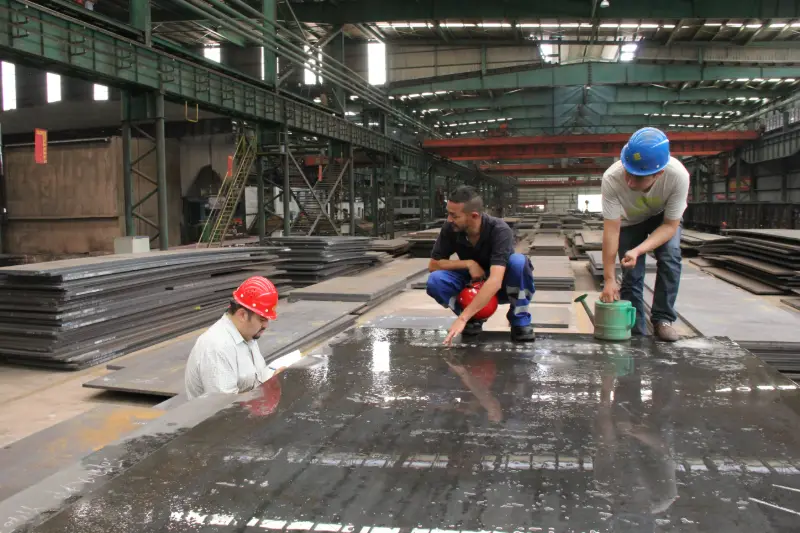
GB713 14Cr1MoR Pressure Vessel Steel Plate
GB713 14Cr1MoR Pressure Vessel Steel Plate: Properties, Equivalents & Uses
Comprehensive datasheet of 14Cr1MoR steel plate under GB713 standard, covering chemical composition, mechanical and thermal properties, international equivalents, and engineering applications.
Normalizing, tempering, hot rolling, cold forming, welding, machining, cutting
- Phone : +8618037372205
- Email : [email protected]
- WhatsApp: Contact via Whtsapp
- WeChat: +8618037372205
GB713 14Cr1MoR Pressure Vessel Steel Plate Introduction
14Cr1MoR is a chromium-molybdenum alloy steel plate specifically designed for pressure vessels and boilers operating at elevated temperatures, standardized under GB/T 713. It belongs to the 1.25Cr-0.5Mo family, offering a balanced combination of high-temperature strength, oxidation resistance, and hydrogen attack resistance. The grade is widely used in the fabrication of critical equipment such as reactors, separators, steam drums, and heat exchangers in petrochemical, oil & gas, and power generation industries.
- Excellent creep resistance up to approximately 550°C
- Good weldability with proper preheat and post-weld heat treatment
- Proven resistance to high-temperature hydrogen attack (HTHA), suitable for hydrogen service under Nelson curve guidelines
- Supplied in normalized and tempered condition to ensure uniform microstructure and mechanical properties
- Available in thicknesses up to 200 mm, with guaranteed impact toughness at 20°C
GB713 14Cr1MoR Pressure Vessel Steel Plate Chemical Composition
Chemical composition according to GB/T 713-2014 for 14Cr1MoR. All values are in weight percent. Residual elements Ni and Cu are limited to ensure hot workability and toughness. The steel is fully killed and fine-grained treated.
| Element | Standard Value | Remarks |
|---|---|---|
| Carbon (C) | ≤0.17 | For thickness >150 mm, C may be ≤0.20 by agreement |
| Silicon (Si) | 0.50 – 0.80 | Promotes deoxidation and strength |
| Manganese (Mn) | 0.40 – 0.65 | Contributes to hardenability and strength |
| Phosphorus (P) | ≤0.020 | Residual, tightly controlled for toughness |
| Sulfur (S) | ≤0.010 | Ultra-low sulfur for improved ductility |
| Chromium (Cr) | 1.15 – 1.50 | Primary element for creep and oxidation resistance |
| Molybdenum (Mo) | 0.45 – 0.65 | Enhances elevated-temperature strength |
| Nickel (Ni) | ≤0.30 | Residual element, maximum limit |
| Copper (Cu) | ≤0.30 | Residual element, maximum limit |
GB713 14Cr1MoR Pressure Vessel Steel Plate Thermal and Electrical Physical Properties
Physical properties for 1.25Cr-0.5Mo steel at room temperature and elevated temperatures. These represent typical engineering data and are not mandatory requirements of GB/T 713. Values may vary slightly depending on heat treatment and product form.
| Property | Standard Required Value | Unit | Test Condition |
|---|---|---|---|
| Density (ρ) | 7.85 | g/cm³ | At 20°C |
| Modulus of Elasticity (E) | 210 | GPa | At 20°C |
| Shear Modulus (G) | 81 | GPa | At 20°C |
| Poisson's Ratio (ν) | 0.30 | – | At 20°C |
| Thermal Expansion Coefficient (α) | 11.2 | 10⁻⁶/K | 20 – 100°C |
| Thermal Expansion Coefficient (α) | 12.5 | 10⁻⁶/K | 20 – 300°C |
| Thermal Expansion Coefficient (α) | 13.5 | 10⁻⁶/K | 20 – 500°C |
| Thermal Conductivity (λ) | 42.7 | W/(m·K) | At 20°C |
| Thermal Conductivity (λ) | 39.8 | W/(m·K) | At 200°C |
| Thermal Conductivity (λ) | 35.6 | W/(m·K) | At 400°C |
| Specific Heat Capacity (cₚ) | 460 | J/(kg·K) | At 20°C |
| Electrical Resistivity (ρ_e) | 0.20 | μΩ·m | At 20°C |
GB713 14Cr1MoR Pressure Vessel Steel Plate Mechanical Properties
Room-temperature tensile, impact, and bending properties are guaranteed by GB/T 713-2014. Properties depend on plate thickness. The steel exhibits excellent ductility and toughness after normalizing and tempering. Impact testing is performed on Charpy V-notch specimens at 20°C.
| Property | Standard Required Value | Unit | Test Condition / Remarks |
|---|---|---|---|
| Yield Strength (ReH / ReL) | ≥ 310 | MPa | Room temperature; applicable for thickness ≤150 mm |
| Tensile Strength (Rm) | 520 – 680 | MPa | Plate thickness ≤100 mm |
| Tensile Strength (Rm) | 510 – 670 | MPa | Plate thickness >100 – 200 mm |
| Elongation (A) | ≥ 19 | % | Gauge length 5.65√S₀; thickness ≤100 mm |
| Elongation (A) | ≥ 18 | % | Thickness >100 – 200 mm |
| Charpy V-notch Impact Energy (KV₂) | ≥ 47 | J | At 20°C; transverse specimen; thickness ≤150 mm |
| Bend Test (180°) – Bend Diameter | d = 3a | – | Thickness ≤60 mm; a = specimen thickness |
| Bend Test (180°) – Bend Diameter | d = 4a | – | Thickness >60 – 100 mm |
| Bend Test (180°) – Bend Diameter | d = 5a | – | Thickness >100 – 150 mm |
GB713 14Cr1MoR Pressure Vessel Steel Plate Completely Equivalent Material Standards and Replaceable Grades
| Country/Region | Standard | Grade | Remarks |
|---|---|---|---|
| China | GB/T 713-2014 | 14Cr1MoR | Original specification |
| USA | ASTM A387 / ASME SA387 | Grade 11 Class 2 | Identical tensile strength range (515–690 MPa) and yield strength (≥310 MPa); direct substitute |
| International | ISO 9328-2:2018 | 13CrMo4-5 | Composition nearly identical; tensile strength in ISO is 440–590 MPa, slightly lower, but often accepted with engineering agreement |
| Japan | JIS G4109:2008 | SCMV 2-2 | Tensile strength 520–670 MPa, yield ≥ 275 MPa; lower yield may require design adjustment |
GB713 14Cr1MoR Pressure Vessel Steel Plate Application Introduction
14Cr1MoR is engineered for long-term service in high‑temperature, high‑pressure hydrogen environments. Its microstructure after normalizing and tempering (bainite/ferrite) provides an optimal balance of creep strength and toughness. It is extensively used in the construction of critical static equipment in the process and power industries. The steel is compatible with established welding consumables (e.g., E8018-B2 / ER80S-G) and requires preheating (typically 150–250°C) and post‑weld heat treatment (PWHT) to avoid cold cracking and restore toughness.
Product Applications: High‑pressure separators, Steam drums and mud drums, Quench and waste heat boilers, Catalytic reforming reactors, Hydrocracking and hydrotreating reactors, Heat exchangers (shell‑and‑tube, U‑tube), Hot wall columns and fractionators, Piping systems in high‑temperature hydrogen service
Processed into products: Cylindrical shells and hemispherical heads, Tube sheets and channel covers, Forged flanges and nozzles (material often equivalent forging grade 14Cr1MoⅢ/Ⅳ), Support skirts and saddles, Internal trays and baffles, Thick‑wall rolled and welded pipes
Application industries: Oil refining and petrochemical, Chemical processing, Power generation (fossil fuel and nuclear steam generators), Gas processing and LNG, Fertilizer (ammonia, urea synthesis)
GB713 14Cr1MoR Pressure Vessel Steel Plate Similar / Alternative Material Recommendations
| Country/Region | Standard | Grade | Remarks |
|---|---|---|---|
| EU | EN 10028-2:2017 | 13CrMo4-5 | Similar Cr-Mo content; tensile strength typically 440–590 MPa; may be applicable with design review |
| China | GB/T 713-2014 | 15CrMoR | Lower chromium (0.80–1.15%) – suitable for less demanding high‑temperature service |
| USA | ASTM A387 / ASME SA387 | Grade 12 Class 2 | 1.00Cr-0.50Mo steel; lower Cr reduces high‑temperature strength compared to 14Cr1MoR |
| Russia | GOST 5520-79 | 12ХМ (12CrMo) | 1.0Cr-0.5Mo; slightly lower creep resistance |
Notes:
- Welding: use low‑hydrogen processes (SMAW, SAW, GTAW) with matching filler metals; preheat and PWHT are mandatory per ASME Section VIII or GB 150.
- Hydrogen service: 14Cr1MoR resists high‑temperature hydrogen attack (HTHA) up to the temperature‑hydrogen partial pressure limits defined by the Nelson curve for 1.25Cr‑0.5Mo steel (API RP 941).
- Heat treatment: normalizing 890–950°C plus tempering 650–720°C; cooling rate must be sufficient to avoid temper embrittlement.
- Additional testing: ultrasonic examination per GB/T 2970 or equivalent is often specified; step cooling tests and simulated PWHT may be agreed for heavy sections.
- For thicknesses above 150 mm, mechanical properties and chemical composition may be subject to special agreement between purchaser and manufacturer.
- Share



