
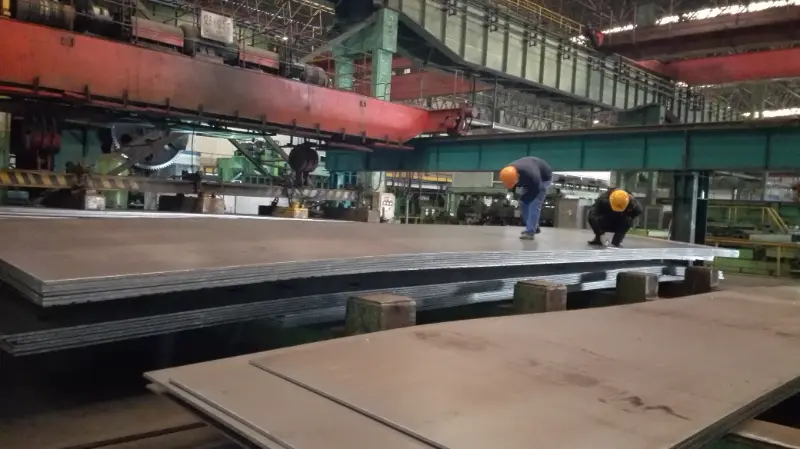
Q345R Pressure Vessel Steel Plate
Q345R Pressure Vessel Steel Plate: GB713 Standard, Properties & Equivalents
Detailed material data for Q345R steel plate according to GB/T 713, including chemical composition, mechanical and thermal properties, international equivalents, and application guidance.
Hot rolling, controlled rolling, normalizing, tempering, quenching, welding, cutting, forming
- Phone : +8618037372205
- Email : [email protected]
- WhatsApp: Contact via Whtsapp
- WeChat: +8618037372205
Q345R Pressure Vessel Steel Plate Introduction
Q345R is a low-alloy high-strength steel plate specifically designed for pressure vessels and boilers under the Chinese standard GB/T 713. It offers a minimum yield strength of 345 MPa in the as-rolled or normalized condition and excellent weldability with proper procedures. The steel is characterized by controlled carbon content, Mn addition for strength and toughness, and full aluminum killing for fine grain structure. It is widely used for welded pressure vessels operating at moderate temperatures and pressures. The material provides good notch toughness at 0°C and reliable performance in low-temperature environments when specified. Its balanced composition ensures good formability and resistance to brittle fracture.
Q345R Pressure Vessel Steel Plate Chemical Composition
The chemical composition below complies with GB/T 713-2014 for Q345R steel. All values are in weight percent (mass fraction) based on heat analysis. The steel is fully killed with aluminum and may contain microalloying elements such as Nb, V, Ti for grain refinement and strength enhancement. Carbon equivalent (CEV) limits may be applied by agreement.
| Chemical Element | Standard Value | Remarks |
|---|---|---|
| C | ≤0.20 | Carbon |
| Si | ≤0.55 | Silicon |
| Mn | 1.20~1.60 | Manganese |
| P | ≤0.025 | Phosphorus |
| S | ≤0.010 | Sulfur |
| Cu | ≤0.30 | Copper (residual) |
| Ni | ≤0.30 | Nickel (residual) |
| Cr | ≤0.30 | Chromium (residual) |
| Mo | ≤0.08 | Molybdenum |
| V | ≤0.050 | Vanadium |
| Nb | ≤0.050 | Niobium |
| Ti | ≤0.030 | Titanium |
| Alt | ≥0.020 | Total aluminum (acid-soluble Al ≥0.015) |
| Ceq | ≤0.45 | Carbon equivalent: CEV = C + Mn/6 + (Cr+Mo+V)/5 + (Ni+Cu)/15, as agreed |
Q345R Pressure Vessel Steel Plate Thermal and Electrical Physical Properties
The following physical properties are typical for Q345R steel at room temperature unless otherwise noted. These values are derived from general carbon-manganese steel data and are suitable for engineering design calculations. Actual values may vary slightly depending on exact composition and heat treatment.
| Property | Typical Value | Unit | Test Condition |
|---|---|---|---|
| Density (ρ) | ~7850 | kg/m³ | 20°C |
| Elastic Modulus (E) | ~212 | GPa | Room temperature |
| Shear Modulus (G) | ~81 | GPa | Room temperature, typical |
| Poisson's Ratio (ν) | ~0.29 | – | Room temperature, typical |
| Thermal Expansion Coefficient (α) | ~11.5 | 10⁻⁶/K | 20~100°C, average |
| Thermal Conductivity (λ) | ~50 | W/(m·K) | 20°C |
| Specific Heat Capacity (c) | ~460 | J/(kg·K) | 20°C |
| Electrical Resistivity (ρ_e) | ~0.2 | µΩ·m | 20°C |
Q345R Pressure Vessel Steel Plate Mechanical Properties
Mechanical properties are guaranteed according to GB/T 713-2014 for Q345R in delivery condition. Test specimens are taken in the transverse direction (for plates) or longitudinal for wide flats. Impact test temperature is 0°C. Bend test uses full-thickness specimens (b ≥ 35 mm). Property values may vary with plate thickness; multiple ranges are shown.
| Property | Required Value | Unit | Test Condition |
|---|---|---|---|
| Yield Strength (ReH) | ≥345 | MPa | Thickness ≤ 16 mm |
| Yield Strength (ReH) | ≥335 | MPa | 16 mm < thickness ≤ 36 mm |
| Yield Strength (ReH) | ≥325 | MPa | 36 mm < thickness ≤ 60 mm |
| Yield Strength (ReH) | ≥305 | MPa | 60 mm < thickness ≤ 100 mm |
| Yield Strength (ReH) | ≥285 | MPa | 100 mm < thickness ≤ 150 mm |
| Yield Strength (ReH) | ≥265 | MPa | 150 mm < thickness ≤ 200 mm |
| Tensile Strength (Rm) | 470~630 | MPa | Thickness ≤ 100 mm |
| Tensile Strength (Rm) | 470~610 | MPa | 100 mm < thickness ≤ 200 mm |
| Elongation (A) | ≥20 | % | Thickness ≤ 200 mm, gauge L0=5.65√S0 |
| Impact Energy (KV2) | ≥41 | J | Thickness ≤ 60 mm, 0°C, longitudinal |
| Impact Energy (KV2) | ≥34 | J | 60 mm < thickness ≤ 200 mm, 0°C, longitudinal |
| Bend Test (180°) | d=2a | – | Thickness ≤ 16 mm, b ≥ 35 mm |
| Bend Test (180°) | d=3a | – | Thickness > 16 mm, b ≥ 35 mm |
Q345R Pressure Vessel Steel Plate Fully Equivalent Material Standards and Substitutable Grades
| Country/Region | Standard | Grade | Remarks |
|---|---|---|---|
| China | GB/T 713-2014 | Q345R | Reference grade, pressure vessel plate |
| USA | ASTM A516/A516M | Grade 70 | Close equivalent; carbon steel plate for moderate/lower temperature service. Check thickness and impact requirements. |
| European Union | EN 10028-2 | P355GH | Close equivalent; elevated temperature pressure vessel steel. Similar strength. |
| Japan | JIS G3115 | SPV355 | Close equivalent; pressure vessel steel for intermediate and moderate temperature service. |
| International | ISO 9328-2 | P355 | Close equivalent; steel plates for pressure purposes, elevated temperature. |
Q345R Pressure Vessel Steel Plate Application Introduction
Q345R is primarily used in welded pressure vessels and boiler drums operating at moderate temperatures (typically up to 400°C). Its good weldability and toughness make it suitable for critical components. Preheating may be required for thicker sections or when welding with low hydrogen processes. Post-weld heat treatment (PWHT) is often applied according to construction codes (e.g., ASME BPVC, GB 150).
Product Applications: Pressure vessels (separators, scrubbers, columns), Boiler drums and shells, Heat exchangers, Storage tanks (LPG, ammonia, etc.), Reactors, Desalination equipment
Processed into products: Shell courses (cylindrical and spherical), Elliptical and torispherical heads, Flanges and blind flanges, Tube sheets, Nozzles and reinforcement pads, Internal support structures and baffles
Application industries: Oil & Gas, Chemical Processing, Power Generation, Petrochemical, Pharmaceutical Equipment, Fertilizer Plants, Shipbuilding (pressure parts)
Q345R Pressure Vessel Steel Plate Similar / Alternative Material Recommendations
| Country/Region | Standard | Grade | Remarks |
|---|---|---|---|
| USA | ASTM A516/A516M | Grade 65 | Similar; lower strength (min YS 240 MPa), suitable for less demanding pressure vessel applications. |
| European Union | EN 10028-2 | P295GH | Similar; lower strength (min YS 295 MPa), good formability and weldability. |
| Japan | JIS G3115 | SPV315 | Similar; lower strength (min YS 315 MPa), used for general pressure vessels. |
| China | GB/T 713-2014 | Q370R | Higher strength variant (min YS 370 MPa), used when design requires thinner walls. Not directly interchangeable without re-evaluation. |
| China | GB/T 713-2014 | Q245R | Lower strength (min YS 245 MPa), good for low-pressure vessels and boilers. |
Notes:
Welding considerations: Q345R exhibits good weldability with low-hydrogen electrodes (E5015, E5016) or submerged arc welding. For thicknesses >30 mm or when carbon equivalent exceeds 0.43%, preheat to 100–150°C is recommended. PWHT: Stress relief annealing at 600–650°C for 1 hour per 25 mm of thickness is typical. Inspection: Ultrasonic testing is often specified for thick plates (>36 mm) according to GB/T 2970. Marking: Plates are marked with grade, heat number, and standard. For sour service applications, additional hydrogen-induced cracking (HIC) testing may be required by supplementary agreement.
- Share



