
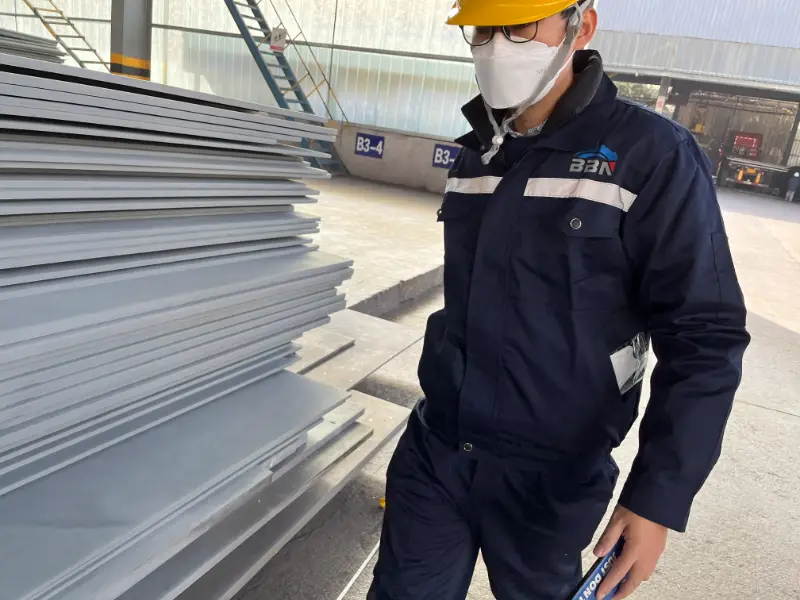
Q245R Pressure Vessel Steel Plate
Q245R Pressure Vessel Steel Plate - GB713 Grade for Boilers and Storage Tanks
Q245R is a carbon steel plate for boilers and pressure vessels under Chinese standard GB713. It offers good weldability, moderate strength, and high ductility. Widely used in medium- and low-temperature pressure equipment.
Hot rolling, normalizing (N), stress relieving, thermo-mechanical control process (TMCP, optional for thinner gauges)
- Phone : +8618037372205
- Email : [email protected]
- WhatsApp: Contact via Whtsapp
- WeChat: +8618037372205
Q245R Pressure Vessel Steel Plate Introduction
Q245R is a carbon-manganese steel grade specified in GB 713 for boilers and pressure vessels. It corresponds to the former Chinese grades 20g and 20R. The steel provides excellent weldability, satisfactory formability, and good toughness at room temperature and moderately high temperatures.
- Minimum yield strength of 245 MPa
- Tensile strength between 400 and 520 MPa
- Good impact properties down to 0°C or -20°C depending on thickness and impact test requirements
It is typically supplied in normalized or as-rolled condition, and is suitable for vessels operating at medium and low temperatures up to about 430°C.
Q245R Pressure Vessel Steel Plate Chemical Composition
All values according to GB 713-2014 for Q245R. The steel is a fully killed carbon-manganese steel with controlled sulfur and phosphorus. Residual elements like Cr, Ni, Cu are limited to maintain weldability.
| Element | Standard Value | Remarks |
|---|---|---|
| Carbon (C) | ≤ 0.20 | Maximum |
| Silicon (Si) | ≤ 0.35 | Maximum |
| Manganese (Mn) | 0.50 – 1.00 | Range |
| Phosphorus (P) | ≤ 0.025 | Maximum |
| Sulfur (S) | ≤ 0.010 | Maximum |
| Aluminum (Alt) | ≥ 0.020 | Total aluminum, fine grain practice |
| Chromium (Cr) | ≤ 0.30 | Residual element |
| Nickel (Ni) | ≤ 0.30 | Residual element |
| Copper (Cu) | ≤ 0.30 | Residual element |
| Nitrogen (N) | ≤ 0.012 | If not reported, N content is considered ≤0.012 for info |
| Other | Cr+Ni+Cu ≤ 0.70 | Sum of residual elements |
Q245R Pressure Vessel Steel Plate Physical Properties
Unless specified in GB 713, the following values are typical for low-carbon steel at room temperature. They are suitable for design calculations and finite element analysis of Q245R plates.
| Property | Typical Value | Unit | Test Condition |
|---|---|---|---|
| Density (ρ) | 7.85 | g/cm³ | 20°C |
| Modulus of Elasticity (E) | 206 | GPa | Room temperature |
| Shear Modulus (G) | 80 | GPa | Room temperature |
| Poisson's Ratio (ν) | 0.29 – 0.30 | - | Room temperature |
| Thermal Expansion Coefficient (α) | 12.2 × 10⁻⁶ | K⁻¹ | 20–100°C |
| Thermal Expansion Coefficient (α) | 13.9 × 10⁻⁶ | K⁻¹ | 20–300°C |
| Thermal Conductivity (λ) | 52 | W/(m·K) | 20°C |
| Specific Heat Capacity (c) | 460 | J/(kg·K) | 20°C |
| Electrical Resistivity (ρₑ) | 0.17 × 10⁻⁶ | Ω·m | 20°C |
Q245R Pressure Vessel Steel Plate Mechanical Properties
Minimum mechanical properties as per GB 713-2014, valid for normalized or as-rolled condition. Impact energy is given for longitudinal V-notch Charpy specimens at 0°C or -20°C depending on plate thickness.
| Property | Standard Requirement | Unit | Test Condition |
|---|---|---|---|
| Yield Strength (ReH) | ≥ 245 | MPa | Thickness ≤ 16 mm |
| Yield Strength (ReH) | ≥ 235 | MPa | Thickness > 16–36 mm |
| Yield Strength (ReH) | ≥ 225 | MPa | Thickness > 36–60 mm |
| Yield Strength (ReH) | ≥ 215 | MPa | Thickness > 60–100 mm |
| Yield Strength (ReH) | ≥ 210 | MPa | Thickness > 100–250 mm |
| Tensile Strength (Rm) | 400 – 520 | MPa | All thicknesses |
| Elongation (A) | ≥ 25 | % | Gauge length 5.65√S₀, transverse or longitudinal |
| Impact Energy (KV₂) | ≥ 34 | J | 0°C, longitudinal V-notch |
| Impact Energy (KV₂) | ≥ 27 | J | -20°C, longitudinal V-notch (optional requirement) |
| Bend Test (d=2a) | No cracks or defects | - | 180° bend test, d=2a (mandrel diameter equals 2x specimen thickness) |
| Hardness (HBW) | ≤ 180 | - | Typical reference, not always mandatory |
Q245R Pressure Vessel Steel Plate Fully Equivalent International Grades and Substitute Recommendations
| Country/Region | Standard | Grade | Remarks |
|---|---|---|---|
| China | GB 713-2014 | Q245R | Original grade, fully compliant |
| International | ISO 9328-1:2018 | P265 | Very close chemical and mechanical match; P265NH if normalized |
| Europe | EN 10028-2:2017 | P265GH | Identical yield/tensile range, for pressure vessels at elevated temperatures; fully exchangeable |
| USA | ASME SA-516/SA-516M-2023 | SA-516 Grade 60 | Closest ASME equivalent, yield 220–260 MPa, tensile 415–550 MPa; normally normalized |
| Japan | JIS G3103:2019 | SB410 | Similar tensile strength, often used for boilers; slight composition differences acceptable |
| Korea | KS D 3521:2022 | SB410 | Equivalent to JIS, interchangeable with Q245R |
| India | IS 2002:2009 | Gr.1B / SA-516 Gr.60 | Used in boiler & pressure vessel fabrication |
Q245R Pressure Vessel Steel Plate Application Introduction
Q245R is primarily used in welded pressure vessels and boilers that operate at medium temperatures (up to ~430°C). Its excellent formability and weldability make it suitable for complex vessel fabrications without requiring preheating for moderate thicknesses. Typical industry sectors include:
Product Applications: Horizontal and vertical pressure vessels, Boiler drums and shells, Heat exchangers (shells and channels), LPG storage spheres and bullets, Separators, accumulators, and receiver tanks, Reactor bodies
Processed into products: Vessel shell courses and formed heads, Nozzles and reinforcement pads, Flanges (when forged from plate), Baffles and support skirts, Manhole covers and blind flanges, Steam drums and water drums in boilers
Application industries: Oil & Gas (downstream and midstream), Petrochemical and Chemical Processing, Power Generation (conventional and thermal power plants), Shipbuilding (pressure vessels on board), Pharmaceutical & Food Processing (storage tanks), Water Treatment (pressurized filters)
Q245R Pressure Vessel Steel Plate Similar Materials for Consideration When Substitution Needed
| Country/Region | Standard | Grade | Remarks |
|---|---|---|---|
| China | GB 713 | Q345R | Higher strength (yield ≥ 345 MPa), may require redesign; not a direct substitute but widely used |
| USA | ASME SA-516 | Grade 65 | Higher tensile strength but similar weldability; can replace Q245R in some designs with thicker wall |
| Europe | EN 10028-2 | P235GH | Lower strength, can be used for lower-pressure vessels only |
| Japan | JIS G3103 | SB450 | Higher strength variant, similar applications; check toughness requirements |
| Russia | GOST 5520 | 16K (16К) | Analogous carbon steel for boilers, comparable but requires verification |
Notes:
- For thicknesses greater than 30 mm, normalizing heat treatment is strongly recommended to refine grain structure and ensure toughness.
- Impact test requirements (0°C or -20°C) must be specified at ordering; Q245R without impact test is allowed but not recommended for critical service.
- Ultrasonic testing per GB/T 2970 or equivalent is often required for pressure vessel plates; the acceptance level should be agreed upon.
- For service in hydrogen or sour environments, supplementary HIC/SSC testing per NACE MR0175 may be applied; Q245R can be produced with controlled sulfur and calcium treatment to meet these requirements.
- Post-weld heat treatment (PWHT) is typically carried out at 580–620°C; the steel has a proven record under simulated PWHT cycles without significant loss of properties.
- Share



