
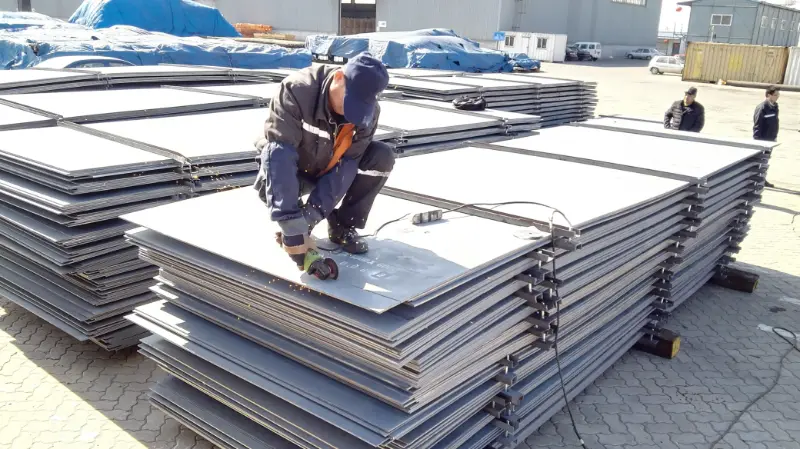
DIN 17155 10CrMo910 Boiler & Pressure Vessel Steel Plate
10CrMo910 Boiler & Pressure Vessel Steel Plate (DIN 17155)
Detailed material data for DIN 17155 10CrMo910 steel plate designed for high-temperature boiler and pressure vessel applications, including full chemical, mechanical, thermal and electrical property tables and international equivalents.
Hot forming, welding (preheat and post‑weld heat treatment required), cutting, machining, bending, cold forming (limited due to strength)
- Phone : +8618037372205
- Email : [email protected]
- WhatsApp: Contact via Whtsapp
- WeChat: +8618037372205
DIN 17155 10CrMo910 Boiler & Pressure Vessel Steel Plate Introduction
DIN 17155 10CrMo910 is a 2.25% chromium–1% molybdenum alloy steel specifically designed for welded pressure vessels and steam boilers operating at elevated temperatures. This fine‑grain, fully killed steel offers excellent creep resistance and retains moderate strength up to 600 °C.
Key characteristics:
- Good hot forming and welding performance under controlled conditions
- Homogeneous fine‑grain microstructure after normalizing and tempering
- High long‑term rupture strength, essential for cyclic thermal loads
- Balance of toughness and strength in both the base metal and heat‑affected zones
Its substantial Cr and Mo content provides enhanced oxidation resistance compared to plain carbon or carbon‑manganese steels, making it a preferred choice for thick‑walled components in power generation and petrochemical plants. The standard DIN 17155 has been superseded by EN 10028‑2 (grade 10CrMo9‑10, 1.7380), but the essential technical data remain unchanged for existing installations.
DIN 17155 10CrMo910 Boiler & Pressure Vessel Steel Plate Chemical composition
Limiting values as specified in DIN 17155 for grade 10CrMo910. The steel is fully killed and fine‑grain treated. Residual elements (Cu, Ni, Cr+Cu+Mo, etc.) are controlled to ensure weldability and toughness. All values are in weight‑percent.
| Element | Standard value (%) | Remarks |
|---|---|---|
| Carbon (C) | 0.08 – 0.15 | Ensures hardenability and creep strength |
| Silicon (Si) | 0.15 – 0.50 | Deoxidation element |
| Manganese (Mn) | 0.40 – 0.80 | Increases strength and hardenability |
| Phosphorus (P) | ≤ 0.030 | Maximum limited for toughness |
| Sulfur (S) | ≤ 0.025 | Maximum limited for cleanliness |
| Chromium (Cr) | 2.00 – 2.50 | Key element for corrosion/oxidation resistance and creep strength |
| Molybdenum (Mo) | 0.90 – 1.10 | Provides high‑temperature strength and resistance to temper embrittlement |
DIN 17155 10CrMo910 Boiler & Pressure Vessel Steel Plate Thermal and electrical physical properties
These values are not mandatory requirements of DIN 17155 but represent the typical bulk performance of 10CrMo910 / 1.7380 in the normalised and tempered condition. They are essential for design calculations in heated and cooled components.
| Property | Typical value | Unit | Test condition / Temperature |
|---|---|---|---|
| Density (ρ) | 7.85 | g/cm³ | At 20 °C |
| Elastic modulus (E) | 210 – 212 | GPa | At 20 °C |
| Elastic modulus (E) | 195 | GPa | At 300 °C |
| Elastic modulus (E) | 185 | GPa | At 500 °C |
| Shear modulus (G) | ~ 81 | GPa | At 20 °C (calculated from E and ν) |
| Poisson's ratio (ν) | 0.28 – 0.30 | — | At 20 °C |
| Thermal expansion (α) | 11.2 | 10⁻⁶ / K | From 20 °C to 100 °C |
| Thermal expansion (α) | 12.5 | 10⁻⁶ / K | From 20 °C to 300 °C |
| Thermal expansion (α) | 13.5 | 10⁻⁶ / K | From 20 °C to 500 °C |
| Thermal conductivity (λ) | 40 | W/(m·K) | At 20 °C |
| Thermal conductivity (λ) | 38 | W/(m·K) | At 300 °C |
| Thermal conductivity (λ) | 35 | W/(m·K) | At 500 °C |
| Specific heat capacity (cp) | ~ 460 | J/(kg·K) | At 20 °C |
| Specific heat capacity (cp) | ~ 550 | J/(kg·K) | At 500 °C |
| Electrical resistivity (ρₑ) | 0.30 – 0.35 | µΩ·m | At 20 °C |
DIN 17155 10CrMo910 Boiler & Pressure Vessel Steel Plate Mechanical properties at room temperature
Minimum requirements after normalising and tempering, applicable to plate thickness ≤ 60 mm. Test pieces taken transverse to the rolling direction unless otherwise stated. For thicker sections, yield strength may be slightly reduced; consult the full standard for thickness‑dependent values.
| Property | Standard requirement | Unit | Test condition / Remarks |
|---|---|---|---|
| Upper yield strength (ReH) | ≥ 280 | MPa | Room temperature, t ≤ 60 mm |
| Tensile strength (Rm) | 480 – 600 | MPa | Room temperature, t ≤ 60 mm |
| Elongation after fracture (A) | ≥ 20 | % | Gauge length 5.65√S₀, longitudinal |
| Charpy V‑notch impact energy (KV) | ≥ 27 | J | +20 °C, transverse test piece |
| Charpy V‑notch impact energy (KV) | ≥ 27 | J | 0 °C, transverse test piece (optional, if agreed) |
| Charpy V‑notch impact energy (KV) | ≥ 27 | J | –20 °C, transverse test piece (optional, if agreed) |
| Bend test (180°) | No cracking | — | Mandrel diameter ≤ 3.5 × t (plate thickness) |
DIN 17155 10CrMo910 Boiler & Pressure Vessel Steel Plate Fully equivalent material standards and substitutable grades
| Country / Region | Standard | Grade | Remarks |
|---|---|---|---|
| EU (harmonised) | EN 10028‑2 | 10CrMo9‑10 (1.7380) | Direct successor of DIN 17155 10CrMo910; identical composition and properties |
| Germany | DIN 17155 (historic) | 10CrMo910 | Original standard; now withdrawn |
| USA | ASTM A387 / A387M | Grade 22 Class 2 | Chemical composition equivalent after adjustment for US practices; same application |
| Japan | JIS G4109 | SCMV4‑2 | Pressure vessel chromium‑molybdenum alloy steel plate, direct equivalent |
| France | NF A36‑206 | 10 CD 9‑10 | Completely interchangeable with 10CrMo9‑10 |
| Italy | UNI 5869 | 10CrMo9‑10 | Same as EN grade; commonly used in pressure equipment |
| United Kingdom | BS EN 10028‑2 | 10CrMo9‑10 (formerly BS 1501‑622 Gr. 515/590) | Old BS 1501‑622 also becomes equivalent; current EN standard applies |
DIN 17155 10CrMo910 Boiler & Pressure Vessel Steel Plate Application Introduction
10CrMo910 plate is engineered for high‑temperature pressure equipment where long‑term creep resistance and structural integrity are critical. The following lists typical industries, products and specific components that benefit from this steel grade.
Product Applications: Steam boiler drums, High‑pressure superheater and re‑heater headers, Shells of catalytic and hydro‑cracking reactors, Feedwater heaters and economiser bodies, Process heat exchangers, Large‑diameter high‑temperature piping (welded from plate)
Processed into products: Cylindrical shell courses and dished heads of pressure vessels, Tube sheets for heat exchangers, Flanges and blind flanges for high‑temperature service, Reinforcement pads and nozzles welded into vessel walls, Manhole rings and closure plates, Baffle plates and support structures inside hot vessels
Application industries: Power generation (conventional steam, nuclear auxiliary systems), Petrochemical and refinery, Chemical processing, Oil and gas (high‑temperature separators, reactors), Industrial boiler manufacturing
DIN 17155 10CrMo910 Boiler & Pressure Vessel Steel Plate Closely related alternative grades
| Country / Region | Standard | Grade | Remarks |
|---|---|---|---|
| Germany | DIN 17175 (seamless tubes) | 10CrMo910 (tube) | Identical composition but for tube products; plates can be substituted by tube hollows only after evaluation |
| EU | EN 10216‑2 | 10CrMo9‑10 (1.7380) | Seamless steel tubes version; similar chemistry but different product form |
| USA | ASTM A387 | Grade 22 Class 1 | Lower tensile strength class (415–585 MPa) than Class 2; can be used in less demanding situations |
| EU | EN 10028‑2 | 12CrMo9‑10 (1.7375) | Slightly higher carbon content (0.10–0.17%); similar high‑temperature properties |
| EU | EN 10028‑2 | 13CrMo4‑5 (1.7335) | 1%Cr‑0.5%Mo steel; lower creep strength, used up to ~530 °C instead of 600 °C |
Notes:
- All mechanical property values refer to the normalised and tempered condition. For plates supplied in the as‑normalised condition, verify compliance with the purchase specification.
- Welding requires preheat (typically 200–300 °C) and immediate post‑weld heat treatment (PWHT) at 680–720 °C to avoid cracking and to restore toughness.
- The historical DIN 17155 standard does not define detailed elevated temperature proof stress; for design purposes, refer to EN 10028‑2 tables or ASME Section II, Part D for Grade 22.
- Long‑term exposure to temperatures above 600 °C can cause carbide coarsening, which reduces creep rupture strength; operating temperature should be limited accordingly.
- Share



