
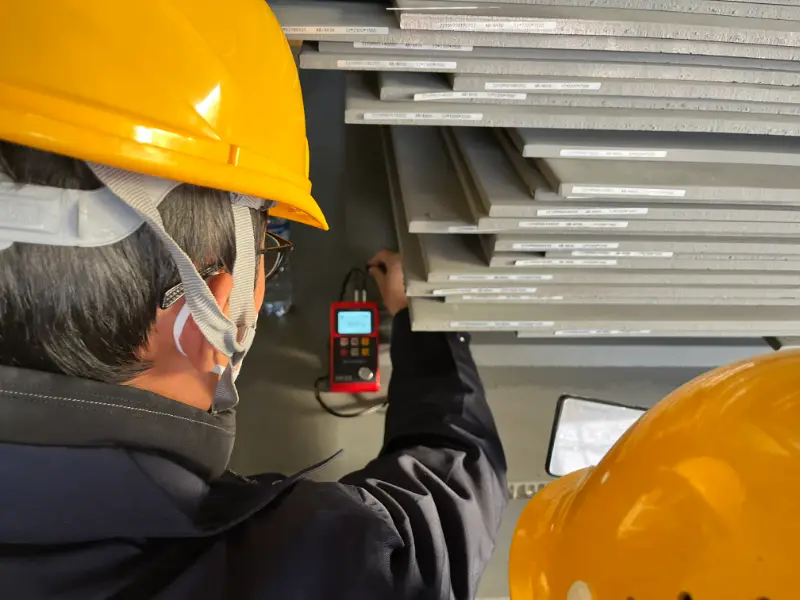
NK Grade E40 Shipbuilding Steel Plate
NK Grade E40 Shipbuilding Steel Plate: High-Strength Marine Structural Steel
NK Grade E40 is a high-strength hull structural steel certified by Nippon Kaiji Kyokai (ClassNK) for marine and offshore applications with excellent low-temperature toughness and weldability.
Welding (all common methods), cold and hot forming, flame cutting, machining
- Phone : +8618037372205
- Email : [email protected]
- WhatsApp: Contact via Whtsapp
- WeChat: +8618037372205
NK Grade E40 Shipbuilding Steel Plate Introduction
NK Grade E40 is a normalized or thermo-mechanically controlled processed (TMCP) high-strength steel for shipbuilding, complying with the Nippon Kaiji Kyokai (ClassNK) rules. It offers a minimum yield strength of 390 MPa and good notch toughness at temperatures down to -40°C, making it suitable for critical structural components in harsh marine environments. The steel is microalloyed with elements such as niobium, vanadium, and titanium, which provide fine grain structure and improved mechanical properties. Key characteristics:
- High yield and tensile strength, reducing weight while maintaining safety
- Excellent weldability with low carbon equivalent (CE) for improved fabrication efficiency
- Good low-temperature impact toughness (27 J min at -40°C)
- Compliance with international ship classification society standards
NK Grade E40 Shipbuilding Steel Plate Chemical Composition
The following chemical composition limits comply with NK Rules Part K for E40 grade (t ≤ 100 mm). Microalloying elements such as niobium, vanadium, and titanium are used for grain refinement and precipitation strengthening. Remarks:
- Carbon equivalent (CE) is typically controlled to a maximum of 0.38-0.45% depending on thickness, ensuring good weldability.
- Fine grain practice is mandatory (aluminum or other grain-refining elements).
| Element | Standard Value (wt.%) | Remarks |
|---|---|---|
| C | ≤ 0.18 | Max. |
| Mn | 0.90 - 1.60 | If other refining elements used, Mn may be lowered |
| Si | 0.10 - 0.50 | Max. |
| P | ≤ 0.025 | Max. |
| S | ≤ 0.025 | Max. |
| Al (acid-soluble) | ≥ 0.015 | Min., for fine grain practice |
| Nb | 0.02 - 0.05 | Optional microalloy |
| V | 0.05 - 0.10 | Optional microalloy |
| Ti | ≤ 0.02 | Max. |
| Cu | ≤ 0.35 | Max. |
| Cr | ≤ 0.20 | Max. |
| Ni | ≤ 0.40 | Max. |
| Mo | ≤ 0.08 | Max. |
| N | ≤ 0.009 | Max., if applicable |
NK Grade E40 Shipbuilding Steel Plate Thermal and Electrical Physical Properties
The following data represent typical values for high-strength low-alloy (HSLA) steel similar to NK E40 at room temperature unless otherwise stated. Actual values may vary slightly depending on the manufacturing process and exact chemical composition.
| Property | Typical Value | Unit | Test Condition |
|---|---|---|---|
| Density (ρ) | 7850 | kg/m³ | 20°C |
| Modulus of elasticity (E) | 205 | GPa | 20°C |
| Shear modulus (G) | 80 | GPa | 20°C |
| Poisson's ratio (ν) | 0.295 | - | 20°C |
| Coefficient of thermal expansion (α) | 11.7 × 10^-6 | 1/K | 20 - 100°C |
| Thermal conductivity (λ) | ~48 | W/(m·K) | 20°C |
| Specific heat capacity (c) | ~470 | J/(kg·K) | 20°C |
| Electrical resistivity (ρe) | ~0.23 × 10^-6 | Ω·m | 20°C |
NK Grade E40 Shipbuilding Steel Plate Mechanical Properties
Mechanical properties are determined on test pieces taken in the transverse direction unless otherwise agreed. Impact test specimens are taken in the longitudinal direction for plates and wide flats (Charpy V-notch). Properties for thicknesses above 100 mm shall be specially agreed. Testing condition: normalizing or TMCP as delivery state.
| Property | Standard Requirement | Unit | Test Condition |
|---|---|---|---|
| Yield strength (ReH) | ≥ 390 | MPa | Thickness ≤ 50 mm |
| Yield strength (ReH) | ≥ 370 | MPa | Thickness 50 < t ≤ 70 mm |
| Yield strength (ReH) | ≥ 350 | MPa | Thickness 70 < t ≤ 100 mm |
| Tensile strength (Rm) | 510 - 650 | MPa | All thicknesses |
| Elongation (A) | ≥ 20 | % | Gauge length = 5.65√S0 |
| Charpy V-notch impact energy (KV) | ≥ 27 (longitudinal) | J | At -40°C |
| Bend test | No cracks (d = 3a) | - | a = specimen thickness; t ≤ 25 mm |
| Bend test | No cracks (d = 4a) | - | a = specimen thickness; t > 25 mm |
NK Grade E40 Shipbuilding Steel Plate Fully Equivalent Material Standards and Substitutable Grades
| Country/Region | Standard | Grade | Remarks |
|---|---|---|---|
| International (IACS) | IACS UR W11 | EH40 | Equivalent toughness class ( -40°C ) |
| USA | ABS Rules | EH40 | American Bureau of Shipping |
| UK | LR Rules | EH40 | Lloyd's Register |
| France | BV Rules | EH40 | Bureau Veritas |
| Norway | DNV Rules | E40 | Det Norske Veritas (now DNV GL) |
| China | CCS Rules | E40 | China Classification Society |
| Italy | RINA Rules | EH40 | Registro Italiano Navale |
| Russia | RS Rules | E40 | Russian Maritime Register of Shipping |
| Korea | KR Rules | EH40 | Korean Register |
| Europe (EN) | EN 10025-4 | S420ML | Thermomechanically rolled weldable fine grain structural steel; toughness at -50°C |
NK Grade E40 Shipbuilding Steel Plate Application Introduction
NK Grade E40 is ideal for critical welded structures in the shipbuilding and offshore industry. Its high strength-to-weight ratio allows for lighter designs, while guaranteed toughness at -40°C ensures resistance against brittle fracture in cold waters. Fabrication notes:
- Preheating is typically required only for very thick sections or when using low-hydrogen processes.
- Steel can be welded by all common methods (SAW, SMAW, FCAW, GMAW).
- Post-weld heat treatment is not normally required due to the controlled alloy design.
Product Applications: Hull plates for container ships, bulk carriers, tankers, and LNG carriers, Deck and bottom longitudinals, Hatch coaming girders, Offshore platform top-side modules, Self-elevating platform leg chords and rack plates
Processed into products: Shell plates and stiffeners, Bracket and transverse web plates, Keel plates, Crane pedestal structures, Mooring equipment support plates, Fatigue-critical nodes in jack-up rigs
Application industries: Shipbuilding (commercial and naval vessels), Offshore oil & gas platforms (jackets, decks, legs), Renewable energy offshore structures (wind turbine foundations), Heavy marine engineering, Port and harbor construction
NK Grade E40 Shipbuilding Steel Plate Similar or Alternative Steel Grades for Consideration
| Country/Region | Standard | Grade | Remarks |
|---|---|---|---|
| Japan / IACS | NK Rules | E36 | Next lower strength level (min. yield 355 MPa); similar toughness class (-40°C) |
| Japan / IACS | NK Rules | AH40 | Same strength (390 MPa) but impact test at 0°C; suitable for less severe environments |
| Japan / IACS | NK Rules | DH40 | Same strength, impact at -20°C |
| Europe | EN 10025-4 | S420M | Similar strength, but with less guaranteed low-temperature toughness (M) unless -ML option |
| Europe | EN 10225 | S420G2+Q/M | Offshore structural steel with similar strength, high toughness, and through-thickness properties |
Notes:
Certification: All plates must be stamped with the NK mark and supplied with a ClassNK certificate. Through-thickness properties: If Z-direction (through-thickness) tensile ductility is required, grades with improved properties (Z25, Z35) according to the material specification can be ordered. Surface condition and inspection: Ultrasonic testing per EN 10160, ASTM A578, or equivalent is common for critical applications. The user should consult the latest NK Rules and the specific project specification for full requirements.
- Share



