
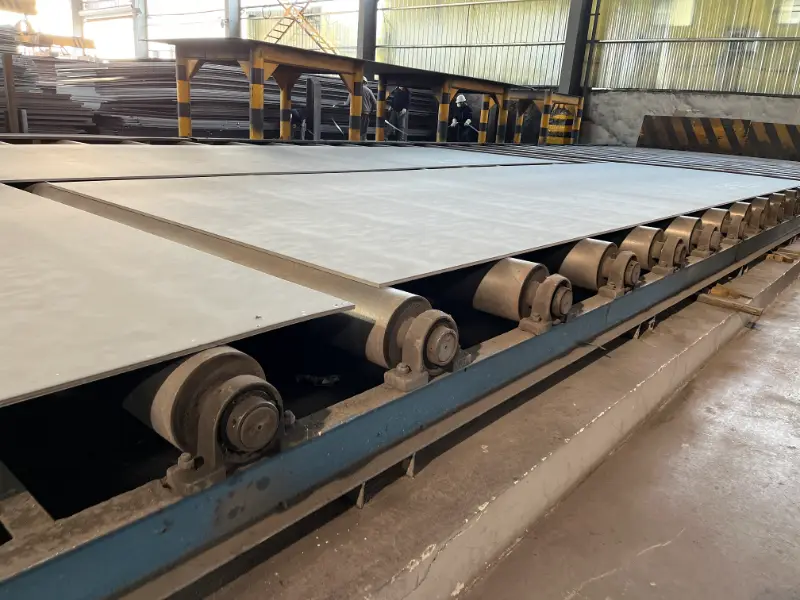
NK Grade D40 Shipbuilding Steel Plate
NK Grade D40 Shipbuilding Steel Plate: High-Strength Hull Structural Steel with Superior Low-Temperature Toughness
Comprehensive technical data for NK Grade D40 shipbuilding steel plate, including chemical composition, mechanical and thermal properties, international equivalents, and application guidance for marine and offshore structures.
Welding, cutting (oxy-fuel, plasma, laser), cold forming, hot forming, machining
- Phone : +8618037372205
- Email : [email protected]
- WhatsApp: Contact via Whtsapp
- WeChat: +8618037372205
NK Grade D40 Shipbuilding Steel Plate Introduction
NK Grade D40 is a high-strength structural steel plate specifically developed for ship and offshore structures, certified by ClassNK (Nippon Kaiji Kyokai) in accordance with its Rules for the Survey and Construction of Steel Ships. With a minimum yield strength of 390 MPa and guaranteed impact toughness at -20°C, it belongs to the D-grade toughness category, offering an excellent balance between strength, weldability, and resistance to brittle fracture.
The steel is typically supplied in normalized or thermo-mechanically controlled processed (TMCP) condition. Its fine-grained microstructure, achieved through controlled rolling or normalizing, ensures reliable performance in cold marine environments.
Key features:
- High yield and tensile strength for weight reduction
- Good low-temperature toughness (≥41 J at -20°C)
- Excellent weldability with carefully controlled carbon equivalent
- Widely used in deck, bottom, side shell, and bulkhead structures of large vessels
NK Grade D40 Shipbuilding Steel Plate Chemical Composition
The chemical composition of NK D40 is designed to provide high strength while maintaining excellent weldability and notch toughness. Typical limits follow IACS UR W11 and ClassNK Rules. Microalloying elements such as niobium, vanadium, and titanium are often used to achieve fine grain size and precipitation strengthening. Carbon equivalent (CE) is usually restricted to ≤0.40% (for thicknesses ≤50 mm) to ensure crack-free welding.
- All values are maximum unless a range is given.
- For TMCP products, tighter control of microalloying additions may apply.
| Element | Specified Value (max) | Remarks |
|---|---|---|
| C | 0.18 | Ladle analysis; for thickness ≤50 mm, may be limited to 0.16 for TMCP |
| Si | 0.50 | Deoxidation element |
| Mn | 0.90 – 1.60 | Range may be narrowed depending on thickness |
| P | 0.035 | Strictly controlled for toughness |
| S | 0.035 | Low sulfur for improved through-thickness properties |
| Als (total Al) | ≥0.015 | Fine grain practice; acid soluble Al min 0.015 |
| Nb | 0.02 – 0.05 | Optional grain refiner; typical range when added |
| V | 0.05 – 0.10 | Optional; may be combined with Nb |
| Ti | ≤0.02 | Optional for grain refinement |
| Cu | ≤0.35 | Residual element |
| Cr | ≤0.20 | Residual element |
| Ni | ≤0.40 | Residual element |
| Mo | ≤0.08 | Residual element |
| CEV | ≤0.40 | Carbon equivalent = C + Mn/6 + (Cr+Mo+V)/5 + (Ni+Cu)/15; generally ≤0.40 for t ≤50 mm |
NK Grade D40 Shipbuilding Steel Plate Thermal and Electrical Physical Properties
The following physical properties represent typical values for NK D40 steel in normalized or TMCP condition at room temperature unless otherwise stated. These data are not part of the classification requirements but are essential for design calculations (thermal expansion, heat transfer, elastic deformation).
- Density: 7.85 g/cm³
- Poisson's ratio: 0.3
- Values may vary slightly with exact heat chemistry and processing route.
| Property | Typical Value | Unit | Condition / Remarks |
|---|---|---|---|
| Density (ρ) | 7.85 | g/cm³ | 20°C |
| Modulus of Elasticity (E) | 205 | GPa | 20°C |
| Shear Modulus (G) | 80 | GPa | 20°C, calculated from E and ν |
| Poisson's Ratio (ν) | 0.3 | — | Typical for ferritic steel |
| Thermal Expansion Coefficient (α) | 12.0 × 10⁻⁶ | 1/K | 20 – 100°C |
| Thermal Expansion Coefficient (α) | 12.5 × 10⁻⁶ | 1/K | 20 – 200°C |
| Thermal Expansion Coefficient (α) | 13.3 × 10⁻⁶ | 1/K | 20 – 400°C |
| Thermal Conductivity (λ) | 45 | W/(m·K) | 20°C |
| Thermal Conductivity (λ) | 41 | W/(m·K) | 200°C |
| Specific Heat Capacity (c) | 460 | J/(kg·K) | 20°C |
| Electrical Resistivity (ρₑ) | 0.25 × 10⁻⁶ | Ω·m | 20°C |
NK Grade D40 Shipbuilding Steel Plate Mechanical Properties
Mechanical properties are determined on standard longitudinal tensile and Charpy V-notch impact specimens taken from the plate quarter-thickness position. Requirements are valid for thicknesses up to 100 mm; values may be adjusted for greater thicknesses according to ClassNK Rules.
- Yield strength and tensile strength apply to transverse test pieces; values shown are minimum unless a range is indicated.
- Impact test temperature: -20°C for D40 grade; average absorbed energy to be ≥41 J.
- Bend test: 180° around a former of diameter 3a (where a = specimen thickness) without cracking.
| Property | Specified Value | Unit | Test Condition |
|---|---|---|---|
| Yield Strength (ReH) | ≥ 390 | MPa | t ≤ 50 mm, longitudinal |
| Yield Strength (ReH) | ≥ 370 | MPa | 50 < t ≤ 70 mm, longitudinal |
| Yield Strength (ReH) | ≥ 355 | MPa | 70 < t ≤ 100 mm, longitudinal |
| Tensile Strength (Rm) | 510 – 650 | MPa | t ≤ 100 mm, longitudinal |
| Elongation (A) | ≥ 20 | % | Gauge length 5.65√So, longitudinal, t ≤ 50 mm |
| Elongation (A) | ≥ 19 | % | Gauge length 5.65√So, longitudinal, 50 < t ≤ 70 mm |
| Elongation (A) | ≥ 18 | % | Gauge length 5.65√So, longitudinal, 70 < t ≤ 100 mm |
| Charpy V-notch Impact (KV2) | ≥ 41 (avg) / ≥ 34 (single) | J | Longitudinal, at -20°C |
| Bend Test | 180°, d=3a, no cracks | — | Transverse, a = specimen thickness |
NK Grade D40 Shipbuilding Steel Plate Internationally Recognized Fully Equivalent Standards and Grades
| Country/Region | Standard | Grade | Remarks |
|---|---|---|---|
| International (IACS) | UR W11 | DH40 | Identical toughness and strength requirements |
| Norway | DNV Rules | DH40 | DNV classification reference |
| USA | ABS Rules | DH40 | American Bureau of Shipping equivalent |
| UK | LR Rules | DH40 | Lloyd's Register equivalent |
| France | BV Rules | DH40 | Bureau Veritas equivalent |
| China | CCS Rules | DH40 | China Classification Society equivalent |
| Korea | KR Rules | DH40 | Korean Register equivalent |
| Italy | RINA Rules | DH40 | Registro Italiano Navale equivalent |
| Germany | GL Rules (historical) | DH40 | Former Germanischer Lloyd designation |
| Japan | NK Rules | D40 | Original designation; also interchangeable with NK D40N (normalized), D40T (TMCP) |
NK Grade D40 Shipbuilding Steel Plate Application Introduction
NK D40 steel plates are primarily used in the construction of structural components for ships and offshore facilities that demand high strength combined with reliable low-temperature toughness. The guaranteed Charpy impact value at -20°C makes it suitable for service in cold waters and environments where brittle fracture is a concern. Typical applications include:
- Hull envelope (side shell, bottom plating, weather decks)
- Longitudinal and transverse stiffeners, girders, and frames
- Bulkheads, decks, and superstructure supporting members
- Fixed and mobile offshore platforms, topside modules, and helideck support structures
With excellent weldability and formability, D40 can be efficiently fabricated into complex assemblies, including curved shell plates and panel line production. It is also used in heavy civil engineering (e.g., bridge bearing plates, crane structural boxes) when shipbuilding-grade steel is specified.
Product Applications: Large container ships, bulk carriers, tankers, LNG/LPG carriers, Navy auxiliary vessels and patrol boats, Semi-submersible rigs and jack-up rig legs, Offshore wind turbine substructures (monopiles, transition pieces), Prefabricated hull blocks and panels
Processed into products: Main deck plates and sheer strake, Bottom shell and bilge strake, Longitudinal stiffeners (angles, bulb profiles, flat bars), Transverse web frames and floor plates, Swash bulkheads and corrugated bulkheads, Hatch coamings and coming topside supports, Module support stools and load‑bearing base plates on offshore platforms
Application industries: Shipbuilding and marine engineering, Offshore oil and gas structures (jackets, topsides, FPSOs), Port and harbour engineering (caissons, quay walls), Bridge construction (when naval-grade toughness is required), Heavy lifting equipment (gantry crane girders, mobile crane booms)
NK Grade D40 Shipbuilding Steel Plate Closely Related Alternative Materials and Substitutes
| Country/Region | Standard | Grade | Remarks |
|---|---|---|---|
| IACS | UR W11 | AH40 | Same strength, Charpy at 0°C; lower toughness requirement |
| IACS | UR W11 | EH40 | Same strength, Charpy at -40°C; higher toughness, may require extra alloying |
| Japan | JIS G 3106 | SM490B | Rolled steel for welded structures; min YS 325 MPa (for t ≤ 16mm); not direct substitute but similar chemistry |
| Japan | JIS G 3106 | SM490C | Similar to SM490B with improved toughness; not a ship classification grade |
| USA | ASTM A131 | DH40 | ASTM shipbuilding spec – matches IACS DH40, equivalent properties |
| Europe | EN 10025-4 | S420M/ML | Thermomechanical rolled steel with YS 420 MPa (for t ≤ 16mm); slightly higher strength, comparable weldability; nontraditional in shipping |
Notes:
- All data are based on ClassNK Rules (Part K, 2023 edition) and IACS UR W11. They represent minimum requirements or typical values; actual test certificates may show higher values.
- For TMCP condition, the carbon equivalent (CEV) is usually lower than for normalized material, improving weldability.
- For thicknesses above 100 mm, special agreement with ClassNK is needed regarding impact properties and sampling.
- Normalized delivery state may be denoted as NKD40N, TMCP as NKD40T.
- Z‑direction properties (through-thickness) can be certified according to ClassNK additional symbol Z (e.g., Z25 or Z35) when required.
- All mechanical tests are witnessed by ClassNK surveyors.
- This steel can be supplied to other equivalent classification society rules by notation of the respective grade (e.g., DH40) with ClassNK certificate.
- Share



