
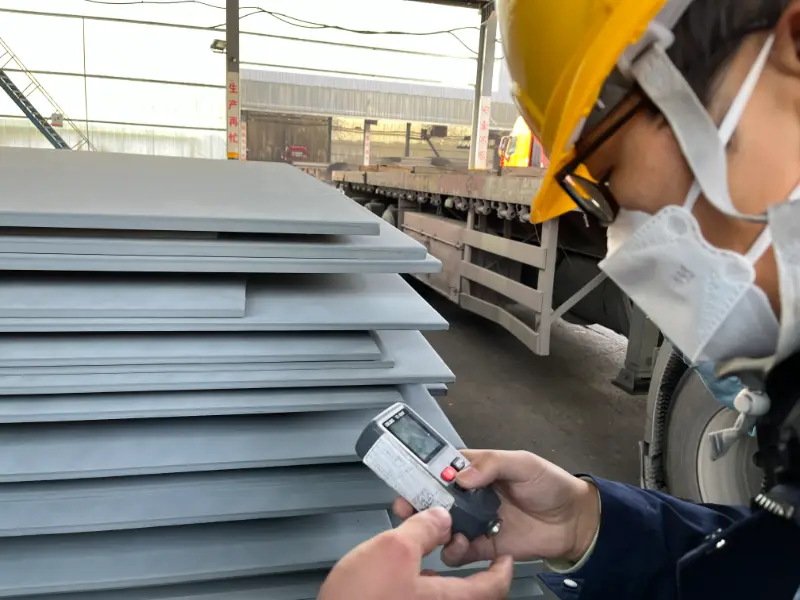
NK Grade A40 Shipbuilding Steel Plate
NK Grade A40 Shipbuilding Steel Plate - High-Strength Marine Structural Steel (AH40)
NK Grade A40 is a high-strength shipbuilding steel plate classified by Nippon Kaiji Kyokai (ClassNK) under the AH40 designation. It delivers minimum yield strength of 390 MPa and excellent weldability for critical marine structures.
Hot rolling, normalizing, thermo-mechanical controlled processing (TMCP), normalizing rolling, welding, cutting, forming
- Phone : +8618037372205
- Email : [email protected]
- WhatsApp: Contact via Whtsapp
- WeChat: +8618037372205
NK Grade A40 Shipbuilding Steel Plate Introduction
NK Grade A40, designated AH40 in the Nippon Kaiji Kyokai (ClassNK) Rules, is a normalized or thermo-mechanically rolled high-strength shipbuilding structural steel with a specified minimum yield strength of 390 MPa. It belongs to the enhanced-strength group intended for hull members, decks, and other primary structural parts of seagoing vessels and offshore units. The steel is produced to fine-grained practice and exhibits excellent toughness at 0 °C (longitudinal KV2 ≥ 34 J), good weldability, and resistance to brittle fracture. Typical applications include container ships, bulk carriers, tankers, and offshore platforms that require higher strength-to-weight ratios while maintaining strict safety margins. Delivery condition is normally normalized (N), thermo-mechanical controlled processed (TMCP), or normalized-rolled (NR), depending on thickness and purchaser requirements.
- High yield strength (≥390 MPa) reduces section thickness and structural weight.
- Guaranteed impact toughness at 0 °C enables service in cold waters.
- Full compliance with ClassNK Part K and IACS unified requirements ensures global acceptance.
- Available in a wide range of thicknesses up to 100 mm with appropriate through-thickness properties.
NK Grade A40 Shipbuilding Steel Plate Chemical Composition
The chemical requirements for NK Grade AH40 are defined in ClassNK Rules Part K, Table K3.1.1-2. The steel is fully killed and fine-grain treated with aluminium, niobium, vanadium, or titanium, alone or in combination. Residual elements are controlled to ensure consistent weldability and toughness. Carbon equivalent (CEV) is limited to 0.40% max for thicknesses ≤ 50 mm and 0.42% max for 50-100 mm. Values are for ladle analysis; product analysis tolerances apply.
| Element | Standard Value (wt.%) | Remarks |
|---|---|---|
| C | ≤ 0.18 | For all thicknesses up to 100 mm |
| Si | ≤ 0.50 | |
| Mn | 0.90 – 1.60 | |
| P | ≤ 0.035 | |
| S | ≤ 0.035 | |
| Nb | ≤ 0.05 | Grain refining element; optional |
| V | ≤ 0.10 | Grain refining element; optional |
| Ti | ≤ 0.02 | Grain refining element; optional |
| Al (acid soluble) | ≥ 0.015 | Grain refining element; optional if other element(s) used |
| Cu | ≤ 0.35 | Residual element, max. |
| Cr | ≤ 0.20 | Residual element, max. |
| Ni | ≤ 0.40 | Residual element, max. |
| Mo | ≤ 0.08 | Residual element, max. |
NK Grade A40 Shipbuilding Steel Plate Thermal and Electrical Physical Properties
The following physical properties are not mandatory in the ClassNK rules and are provided as typical engineering data for common carbon-manganese structural steels with similar composition and strength level. Actual values may vary slightly depending on exact chemistry and processing route. These values are widely accepted for design calculations.
| Property | Typical Value | Unit | Test Condition / Remarks |
|---|---|---|---|
| Density (ρ) | 7.85 | g/cm³ | At 20 °C |
| Modulus of elasticity (E) | 205 – 210 | GPa | At 20 °C |
| Shear modulus (G) | ~80 | GPa | At 20 °C |
| Poisson ratio (ν) | 0.30 | – | At 20 °C, elastic range |
| Thermal expansion coefficient (α) | 11.7 × 10⁻⁶ | /K | 20 – 100 °C |
| Thermal expansion coefficient (α) | 12.5 × 10⁻⁶ | /K | 20 – 200 °C |
| Thermal conductivity (λ) | ~52 | W/(m·K) | At 100 °C |
| Specific heat capacity (cp) | ~460 | J/(kg·K) | At 20 °C |
| Electrical resistivity (ρe) | 0.15 – 0.20 | µΩ·m | At 20 °C |
NK Grade A40 Shipbuilding Steel Plate Mechanical Properties
Mechanical testing is carried out on specimens taken from plates in the delivery condition (normalized or TMCP). Tensile properties are transverse (perpendicular to rolling direction) unless otherwise agreed. Impact tests are performed on longitudinal Charpy-V specimens at 0 °C. Bend tests confirm formability. Minimum values depend on plate thickness. Thickness ranges affect elongation requirements.
| Property | Requirement | Unit | Test Condition / Notes |
|---|---|---|---|
| Yield strength (ReH) | ≥ 390 | MPa | Thickness ≤ 100 mm |
| Tensile strength (Rm) | 510 – 650 | MPa | |
| Elongation (A) | ≥ 20 | % | t ≤ 50 mm, gauge length 50 mm |
| Elongation (A) | ≥ 19 | % | 50 < t ≤ 70 mm, gauge length 50 mm |
| Elongation (A) | ≥ 18 | % | 70 < t ≤ 100 mm, gauge length 50 mm |
| Bend test (180°) | d = 3a | – | t ≤ 25 mm (a = specimen thickness) |
| Bend test (180°) | d = 4a | – | t > 25 mm |
| Charpy-V impact (KV2) longitudinal | ≥ 34 | J | At 0 °C |
| Charpy-V impact (KV2) transverse | ≥ 24 | J | At 0 °C |
NK Grade A40 Shipbuilding Steel Plate Exactly Equivalent Material Standards and Replaceable Grades
| Country / Society | Standard | Grade | Remarks |
|---|---|---|---|
| Japan (ClassNK) | NK Rules Part K | AH40 | Parent standard; also DH40 / EH40 / FH40 for lower service temperatures |
| USA (ABS) | ABS Rules Part 2 | AH40 | Identical requirements under IACS UR W11 |
| UK (LR) | Lloyd's Register Rules | AH40 | Recognised equivalent; also DH40, EH40, FH40 |
| Norway/Germany (DNV) | DNV Rules Pt.2 Ch.2 | NV A40 | Old designation NVA40; covers AH40 grade |
| France (BV) | Bureau Veritas Rules | AH40 | Equivalent high-strength grade |
| China (CCS) | CCS Rules Part 1 | AH40 | Equivalent to NK AH40 |
| Korea (KR) | Korean Register Rules | AH40 | Same mechanical and chemical criteria |
| Italy (RINA) | RINA Rules Part D | AH40 | IACS harmonised grade |
| Russia (RS) | RS Rules | A40 | Equivalent to AH40 |
NK Grade A40 Shipbuilding Steel Plate Application Introduction
NK Grade A40 (AH40) steel plates are designed for welded structures where high strength, moderate toughness at 0 °C, and excellent fabrication characteristics are required. They are typically used in shipbuilding and offshore engineering to reduce weight without sacrificing safety. The material can be shaped by cutting, welding and forming, and is supplied in thicknesses up to 100 mm. Its good weldability allows for manual and automatic welding processes with low-hydrogen consumables and preheating if needed. Typical industries and applications include:
Product Applications: Hull plates (outer shell, bottom, side shell), Strength decks on container ships, Longitudinal stiffeners and transverse webs, Bulkheads and deep tank structures, Box girders and crane pedestals on offshore vessels, Reinforcement pads and doubler plates
Processed into products: Deck stringers and sheer strakes, Bottom longitudinals and girders, Transverse floors and frames, Box-type crane columns, Heavy lifting lugs and pad-eyes, Stiffened panels for superstructures, Bollards and fairlead foundations
Application industries: Commercial shipbuilding (container ships, bulk carriers, tankers), Naval and coastguard vessels, Offshore oil & gas (jack-up rigs, platform superstructures), Marine heavy lift and crane structures, Arctic and ice-class ships (combined with AH40/EH40/FH40 for low-temperature service), Bridge and port machinery (secondary use)
NK Grade A40 Shipbuilding Steel Plate Similar / Near-Equivalent Material Standards and Grades
The grades listed below are not identical to NK AH40 but are structurally similar in strength, toughness, and intended use. They may be considered for substitution after careful evaluation of chemical and mechanical compatibility, especially in terms of CEV, delivery condition, and minimum service temperature.
| Country / Region | Standard | Grade | Remarks |
|---|---|---|---|
| Europe | EN 10025-4 | S420M / S420ML | TMCP structural steel; min ReH 420 MPa for t≤50 mm; impact test at -20 °C (ML) or -50 °C (ML2). Slightly richer chemistry, check CEV. |
| International | ISO 4950-2 | E420 | High-strength quenched and tempered structural steel; higher yield, limited thickness availability. |
| USA | ASTM A131 / A131M | AH40 | ASTM A131 AH40 has the same strength but may differ in fine-grain practice and delivery condition. Verify grain refining. |
| USA | ASTM A572 / A572M | Grade 60 [415] | General structural steel; ReH min 415 MPa, no shipboard certification; limited toughness requirements unless supplementary. |
| Japan | JIS G3106 | SM490YA | Welded structural steel; ReH ≥ 365 MPa for SM490YA, slightly lower strength but similar toughness at 0 °C. Not a direct substitute for A40. |
| China | GB/T 712 | AH40 | Chinese shipbuilding steel with same strength; chemistry aligned with IACS; good alternative. |
Notes:
Additional remarks:
- NK Grade A40 is part of the IACS Unified Requirement W11, ensuring world-wide acceptance.
- For plates above 40 mm, consideration of through-thickness properties (Z-quality) according to NK Rules or EN 10164 may be required.
- When the material is intended for low-temperature service, DH40 (impact at -20 °C), EH40 (-40 °C), or FH40 (-60 °C) should be selected.
- Preheating before welding is recommended when plate thickness exceeds 30 mm or under high restraint to avoid cold cracking.
- Surface inspection and ultrasonic testing in accordance with ClassNK requirements are mandatory for critical structural members.
- Share



