
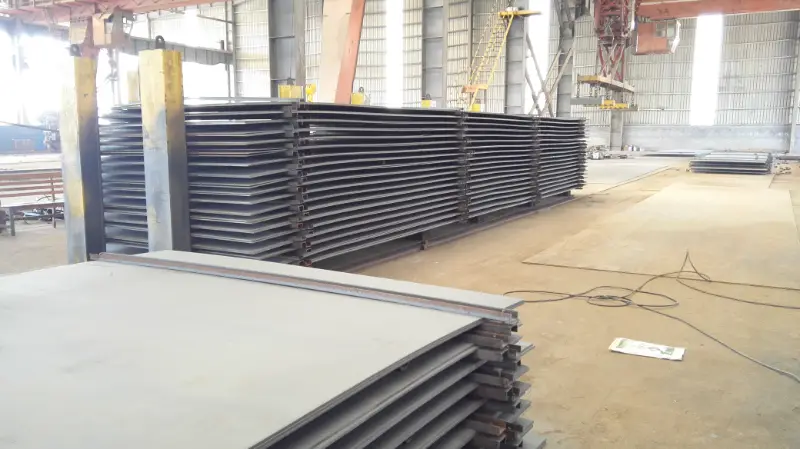
NK Grade A47 Shipbuilding Steel Plate
NK Grade A47 Shipbuilding Steel Plate - High-Strength Marine Steel with Reliable Performance
In-depth material data for NK Grade A47 shipbuilding steel plate, including chemical composition, mechanical and thermal properties, applicable international equivalents, and application guidance.
Welding, cutting, forming, cold bending, hot rolling, normalizing, TMCP
- Phone : +8618037372205
- Email : [email protected]
- WhatsApp: Contact via Whtsapp
- WeChat: +8618037372205
NK Grade A47 Shipbuilding Steel Plate Introduction
NK Grade A47 is a high-strength structural steel plate for shipbuilding, classified by ClassNK (Nippon Kaiji Kyokai). It is designed for hull and offshore structural applications requiring a minimum yield strength of 47 ksi (315 MPa). The steel offers excellent weldability, good toughness at specified temperatures, and reliable mechanical properties, ensuring safety and durability in marine environments. It is typically supplied in normalized or thermo-mechanically controlled processed (TMCP) condition, depending on thickness and impact toughness requirements. Key features:
- High strength-to-weight ratio, enabling lighter vessel designs.
- Good low-temperature impact toughness for grades with additional suffix (e.g., KA47, KD47, KE47).
- Excellent weldability, reducing fabrication costs.
- Conforms to international shipbuilding standards.
NK Grade A47 Shipbuilding Steel Plate Chemical Composition
The chemical composition conforms to ClassNK Rules Part K, Table K3.3 for high-strength steel plates. Elements are controlled to ensure good weldability, strength, and toughness. Note: Values are maximum unless a range is indicated. Additional refining elements such as niobium (Nb), vanadium (V), or titanium (Ti) may be added at the manufacturer's discretion to achieve required properties.
| Element | Specified Value (max, %) | Remarks |
|---|---|---|
| Carbon (C) | 0.18 | Ladle analysis; product analysis tolerance +0.02 |
| Silicon (Si) | 0.10 – 0.50 | Range; upper limit may be 0.55 for some producers |
| Manganese (Mn) | 0.90 – 1.60 | Depending on thickness and manufacturer |
| Phosphorus (P) | 0.025 | For improved toughness and weldability |
| Sulfur (S) | 0.025 | Low sulfur for reduced lamellar tearing risk |
| Copper (Cu) | 0.35 | Residual element |
| Nickel (Ni) | 0.40 | Residual element |
| Chromium (Cr) | 0.20 | Residual element |
| Molybdenum (Mo) | 0.08 | Residual element |
| Aluminum (Al), total | ≥ 0.015 | For grain refinement; acid-soluble Al min 0.015% |
| Niobium (Nb) | 0.02 – 0.05 | Typically added for microalloying, optional |
| Vanadium (V) | 0.05 – 0.10 | Optional microalloying element |
| Titanium (Ti) | 0.007 – 0.05 | Optional microalloying element |
| Nitrogen (N) | 0.009 | If no N-binding elements present; otherwise up to 0.012 |
NK Grade A47 Shipbuilding Steel Plate Physical and Thermal Properties
Physical properties are representative for high-strength low-alloy steels with similar composition. These values are not part of the formal NK specification but are derived from established material databases for carbon-manganese structural steels (0.18% C, 1.5% Mn). They are used for design calculations and modelling. Values are typical at room temperature unless otherwise noted.
| Property | Typical Value | Unit | Test Condition |
|---|---|---|---|
| Density (ρ) | 7.85 | g/cm³ | At 20°C |
| Elastic Modulus (E) | 207 | GPa | At 20°C |
| Shear Modulus (G) | 79.3 | GPa | At 20°C |
| Poisson's Ratio (ν) | 0.30 | - | At 20°C |
| Thermal Expansion Coefficient (α) | 11.7 × 10⁻⁶ | /K | From 20°C to 100°C |
| Thermal Expansion Coefficient (α) | 12.5 × 10⁻⁶ | /K | From 20°C to 200°C |
| Thermal Expansion Coefficient (α) | 13.6 × 10⁻⁶ | /K | From 20°C to 400°C |
| Thermal Conductivity (λ) | 50 | W/(m·K) | At 20°C |
| Thermal Conductivity (λ) | 45 | W/(m·K) | At 200°C |
| Thermal Conductivity (λ) | 38 | W/(m·K) | At 400°C |
| Specific Heat Capacity (cₚ) | 460 | J/(kg·K) | At room temperature |
| Electrical Resistivity (ρ_e) | 0.22 – 0.25 | µΩ·m | At 20°C |
NK Grade A47 Shipbuilding Steel Plate Mechanical Properties
Mechanical properties are specified according to ClassNK rules for plate thickness ≤ 50 mm. For thicker plates, slight reductions in strength and elongation may apply. Tensile testing is performed in the transverse direction. Impact energy values are for full-size Charpy V-notch specimens. The designation 'A47' indicates min 315 MPa yield; additional letters (KA, KD, KE) define impact test temperature (0°C, -20°C, -40°C). Typical guaranteed values are listed below.
| Property | Specified Value | Unit | Test Condition |
|---|---|---|---|
| Yield Strength (ReH) | ≥ 315 | MPa | Upper yield point, t ≤ 50 mm; transverse test |
| Tensile Strength (Rm) | 460 – 610 | MPa | For t ≤ 50 mm; transverse test |
| Elongation (A) | ≥ 21 | % | Gauge length 50 mm (or 200 mm); transverse, t ≤ 50 mm |
| Elongation (A) | ≥ 20 | % | Gauge length 50 mm; transverse, 50 < t ≤ 70 mm |
| Elongation (A) | ≥ 19 | % | Gauge length 50 mm; transverse, 70 < t ≤ 100 mm |
| Charpy Impact Energy (KV₂) | ≥ 34 (avg), ≥ 27 (single) | J | For KA47 at 0°C; transverse, full-size specimen |
| Charpy Impact Energy (KV₂) | ≥ 34 (avg), ≥ 27 (single) | J | For KD47 at -20°C; transverse |
| Charpy Impact Energy (KV₂) | ≥ 34 (avg), ≥ 27 (single) | J | For KE47 at -40°C; transverse |
| Bend Test (Diameter ratio) | No cracks | 3×t | 180° bend on flat specimen; t = specimen thickness |
NK Grade A47 Shipbuilding Steel Plate Fully Equivalent Material Standards and Replaceable Grades
| Country/Region | Standard | Grade | Remarks |
|---|---|---|---|
| Japan (NK) | NK Rules Part K | KA47, KD47, KE47 | Identical strength level; suffix indicates impact test temperature |
| International (IACS) | IACS UR W11 | High Strength Steel with YS 315 MPa | Common IACS member societies (ABS, DNV, LR, etc.) equate classes AH36/DH36/EH36 |
| Japan (JIS) | JIS G 3106 | SM490B / SM490C | Similar strength and chemical requirements; used in general construction; verify plate specification for shipbuilding |
| China (CCS) | CCS Rules | AH36, DH36, EH36 | Equivalent to NK KA47, KD47, KE47; min yield 355 MPa, slightly higher strength; fully interchangeable subject to approval |
| Korea (KR) | KR Rules | AH36, DH36, EH36 | Direct equivalent per IACS unified requirements; same as NK A47 strength level |
NK Grade A47 Shipbuilding Steel Plate Application Introduction
NK Grade A47 steel plate is specifically designed for welded ship structures and marine applications where high strength and good toughness are required. Typical usage includes primary hull members subjected to high stress, such as deck plates, bottom shell plating, side shells, and longitudinal strength members. It is also suitable for offshore and port structures. Fabrication: The steel can be processed by all common methods – flame cutting, plasma cutting, cold forming, and welding (SMAW, SAW, GMAW). Preheating is generally not required for thicknesses up to 50 mm when using low-hydrogen consumables, but a minimum workpiece temperature of ~20°C is recommended. Post-weld heat treatment is not mandatory for this grade.
Product Applications: Cargo ship hulls, Oil tanker and chemical tanker structural members, Ice-strengthened vessels (with appropriate impact toughness specification), Ro-Ro and passenger ferry superstructures, Wind turbine installation vessel legs and components
Processed into products: Main deck plating, Bottom and bilge strakes, Longitudinal and transverse bulkheads, Stringer plates and sheer strakes, Hatch coamings and corner reinforcements, Frame webs and floors, Offshore module main beams and columns
Application industries: Shipbuilding: Commercial vessels (bulk carriers, tankers, container ships), naval auxiliary vessels, Offshore engineering: Jack-up rigs, platform decks, accommodation modules, Port and harbor infrastructure: Cranes, container handling equipment, fender panels, Bridge construction (as substitute for SM490 when certification is accepted), Pressure vessel and storage tank fabrication (subject to code requirements)
NK Grade A47 Shipbuilding Steel Plate Similar or Alternative Grades for Cross-Reference
| Country/Region | Standard | Grade | Remarks |
|---|---|---|---|
| European (EN) | EN 10025-4 | S355ML / S355N | Approximate strength (min YS 355 MPa); requires verification of weldability and low temperature toughness; not a direct shipbuilding standard but can be considered for secondary structures |
| USA (ASTM) | ASTM A131 / A131M | Grade AH36 / DH36 / EH36 | Shipbuilding steel standard; min YS 355 MPa (slightly higher); fully compatible in marine applications |
| Russia (GOST) | GOST 5521 | D32 / A32 / D36 / A36 | Older classification; D32 min YS 315 MPa; may serve as equivalent with additional testing |
| ISO | ISO 4950-3 | E 355 | High yield strength flat products; similar strength range; not specific to shipbuilding, but used in structural applications |
Notes:
Additional information:
- NK classification allows optional additions of Cr, Ni, Mo, Cu, Nb, V, Ti as agreed between manufacturer and purchaser, provided mechanical properties are satisfied.
- For thicknesses above 50 mm, the minimum yield strength may be reduced to 295 MPa and elongation requirements adjusted according to NK rules.
- Welding consumable selection should match the steel strength level (e.g., AWS E7018 or equivalent for SMAW); preheat and interpass temperature control is recommended for thicker sections to avoid hydrogen cracking.
- This grade is often supplied with ultrasonic testing (UT) to Class S2E3 or equivalent as per EN 10160 or ASTM A578, upon request.
- 'A47' without a heat treatment suffix normally implies as-rolled condition, but normalized or TMCP is commonly applied when impact toughness at low temperatures is required (i.e., KD47, KE47).
- Share



