
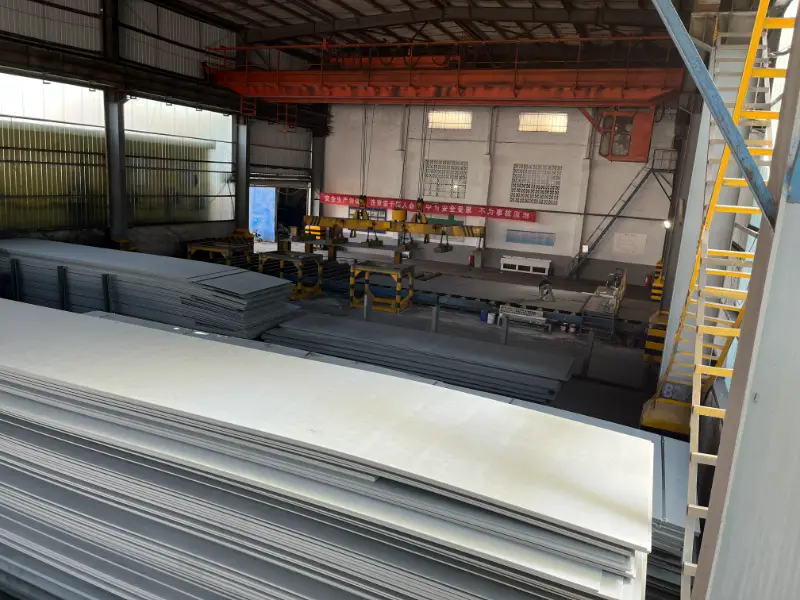
GB3531 09MnNiDR Cryogenic Pressure Vessel Steel Plate
GB3531 09MnNiDR Cryogenic Pressure Vessel Steel Plate - Low Temperature Alloy for Boilers and Storage Tanks
Complete technical datasheet for 09MnNiDR steel per GB 3531: chemical composition, mechanical properties, physical constants, international equivalents, and application guide for low-temperature pressure vessels.
Hot rolling, Normalizing, Normalizing + Tempering
- Phone : +8618037372205
- Email : [email protected]
- WhatsApp: Contact via Whtsapp
- WeChat: +8618037372205
GB3531 09MnNiDR Cryogenic Pressure Vessel Steel Plate Introduction
09MnNiDR is a low‑temperature pressure vessel steel plate manufactured to the Chinese standard GB 3531. Alloyed with nickel (Ni) and micro‑alloyed with niobium (Nb), it is designed for service temperatures down to -70°C. Key attributes include excellent weldability, high tensile strength, and outstanding notch toughness at cryogenic conditions. The steel is supplied in the normalized or normalized plus tempered condition, ensuring a fine‑grained microstructure that meets strict requirements for boilers, storage tanks, and reactors handling liquefied gases. Stringent impact testing at -70°C guarantees reliable performance in severe environments.
GB3531 09MnNiDR Cryogenic Pressure Vessel Steel Plate Chemical Composition
Ladle analysis according to GB 3531‑2014. Residual elements (Cr ≤0.30%, Cu ≤0.25%, Mo ≤0.10%, V ≤0.02%, Ti ≤0.03%) are controlled by steelmaking practice but not part of the grade specification.
| Chemical Element | Standard Value (wt%) | Remarks |
|---|---|---|
| C | ≤0.12 | |
| Si | 0.15~0.50 | |
| Mn | 1.20~1.60 | |
| P | ≤0.020 | |
| S | ≤0.010 | |
| Ni | 0.30~0.80 | |
| Nb | ≤0.04 | |
| Alt | ≥0.020 | Total aluminum (acid soluble) |
GB3531 09MnNiDR Cryogenic Pressure Vessel Steel Plate Thermal and Electrical Physical Properties
Representative physical data for 09MnNiDR at ambient and elevated temperatures. Values are typical for low‑alloy Ni steel and may vary slightly with processing. These are not guaranteed by the product standard.
| Property | Typical Value | Unit | Test Condition / Temperature |
|---|---|---|---|
| Density (ρ) | 7.85 | g/cm³ | at 20°C |
| Elastic Modulus (E) | 206 | GPa | at 20°C |
| Shear Modulus (G) | 79.4 | GPa | at 20°C |
| Poisson's Ratio (ν) | 0.3 | at 20°C | |
| Thermal Expansion (α) | 10.8 | 10⁻⁶/K | 20–100°C |
| Thermal Expansion (α) | 11.5 | 10⁻⁶/K | 20–200°C |
| Thermal Expansion (α) | 12.2 | 10⁻⁶/K | 20–300°C |
| Thermal Expansion (α) | 12.8 | 10⁻⁶/K | 20–400°C |
| Thermal Conductivity (λ) | 36 | W/(m·K) | at 100°C |
| Thermal Conductivity (λ) | 38 | W/(m·K) | at 200°C |
| Thermal Conductivity (λ) | 37 | W/(m·K) | at 300°C |
| Thermal Conductivity (λ) | 34 | W/(m·K) | at 400°C |
| Specific Heat Capacity | 460 | J/(kg·K) | at 20°C |
| Electrical Resistivity (ρₑ) | 0.25 | µΩ·m | at 20°C |
GB3531 09MnNiDR Cryogenic Pressure Vessel Steel Plate Mechanical Properties
Tensile and impact properties per GB 3531‑2014 for normalized or N+T condition. All tests conducted at room temperature except impact testing which is performed at -70°C. Yield strength is lower yield strength (ReL).
| Property | Standard Required Value | Unit | Test Condition / Thickness Range |
|---|---|---|---|
| Yield Strength (ReL) | ≥300 | MPa | Thickness ≤16 mm |
| Yield Strength (ReL) | ≥290 | MPa | 16 mm < Thickness ≤36 mm |
| Yield Strength (ReL) | ≥280 | MPa | 36 mm < Thickness ≤60 mm |
| Yield Strength (ReL) | ≥270 | MPa | 60 mm < Thickness ≤100 mm |
| Yield Strength (ReL) | ≥260 | MPa | 100 mm < Thickness ≤120 mm |
| Tensile Strength (Rm) | 430~560 | MPa | Thickness ≤100 mm |
| Tensile Strength (Rm) | 420~550 | MPa | 100 mm < Thickness ≤120 mm |
| Elongation (A) | ≥23 | % | All thicknesses up to 120 mm (gauge 50 mm) |
| Impact Energy (KV₂) | ≥34 (average) / ≥24 (single) | J | -70°C, Charpy V‑notch |
| Bend Test (180°) | d = 2a | Thickness ≤25 mm | |
| Bend Test (180°) | d = 3a | Thickness >25 mm |
GB3531 09MnNiDR Cryogenic Pressure Vessel Steel Plate Directly Equivalent Material Standards and Substitute Grades
| Country/Region | Standard | Grade | Remarks |
|---|---|---|---|
| China | GB 3531 | 09MnNiDR | Original grade |
| Europe | EN 10028-4 | 13MnNi6-3 | Comparable low‑temperature Ni steel; verify yield strength and impact requirements |
| International | ISO 9328-3 | 13MnNi6-3 | Equivalent to EN 10028-4; similar composition, slight variations possible |
GB3531 09MnNiDR Cryogenic Pressure Vessel Steel Plate Application Introduction
09MnNiDR is engineered specifically for low‑temperature pressure‑retaining structures. Its combination of high strength, excellent ductility, and guaranteed toughness at -70°C makes it a preferred choice for cryogenic storage and processing equipment. The steel can be welded using conventional methods and is easily formed into complex shapes.
Product Applications: Liquefied natural gas (LNG) storage tanks, Liquid ammonia storage spheres, Low‑temperature pressure vessels, Industrial boilers, Shell‑and‑tube heat exchangers
Processed into products: Cylindrical shell courses, Elliptical and hemispherical heads, Tube sheets and flanges, Nozzles and manways, Reinforcement pads, Welded joints
Application industries: Petrochemical, Oil & Gas, Chemical Processing, Cryogenic Storage, Power Generation
GB3531 09MnNiDR Cryogenic Pressure Vessel Steel Plate Near‑equivalent / Similar Grade Recommendations
| Country/Region | Standard | Grade | Remarks |
|---|---|---|---|
| USA | ASTM A203/A203M | Grade A (or B) | Higher nickel (2.10–2.50%), similar -60°C/-70°C toughness; check weldability and mechanicals |
| Japan | JIS G3127 | SL2N255A | Ni approx. 2.10–2.50%; comparable low‑temperature service, strength may differ |
| Europe | EN 10028-4 | 11MnNi5-3 | Similar Ni (0.30–0.80%) and Mn range; slightly different carbon and tensile requirements |
Notes:
Plates are typically supplied with ultrasonic examination per GB/T 2970. Carbon equivalent (CEV) is usually ≤0.45%, ensuring good weldability without preheat for thicknesses up to about 30 mm. For heavier sections, suitable preheat and post‑weld heat treatment should be applied according to fabrication codes. Always consult the latest revision of GB 3531 for mandatory requirements.
- Share



