
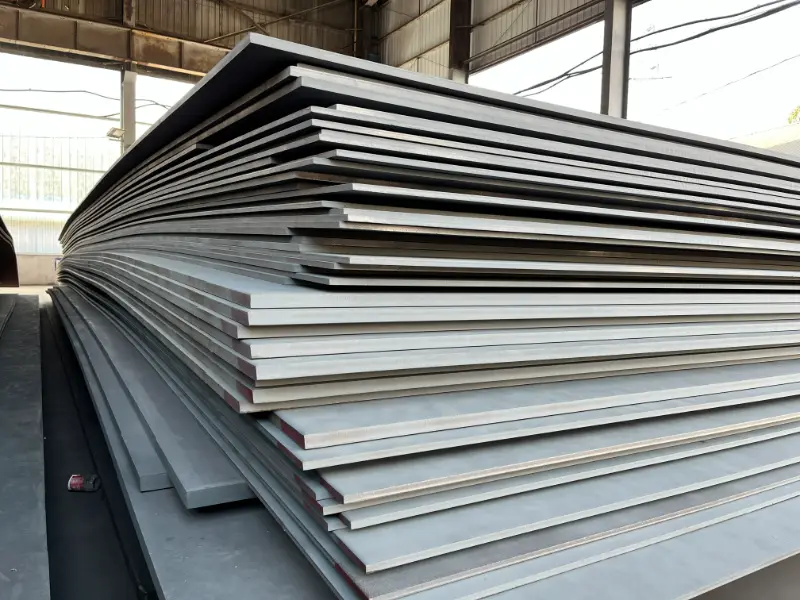
EN10028-5 P460ML1 Pressure Vessel Steel Plate
EN10028-5 P460ML1: High-Strength Fine-Grain Steel for Pressure Vessels & Boilers
Detailed datasheet for P460ML1 thermomechanical rolled fine-grain structural steel for pressure purposes, including chemical composition, mechanical properties, thermal and electrical properties, international equivalents, and application guide.
Thermomechanical rolling (TMCP), normalized rolling possible; suitable for welding, cold forming, hot forming (with care), and machining.
- Phone : +8618037372205
- Email : [email protected]
- WhatsApp: Contact via Whtsapp
- WeChat: +8618037372205
EN10028-5 P460ML1 Pressure Vessel Steel Plate Introduction
EN10028-5 P460ML1 is a thermomechanical rolled weldable fine-grain structural steel specifically designed for pressure vessels and boilers. It offers a minimum yield strength of 460 MPa (for thicknesses up to 16 mm) with excellent low-temperature toughness down to -40 °C. The steel is supplied in the thermomechanical rolled condition, ensuring a fine and uniform grain structure that combines high strength, good ductility, and superior weldability. Its balanced chemistry with low carbon and microalloying elements (Nb, V, Ti) provides predictable mechanical properties and reliable performance under high-pressure and low-temperature service conditions. P460ML1 is widely used in the fabrication of storage tanks, reactors, heat exchangers, and other pressure-retaining components in the oil & gas, chemical, and power generation industries. The material conforms to the requirements of EN 10028-5:2017 and is available in plate form, typically delivered in the normalized or as-rolled thermomechanical condition with optional impact testing at -40 °C.
EN10028-5 P460ML1 Pressure Vessel Steel Plate Chemical Composition
The chemical composition of P460ML1 is tightly controlled to ensure high strength, excellent toughness, and good weldability. Low carbon content reduces the risk of cold cracking, while microalloying with niobium, vanadium, and titanium refines the grain structure and provides precipitation strengthening.
- Nb+V+Ti sum is limited to 0.12% max to avoid excessive hardening and to maintain ductility.
- Aluminium is added for deoxidation and grain refinement; the minimum total Al content ensures fine grain practice.
- Residual elements like Cr, Cu, Mo, and Ni are kept low, but small amounts may be present depending on the scrap used.
| Chemical Element | Standard Value (%) | Remarks |
|---|---|---|
| Carbon (C) | ≤ 0.16 | Ladle analysis |
| Silicon (Si) | ≤ 0.60 | |
| Manganese (Mn) | ≤ 1.70 | |
| Phosphorus (P) | ≤ 0.020 | |
| Sulfur (S) | ≤ 0.010 | |
| Aluminium (Altotal) | ≥ 0.020 | As deoxidation element; fine grain practice |
| Nitrogen (N) | ≤ 0.020 | |
| Niobium (Nb) | ≤ 0.05 | |
| Vanadium (V) | ≤ 0.10 | |
| Titanium (Ti) | ≤ 0.05 | |
| Niobium + Vanadium + Titanium (Nb+V+Ti) | ≤ 0.12 | Sum of microalloying elements |
| Chromium (Cr) | ≤ 0.30 | |
| Copper (Cu) | ≤ 0.30 | |
| Molybdenum (Mo) | ≤ 0.10 | |
| Nickel (Ni) | ≤ 0.50 | May be added for toughness (optional) |
EN10028-5 P460ML1 Pressure Vessel Steel Plate Thermal and Electrical Physical Properties
The physical properties listed are typical for P460ML1 type thermomechanical fine-grain steels and may vary slightly due to processing conditions. These values are provided as general engineering guidance.
- Density is calculated from the nominal composition.
- Elastic modulus and Poisson's ratio are typical for structural steels with similar strength levels.
- Thermal expansion coefficient and thermal conductivity depend on temperature; properties at elevated temperatures are given to support mechanical design for pressure equipment.
- Electrical resistivity is provided for applications requiring electrical conduction data.
| Property | Typical Value | Unit | Test Condition / Remarks |
|---|---|---|---|
| Density (ρ) | ~ 7850 | kg/m³ | At 20 °C |
| Elastic modulus (E) | ~ 210 | GPa | At 20 °C |
| Shear modulus (G) | ~ 81 | GPa | Calculated from E and ν |
| Poisson's ratio (ν) | ~ 0.30 | – | At 20 °C |
| Thermal expansion coef. (α) | 11.1 × 10⁻⁶ | 1/K | 20 – 100 °C |
| Thermal expansion coef. (α) | 12.2 × 10⁻⁶ | 1/K | 20 – 200 °C |
| Thermal expansion coef. (α) | 12.9 × 10⁻⁶ | 1/K | 20 – 300 °C |
| Thermal conductivity (λ) | ~ 45 | W/(m·K) | At 20 °C |
| Thermal conductivity (λ) | ~ 42 | W/(m·K) | At 200 °C |
| Thermal conductivity (λ) | ~ 39 | W/(m·K) | At 400 °C |
| Specific heat capacity (cp) | ~ 460 | J/(kg·K) | At 20 °C |
| Specific heat capacity (cp) | ~ 510 | J/(kg·K) | At 200 °C |
| Specific heat capacity (cp) | ~ 580 | J/(kg·K) | At 400 °C |
| Electrical resistivity (ρe) | ~ 0.25 × 10⁻⁶ | Ω·m | At 20 °C |
EN10028-5 P460ML1 Pressure Vessel Steel Plate Mechanical Properties
Mechanical properties are guaranteed in the thermomechanical rolled condition (+M) for thickness ranges as per EN 10028-5. The material exhibits high yield strength, sufficient tensile strength, and good ductility. Impact toughness is verified at -40 °C in the transverse direction.
- The required minimum elongation after fracture (A) is based on a proportional test piece with gauge length L0 = 5.65√S0 (or non-proportional test piece).
- For plate thicknesses beyond 150 mm, the values shall be agreed at the time of enquiry and order.
- Bend test (180°) is performed according to EN 10028-1; the mandrel diameter depends on thickness and tensile ductility, ensuring no cracks after bending.
| Property | Required Value | Unit | Test Condition / Thickness |
|---|---|---|---|
| Yield Strength (ReH) | ≥ 460 | MPa | t ≤ 16 mm |
| Yield Strength (ReH) | ≥ 450 | MPa | 16 mm < t ≤ 40 mm |
| Yield Strength (ReH) | ≥ 430 | MPa | 40 mm < t ≤ 63 mm |
| Yield Strength (ReH) | ≥ 410 | MPa | 63 mm < t ≤ 80 mm |
| Yield Strength (ReH) | ≥ 400 | MPa | 80 mm < t ≤ 100 mm |
| Yield Strength (ReH) | ≥ 380 | MPa | 100 mm < t ≤ 150 mm |
| Yield Strength (ReH) | upon agreement | MPa | t > 150 mm |
| Tensile Strength (Rm) | 540 – 720 | MPa | t ≤ 250 mm |
| Elongation after fracture (A) | ≥ 17 | % | t ≤ 60 mm (L0 = 5.65√S0) |
| Elongation after fracture (A) | ≥ 17 | % | t > 60 mm (L0 = 5.65√S0) |
| Impact energy (KV2) | ≥ 27 | J | Test temperature -40 °C, transverse test piece, Charpy V-notch |
| Bend test (180°) | No cracks | – | Mandrel diameter: 3t (t ≤ 25 mm); 4t (25 < t ≤ 60 mm); 4.5t (t > 60 mm). Specimen width ≥ 2t. |
EN10028-5 P460ML1 Pressure Vessel Steel Plate Completely Equivalent Material Standards & Substitutable Grade Recommendations
EN 10028-5 P460ML1 is a harmonized European standard directly adopted by all CEN member countries. Thus, the same designation is used across Europe. The ISO standard offers an identical grade under a different document number. The following list shows directly equivalent designations that ensure identical chemical and mechanical requirements.
| Country/Region | Standard | Grade | Remarks |
|---|---|---|---|
| European Union | EN 10028-5:2017 | P460ML1 | Original standard |
| Germany | DIN EN 10028-5 | P460ML1 | Identical adoption |
| France | NF EN 10028-5 | P460ML1 | Identical adoption |
| United Kingdom | BS EN 10028-5 | P460ML1 | Identical adoption |
| Italy | UNI EN 10028-5 | P460ML1 | Identical adoption |
| Spain | UNE EN 10028-5 | P460ML1 | Identical adoption |
| Sweden | SS EN 10028-5 | P460ML1 | Identical adoption |
| Austria | ÖNORM EN 10028-5 | P460ML1 | Identical adoption |
| Netherlands | NEN EN 10028-5 | P460ML1 | Identical adoption |
| Belgium | NBN EN 10028-5 | P460ML1 | Identical adoption |
| International | ISO 9328-2:2018 | P460ML1 | Identical technical requirements |
EN10028-5 P460ML1 Pressure Vessel Steel Plate Application Introduction
P460ML1 is specifically designed for welded pressure vessels and boilers that require high yield strength at ambient and moderately elevated temperatures up to about 400 °C, combined with excellent low-temperature toughness. It is well suited for thermomechanical rolled condition applications where stress-relief heat treatment is not mandatory (if required, special attention to post-weld heat treatment parameters is needed). The steel's fine grain structure and low carbon equivalent promote good weldability without excessive preheat. Common applications include pressure retaining equipment in the oil & gas, petrochemical, and power generation industries.
Product Applications: Pressure vessel shells and heads, Boilers and steam drums, Spherical storage tanks (e.g., for LPG, propylene), Heat exchangers and reboilers, Reactors and process columns, Cryogenic storage tanks (down to -40 °C), High-pressure pipelines and manifolds
Processed into products: Shell plates and formed heads (ellipsoidal, torispherical), Flanges and blind flanges, Nozzle necks and reinforcing pads, Tube sheets and baffle plates, Girth flanges and support skirts, Manways and inspection openings, Welded supports and lifting lugs, Transition pieces and cone sections
Application industries: Oil & gas (upstream & downstream), Chemical and petrochemical processing, Power generation (fossil fuel, nuclear auxiliary), Industrial gases (LNG, LPG, ammonia storage), Shipbuilding (pressure tanks for gas carriers), Heavy machinery and engineering
EN10028-5 P460ML1 Pressure Vessel Steel Plate Similar / Approximate Alternative Material Recommendations
Several steel grades share comparable strength levels and impact toughness, but differ in rolling condition, toughness temperature, or standard. These can be considered for substitution only after careful assessment of technical requirements, welding procedures, and code approvals.
| Country/Region | Standard | Grade | Remarks |
|---|---|---|---|
| Europe | EN 10028-5 | P460ML2 | Same strength, improved toughness at -50 °C; may be used where lower temperature service is required. |
| Europe | EN 10028-5 | P460N | Normalized instead of TMCP, comparable strength; toughness usually at -20 °C (NL1) or -50 °C (NL2), but normalized may have coarser grain. |
| Europe | EN 10028-6 | P460Q / P460QL1 / P460QL2 | Quenched & tempered variant; higher strength at thick gauges, but processing and weldability may differ. |
| USA | ASTM A841/A841M | Grade F | TMCP steel for pressure vessels; minimum yield 450 MPa, tensile 550-690 MPa; similar concept but exact chemistry and impact temperature (-50 °C) differ; verify with ASME code acceptance. |
| USA | ASTM A537/A537M | Class 2 | Heat-treated (quenched & tempered) pressure vessel steel; yield ≥ 415 MPa at ≤ 65 mm; higher carbon, but can be engineered as substitute in non-TMCP applications. |
| Japan | JIS G3115 | SPV490 | High-strength pressure vessel steel (quenched & tempered); minimum yield 490 MPa, often used for similar service; composition and delivery condition differ. |
| China | GB/T 713-2014 | 15MnNiNbDR (or similar) | Chinese Q&T or normalized pressure vessel steel; yield ≥ 460 MPa; careful evaluation needed for welding and toughness at -40 °C. |
Notes:
- CEV (Carbon Equivalent): Typical CEV for P460ML1 is ≤ 0.47 (based on ladle analysis, formula CEV = C + Mn/6 + (Cr+Mo+V)/5 + (Ni+Cu)/15). This ensures good weldability and low cold cracking sensitivity.
- Post weld heat treatment (PWHT): When required, stress relief at 530–580 °C is common; however, the thermomechanical condition may undergo some strength reduction. Consult the steel manufacturer for specific PWHT parameters.
- Non-destructive examination: The material can be supplied with requirements for ultrasonic testing according to EN 10160 or equivalent, to meet pressure vessel codes.
- Certification: EN 10204 Type 3.1 or 3.2 inspection certificates are usually provided, including chemical analysis, tensile tests, and Charpy V-notch impact tests at -40 °C (transverse).
- Forming: Cold and hot forming can be performed. For hot forming, re-normalizing or re-thermomechanical rolling may be necessary to restore properties.
- Share



