
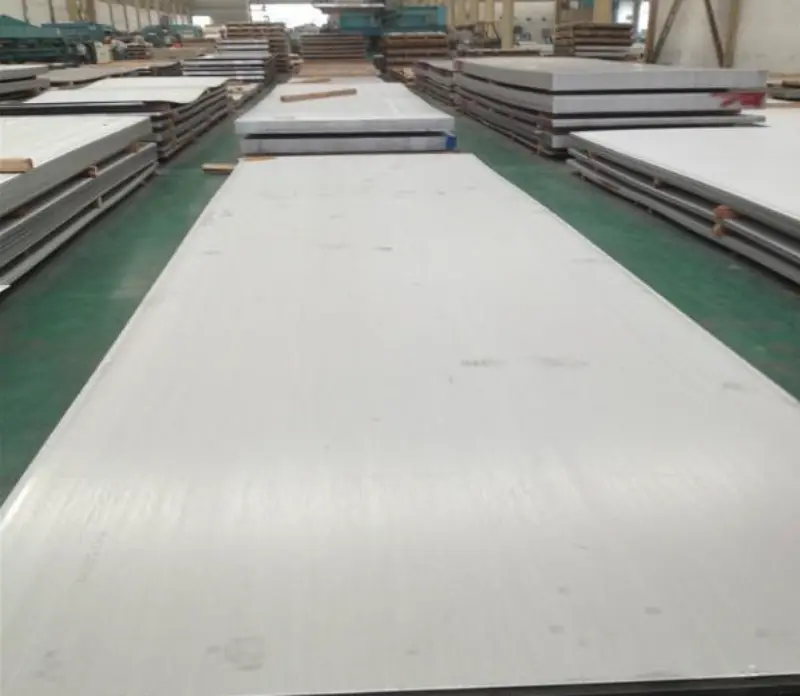
EN10028-5 P460ML2 Pressure Vessel & Boiler Steel Plate
EN10028-5 P460ML2 Pressure Vessel & Boiler Steel Plate - Thermomechanically Rolled Fine Grain Steel
P460ML2 is a high-strength weldable fine grain steel for pressure purposes, delivered in thermomechanically rolled condition to EN 10028-5.
Hot rolling, thermomechanical rolling, cutting, forming, welding, heat treatment (if specified)
- Phone : +8618037372205
- Email : [email protected]
- WhatsApp: Contact via Whtsapp
- WeChat: +8618037372205
EN10028-5 P460ML2 Pressure Vessel & Boiler Steel Plate Introduction
P460ML2 is a high-strength, weldable fine grain steel intended for use in pressure vessels and boilers. It complies with EN 10028-5, which specifies requirements for flat products made of thermomechanically rolled weldable fine grain steels. This grade is characterized by a minimum yield strength of 460 MPa at room temperature, excellent toughness at low temperatures (down to -50°C), and good weldability. The thermomechanical rolling process refines the grain structure, resulting in improved mechanical properties and resistance to brittle fracture. It is typically supplied in the normalized or as-rolled condition, depending on the heat treatment and delivery condition specified. The steel is suitable for welded structures in aggressive environments and is used in the fabrication of pressure vessels, boilers, storage tanks, and other equipment where high strength and low temperature toughness are essential.
EN10028-5 P460ML2 Pressure Vessel & Boiler Steel Plate Chemical Composition
The chemical composition is based on EN 10028-5:2017 for grade P460ML2. Values are maximums unless a range is indicated. Al total ≥ 0.020%, and the sum of Nb+Ti+V ≤ 0.12%. The carbon equivalent value (CEV) is typically limited to 0.45% for improved weldability.
| Element | Standard Value | Remarks |
|---|---|---|
| C | ≤ 0.18 | |
| Si | ≤ 0.60 | |
| Mn | 1.00 - 1.70 | |
| P | ≤ 0.025 | |
| S | ≤ 0.010 | |
| Al (total) | ≥ 0.020 | Usually Al/N ratio control for grain refinement |
| N | ≤ 0.020 | |
| Cr | ≤ 0.30 | |
| Cu | ≤ 0.50 | |
| Mo | ≤ 0.10 | |
| Nb | ≤ 0.05 | Part of microalloying; sum Nb+Ti+V ≤ 0.12% |
| Ni | ≤ 0.50 | |
| Ti | ≤ 0.05 | Part of microalloying |
| V | ≤ 0.10 | Part of microalloying; sum Nb+Ti+V ≤ 0.12% |
| Nb+Ti+V | ≤ 0.12 | Combined microalloy content |
| CEV (IIW) | ≤ 0.45 | Typical limit for thickness ≤ 60 mm, depending on agreement |
EN10028-5 P460ML2 Pressure Vessel & Boiler Steel Plate Thermal and Electrical Physical Properties
Physical properties are typical for thermomechanically rolled fine grain steels and are provided for design and engineering purposes. Density is approximately 7850 kg/m³. Elastic modulus is around 210 GPa at room temperature. The coefficient of thermal expansion varies with temperature, being around 11.7 × 10⁻⁶/K at 20–100°C. Thermal conductivity is moderate, around 42 W/(m·K) at 20°C, decreasing with temperature. Specific heat capacity is about 460 J/(kg·K). Electrical resistivity is typically 0.22 × 10⁻⁶ Ω·m.
| Property | Typical Value | Unit | Test Condition |
|---|---|---|---|
| Density (ρ) | 7850 | kg/m³ | Room temperature |
| Elastic modulus (E) | 210 | GPa | Room temperature |
| Shear modulus (G) | 81 | GPa | Calculated from E and ν |
| Poisson's ratio (ν) | 0.30 | - | Room temperature |
| Thermal expansion coefficient (α) | 11.7 | 10⁻⁶/K | 20–100°C |
| Thermal expansion coefficient (α) | 12.5 | 10⁻⁶/K | 20–200°C |
| Thermal expansion coefficient (α) | 13.5 | 10⁻⁶/K | 20–400°C |
| Thermal conductivity (λ) | 42 | W/(m·K) | 20°C |
| Thermal conductivity (λ) | 39 | W/(m·K) | 200°C |
| Thermal conductivity (λ) | 35 | W/(m·K) | 400°C |
| Specific heat capacity (c) | 460 | J/(kg·K) | 20°C |
| Electrical resistivity (ρ_e) | 0.22 | Ω·mm²/m | 20°C |
EN10028-5 P460ML2 Pressure Vessel & Boiler Steel Plate Mechanical Properties
The mechanical properties are specified in EN 10028-5:2017 for P460ML2. Properties vary with product thickness. Yield strength (ReH) is minimum 460 MPa for thickness ≤ 16 mm, decreasing for thicker sections. Tensile strength (Rm) ranges from 570 to 730 MPa. Elongation (A) is minimum 17% for thinner gauges. Charpy impact energy (KV) is guaranteed at -50°C with a minimum of 27 J (transverse specimens). Bending tests are required with specified mandrel diameters.
| Property | Standard Requirement Value | Unit | Test Condition |
|---|---|---|---|
| Yield strength (ReH) | ≥ 460 | MPa | Thickness ≤ 16 mm |
| Yield strength (ReH) | ≥ 440 | MPa | Thickness > 16 mm ≤ 40 mm |
| Yield strength (ReH) | ≥ 410 | MPa | Thickness > 40 mm ≤ 60 mm |
| Yield strength (ReH) | ≥ 390 | MPa | Thickness > 60 mm ≤ 80 mm |
| Tensile strength (Rm) | 570 - 730 | MPa | Thickness ≤ 60 mm |
| Tensile strength (Rm) | 560 - 720 | MPa | Thickness > 60 mm ≤ 80 mm |
| Elongation (A) | ≥ 17 | % | Gauge length 5.65√So, thickness ≤ 40 mm, transverse |
| Elongation (A) | ≥ 17 | % | Thickness > 40 mm ≤ 60 mm, transverse |
| Elongation (A) | ≥ 17 | % | Thickness > 60 mm ≤ 80 mm, transverse |
| Charpy impact energy (KV) | ≥ 27 (average); ≥ 20 (individual) | J | At -50°C, transverse, 10×10 mm specimen |
| Bend test (mandrel diameter) | 3×t | - | Thickness ≤ 16 mm, 180° bending angle |
| Bend test (mandrel diameter) | 3×t | - | Thickness > 16 mm ≤ 40 mm |
| Bend test (mandrel diameter) | 4×t | - | Thickness > 40 mm ≤ 80 mm |
EN10028-5 P460ML2 Pressure Vessel & Boiler Steel Plate Fully Equivalent Material Standards and Substitute Grades
| Country/Region | Standard | Grade | Remarks |
|---|---|---|---|
| European Union | EN 10028-5:2017 | P460ML2 | Original standard, thermomechanically rolled condition |
| Germany | DIN EN 10028-5 | P460ML2 | National adoption of EN standard |
| United Kingdom | BS EN 10028-5 | P460ML2 | British adoption, no technical differences |
| France | NF EN 10028-5 | P460ML2 | French adoption |
| Italy | UNI EN 10028-5 | P460ML2 |
EN10028-5 P460ML2 Pressure Vessel & Boiler Steel Plate Application Introduction
P460ML2 is designed for welded pressure equipment operating at low temperatures and high pressures. It offers a good balance of strength, toughness, and weldability. Application areas include:
Product Applications: High-pressure spherical and cylindrical storage vessels, Industrial boilers and economizers, Heat exchangers and condensers, Reactors for chemical plants, LNG and LPG storage tanks, Water and steam drums
Processed into products: Shell plates (cylindrical courses and heads), Nozzles and flanges (forged or from plate), Stiffening rings and support saddles, Tube plates in heat exchangers, Manhole and handhole cover plates, Internal baffles and partition plates, Pipe fittings and transition pieces
Application industries: Oil & gas (refineries, LNG storage, pipelines), Chemical and petrochemical processing, Power generation (boilers, heat recovery steam generators), Offshore and marine engineering, Industrial gas storage and transportation, Pressure vessel and boiler manufacturing
EN10028-5 P460ML2 Pressure Vessel & Boiler Steel Plate Similar or Close Substitute Materials
| Country/Region | Standard | Grade | Remarks |
|---|---|---|---|
| European Union | EN 10028-3 | P460NL2 | Normalized fine grain steel with similar yield and tensile properties, but lower impact toughness (minimum -50°C, may be same). P460NL2 is for normalizing, while P460ML2 is for thermomechanical rolling. Service temperature limits may differ. |
| USA | ASTM/ASME | SA-537 Class 2 (A537 CL2) | Quenched and tempered carbon-manganese-silicon steel plates for pressure vessels. Minimum yield 460 MPa, tensile 620–830 MPa, typically used in similar applications but higher carbon and different toughness requirements. Not directly equivalent. |
| USA | ASTM/ASME | SA-516 Grade 70 | Normalized carbon steel for pressure vessels, lower strength (min YS 260 MPa), widely used but requires higher thickness for same pressure. Not a direct substitute in terms of strength. |
| China | GB/T 713 | Q460R | Similar high-strength pressure vessel steel with min. YS 460 MPa, often used in boilers and pressure vessels. Chemical composition and tensile range may differ; verify for specific application. |
| Japan | JIS G 3115 | SPV490 | High-strength steel plates for pressure vessels, min. YS 490 MPa, suitable for high-temperature service. Not identical but close in strength and application. |
Notes:
The steel is supplied with an inspection certificate type 3.1 or 3.2 according to EN 10204. Welding: can be performed using all common welding processes; preheating may be required depending on thickness and carbon equivalent. Post-weld heat treatment (PWHT) is not mandatory but may be applied to relieve residual stresses. The material is generally suitable for service temperatures down to -50°C. For design purposes, the allowable stress values should be derived in accordance with the relevant pressure vessel code (e.g., EN 13445, ASME Section VIII).
- Share



