
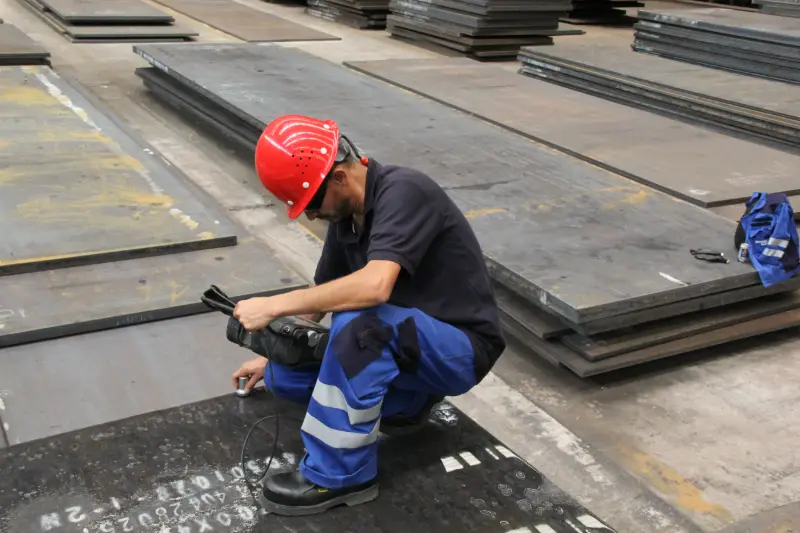
ASTM A709 Grade 50 Steel
ASTM A709 Grade 50 Steel Plate: High-Strength Low-Alloy for Bridge Engineering
Detailed material data for ASTM A709 Grade 50 (A709GR50) carbon and low-alloy high-strength structural steel plate used in bridge construction, covering chemical composition, mechanical and physical properties, international equivalents, and application guidance.
Welding, bolt connection, flame cutting, cold forming, hot forming (with appropriate preheating)
- Phone : +8618037372205
- Email : [email protected]
- WhatsApp: Contact via Whtsapp
- WeChat: +8618037372205
ASTM A709 Grade 50 Steel Introduction
ASTM A709 Grade 50 (A709GR50) is a carbon and low-alloy high-strength structural steel plate primarily intended for use in bridges. It provides a minimum yield strength of 345 MPa (50 ksi) and tensile strength of 450 MPa (65 ksi) in thicknesses up to 100 mm. Key features include excellent weldability, good notch toughness, and reliable atmospheric corrosion resistance when specified with copper content. The grade is supplied in various types (e.g., Type 1 to Type 4) to meet different toughness and chemical requirements, often with controlled carbon equivalent (CE) for enhanced weldability. It is commonly delivered in hot-rolled, normalized, or thermomechanically controlled processed (TMCP) conditions.
- Designed for primary bridge members like girders, trusses, and bearing plates
- Available in multiple impact test temperature classes (e.g., -20°C, -40°C)
- Equivalent to numerous international standards, ensuring global applicability
ASTM A709 Grade 50 Steel Chemical Composition
Typical requirements for ASTM A709 Grade 50 plate (Grade 50 [345]) as per ASTM A709/A709M. The chemical composition below reflects Type 1 (plain carbon-manganese) for general applications. Additional types (Type 2 with Cu, Type 3 with Nb/V, Type 4 with Al) are available for enhanced weather resistance or fine grain practice. All values are maximum unless a range is shown. Carbon equivalent (CE) is usually limited to 0.45% or less for good weldability.
| Element | Standard Value (max, %) | Remarks |
|---|---|---|
| Carbon (C) | 0.23 | Max. For plates over 20 mm, ≤0.23%; for ≤20 mm, ≤0.25% (agreed) |
| Manganese (Mn) | 1.35 | Max. For plates ≤20 mm, 0.80–1.35% may be specified |
| Phosphorus (P) | 0.04 | Max |
| Sulfur (S) | 0.05 | Max |
| Silicon (Si) | 0.40 | Max. May be specified as 0.15–0.40% for killed steel |
| Copper (Cu) (Type 2) | 0.20 min | Required when specified for improved atmospheric corrosion resistance |
| Niobium (Nb) / Vanadium (V) (Type 3) | 0.005–0.05 Nb, 0.01–0.15 V | Either or both may be added for strengthening |
| Aluminum (Al) (Type 4) | 0.02 min total Al or 0.015 min acid-soluble Al | Fine grain practice, optional |
| Nitrogen (N) | 0.015 | Max, unless sufficient nitride-forming elements present |
ASTM A709 Grade 50 Steel Thermal and Electrical Physical Properties
Typical physical properties for ASTM A709 Grade 50 carbon-manganese steel at room temperature (20°C) unless otherwise noted. These values are representative of standard structural steels and may vary slightly with exact composition and heat treatment. Thermal expansion coefficient is given for the 20–100°C range. Properties are useful for design calculations involving thermal loads, heat transfer, and welded connections.
| Property | Typical Value | Unit | Test Condition |
|---|---|---|---|
| Density (ρ) | 7.85 | g/cm³ | 20°C |
| Modulus of Elasticity (E) | 200–210 | GPa | Room temperature |
| Shear Modulus (G) | 79.3–81.0 | GPa | Calculated from E and Poisson's ratio |
| Poisson's Ratio (ν) | 0.29–0.30 | — | Elastic range |
| Thermal Expansion Coefficient (α) | 11.7 | ×10⁻⁶/K | 20–100°C; up to 200°C approx. 12.2 |
| Thermal Conductivity (λ) | 51.9 | W/(m·K) | 20°C; decreases with rising temperature |
| Specific Heat Capacity (cₚ) | 486 | J/(kg·K) | 20°C |
| Electrical Resistivity (ρₑ) | 0.20 | µΩ·m | 20°C; may increase slightly with alloying |
ASTM A709 Grade 50 Steel Mechanical Properties
Minimum tensile and yield properties for ASTM A709 Grade 50 (345) plates under standard condition. Values are based on specification for plates up to 100 mm thick. Impact test requirements are optional and depend on the designated temperature zone (e.g., Zone 1: 0°C, Zone 2: -20°C, Zone 3: -40°C). Elongation is measured on a 200 mm (8 in.) gauge length for plates. Bend test diameters are based on a 180° bend for plates up to 25 mm.
| Property | Standard Requirement | Unit | Test Condition |
|---|---|---|---|
| Yield Strength (ReH) | 345 min | MPa | t ≤ 100 mm; for t > 100 mm, 315 min |
| Tensile Strength (Rm) | 450 min | MPa | All thicknesses |
| Elongation (A200) | 18 min (thickness ≤20 mm) 21 min (thickness >20 mm to 50 mm) 18 min (thickness >50 mm) | % | Gauge length 200 mm |
| Bend Test (D = bend diameter, a = specimen thickness) | 180° bend, D = 1.5a (t ≤20 mm) 180° bend, D = 2.0a (t >20 mm to 50 mm) 180° bend, D = 2.5a (t >50 mm) | — | No cracks on outside of bent portion |
| Charpy V-Notch Impact (KV) (optional) | ≥ 27 J (minimum average) for Temperature Zone 2 ≥ 27 J (minimum average) for Temperature Zone 3 | J | At -20°C (Zone 2) or -40°C (Zone 3), full-size specimen, transverse |
ASTM A709 Grade 50 Steel Fully Equivalent Material Standards and Recommended Alternative Grades
| Country/Region | Standard | Grade | Remarks |
|---|---|---|---|
| USA | ASTM A572/A572M | Grade 50 | Same base chemistry and strength; lacks mandatory impact test for bridge service |
| European Union | EN 10025-2 | S355K2 / S355J2 | Impact toughness at -20°C (J2) or -40°C (K2); similar strength level |
| Japan | JIS G 3106 | SM490B / SM490C | Comparable tensile properties; B for 0°C impact, C for -20°C |
| China | GB/T 1591 | Q345D | 355 MPa yield class, impact at -20°C; tightly matching composition |
| International | ISO 630-2 | S355D | Structural steel with 355 MPa yield and good toughness |
ASTM A709 Grade 50 Steel Application Introduction
ASTM A709 Grade 50 is engineered for primary load-bearing members in bridges where high strength, good weldability, and reliable toughness are essential. It is suitable for both highway and railway bridges in moderate to cold climates when proper impact classes are specified. The material can be fabricated into built-up sections, box girders, and complex welded assemblies.
- Excellent formability and gas-cutting characteristics
- Widely accepted by national bridge design codes
- Available in as-rolled or TMCP condition for improved fabrication efficiency
- Can be galvanized or metallized for extended service life
Product Applications: Bridge girders (plate girders, box girders), Truss bridges (chords, diagonals, verticals), Stiffeners and diaphragm plates, Bridge bearing plates and base plates, Deck support beams, Crane runway beams, Structural columns in bridge towers
Processed into products: Bolted and welded built-up I-sections, Main girder web and flange plates, Cross-frame and lateral bracing members, Rocker and sliding bearings (mild steel component), Stay cable anchorage plates (when qualified), Temporary bridge structures and launching noses, Heavy shoring and falsework components
Application industries: Civil infrastructure and bridge construction, Heavy structural engineering, Railway and highway bridges, Overpasses and viaducts, Offshore platform deck structures (where approved)
ASTM A709 Grade 50 Steel Similar or Closely Related Substitute Materials
| Country/Region | Standard | Grade | Remarks |
|---|---|---|---|
| USA | ASTM A709 | Grade 50W | Weathering grade (Cor-Ten type) with Cu, Cr, Ni; same strength, superior corrosion resistance |
| USA | ASTM A572 | Grade 55 | Slightly higher yield strength (380 MPa) but comparable weldability and ductility |
| European Union | EN 10025-2 | S355J0 | Lower impact toughness (0°C) than S355J2; may be substituted if impact requirements are relaxed |
| Japan | JIS G 3106 | SM520B | 490 MPa tensile strength; higher strength variant for similar bridge applications |
| China | GB/T 714 | Q345qD | Bridge structural steel with 345 MPa yield, specifically designed for Chinese bridge standards |
Notes:
Supplementary Requirements: ASTM A709 allows numerous supplementary requirements (S-suffix) such as S2 for product analysis, S5 for Charpy impact, S18 for maximum carbon equivalent (often 0.45% or 0.47%), and S91 for through-thickness testing. These must be specified at order. Welding: Preheating and interpass temperatures should follow AWS D1.5 or equivalent bridge welding code. For thicknesses above 50 mm, a preheat of 100–150°C is typically recommended. Delivery Condition: The material may be ordered as rolled (AR), normalized (N), or TMCP (M), which affects toughness and flatness. Corrosion Protection: Grade 50 without copper requires protective coating; specify Type 2 if enhanced atmospheric resistance is desired. Dimensional tolerances comply with ASTM A6/A6M.
- Share



