
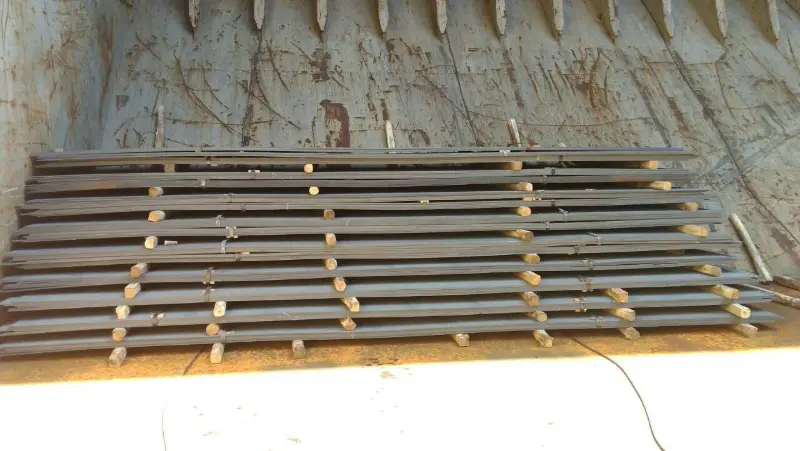
ASTM A709 Grade 50S High-Strength Bridge Steel Plate
ASTM A709 Grade 50S High-Strength Bridge Steel Plate
Expert analysis of ASTM A709 Grade 50S carbon and low-alloy high-strength steel plate: chemical composition, mechanical properties, physical performance, equivalent grades, and bridge engineering applications.
Hot rolling, as-rolled or normalized; can be further processed by welding, cutting, drilling, and forming.
- Phone : +8618037372205
- Email : [email protected]
- WhatsApp: Contact via Whtsapp
- WeChat: +8618037372205
ASTM A709 Grade 50S High-Strength Bridge Steel Plate Introduction
ASTM A709 Grade 50S is a carbon and low-alloy high-strength structural steel plate primarily intended for use in bridge construction. It is a standard grade under ASTM A709/A709M specification, which covers structural steels for bridges. The '50' designation indicates a minimum yield strength of 50 ksi (345 MPa), and the 'S' suffix signifies that it is specifically for structural bridge applications, imposing additional toughness and quality requirements beyond basic structural grades like A572. This steel is typically supplied in the as-rolled condition and offers excellent weldability, good formability, and reliable strength. It is widely used in highway and railway bridges, where high strength, atmospheric corrosion resistance (when specified), and fracture toughness are essential. Grade 50S provides a balanced combination of mechanical properties suitable for both primary and secondary bridge members.
ASTM A709 Grade 50S High-Strength Bridge Steel Plate Chemical Composition per ASTM A709 Grade 50S
The chemical composition limits below are for standard ASTM A709 Grade 50S steel plates, as defined in ASTM A709/A709M. These requirements ensure the proper balance of strength, weldability, and toughness. Maximum limits are given unless a range is specified. Copper may be specified when atmospheric corrosion resistance is not required via other alloys; otherwise it is residual. The steel is fully killed and fine-grained practice is typically employed. Microalloying elements like niobium or vanadium may be added at the manufacturer's discretion to meet strength requirements, but are not separately bounded in the main standard.
| Element | Standard Value (max %) | Remarks |
|---|---|---|
| Carbon (C) | 0.23 | Maximum for thickness ≤ 4 in (100 mm) |
| Manganese (Mn) | 1.35 | Maximum for thickness ≤ 1.5 in (40 mm); may be 1.50 for >1.5 to 2.5 in |
| Phosphorus (P) | 0.04 | Maximum |
| Sulfur (S) | 0.05 | Maximum |
| Silicon (Si) | 0.15-0.40 | Range for killed steel; maximum 0.40 if not killed |
| Copper (Cu) | 0.20 (optional) | Minimum if copper-bearing steel is specified (0.20 min); otherwise residual maximum 0.20 |
ASTM A709 Grade 50S High-Strength Bridge Steel Plate Thermal and Electrical Physical Properties
These physical properties are typical for carbon and low-alloy structural steels and are provided as general guidance. They are not mandatory ASTM requirements but are consistent with Grade 50S steel at room temperature unless otherwise noted. Actual values may vary slightly due to specific heat treatment and composition.
| Property | Typical Value | Unit | Test Condition |
|---|---|---|---|
| Density (ρ) | 7.85 | g/cm³ | At 20 °C |
| Elastic Modulus (E) | 200 | GPa | At 20 °C |
| Shear Modulus (G) | 80 | GPa | At 20 °C |
| Poisson's Ratio (ν) | 0.3 | — | At 20 °C |
| Thermal Expansion Coeff. (α) | 11.7 | 10⁻⁶/°C | 0–100 °C range |
| Thermal Conductivity (λ) | 51.9 | W/(m·K) | At 20 °C |
| Specific Heat | 486 | J/(kg·K) | At 20 °C |
| Electrical Resistivity (ρ_e) | 0.142 | µΩ·m | At 20 °C |
ASTM A709 Grade 50S High-Strength Bridge Steel Plate Mechanical Properties of ASTM A709 Grade 50S
The mechanical properties are as specified in ASTM A709/A709M for plates up to 4 in (100 mm) thickness. These values are minimum requirements unless otherwise noted. Notch toughness (Charpy V‑notch) is not mandatory but is often specified through supplementary requirements for bridge steels; the table includes a common Zone 2 requirement as an example. Elongation values depend on gauge length and specimen type. All properties are for the as‑rolled or normalized condition.
| Property | Standard Requirement | Unit | Test Condition |
|---|---|---|---|
| Yield Strength (ReH) | 50 min | ksi | Up to 4 in (100 mm) thickness |
| Yield Strength (ReH) | 345 min | MPa | Up to 4 in (100 mm) thickness |
| Tensile Strength (Rm) | 65 min | ksi | Up to 4 in (100 mm) thickness |
| Tensile Strength (Rm) | 450 min | MPa | Up to 4 in (100 mm) thickness |
| Elongation (A) | 21 min | % | In 8 in (200 mm) gauge length |
| Elongation (A) | 18 min | % | In 2 in (50 mm) gauge length |
| Charpy Impact (KV2) | 15 min (average) | ft·lbf | At 40 °F (4 °C), Zone 2, transverse, if specified per Suppl. S5 (typical) |
| Charpy Impact (KV2) | 20 min (average) | J | At 40 °F (4 °C), Zone 2, transverse, if specified (typical) |
ASTM A709 Grade 50S High-Strength Bridge Steel Plate Internationally Equivalent Standards and Replaceable Grades
| Country/Region | Standard | Grade | Remarks |
|---|---|---|---|
| Europe | EN 10025-2 | S355J0 | Comparable yield (355 MPa), requires impact at 0 °C; not identical bridge toughness. |
| Europe | EN 10025-3 | S355N | Normalized structural steel with improved toughness; suitable for bridges. |
| Japan | JIS G3106 | SM490A | Yield 325 MPa for plates > 16–40 mm; widely used in bridge construction. |
| International | ISO 630-2 | S355N | Normalized fine-grain structural steel; close match to A709-50S. |
| Australia/NZ | AS/NZS 3678 | 300L15 | Yield 300 MPa; L15 impact at 0 °C; composition similar but strength slightly lower. |
ASTM A709 Grade 50S High-Strength Bridge Steel Plate Application Introduction
ASTM A709 Grade 50S is specifically designed for use in bridge construction and other demanding structural applications. Its high strength and good weldability make it a preferred choice for both permanent and temporary structures. The steel can be fabricated into a wide variety of components using standard workshop methods. Typical applications and products include:
Product Applications: Steel plates for bridge girders and box girders, Structural shapes like W, HP, S, and channel sections, Sheet piling for temporary or permanent retaining walls, Bars and plates for stiffeners and diaphragms
Processed into products: Main bridge girders (I-beams, plate girders), Cross frames and lateral bracing, Bearing plates and stiffeners, Pile caps and pier caps, Orthotropic deck plates, Crane runway beams in industrial plants, Heavy equipment chassis and support structures
Application industries: Bridge engineering (highway, railway, pedestrian), Heavy civil infrastructure, Structural steel fabrication, Offshore structures (supplementary requirements), Mining and material handling (crane beams, tipper frames)
ASTM A709 Grade 50S High-Strength Bridge Steel Plate Similar Material Grades for Comparison
| Country/Region | Standard | Grade | Remarks |
|---|---|---|---|
| USA | ASTM A572/A572M | Grade 50 [345] | Same general chemistry & strength; not specifically bridge-toughness rated without supplementary Charpy. |
| USA | ASTM A992/A992M | Grade 50 | Used for structural shapes; yield 50 ksi, max yield/tensile ratio controlled; not a plate standard. |
| China | GB/T 1591 | Q345D | Yield 345 MPa, impact at -20 °C; widely used in Chinese bridges, similar strength. |
| Europe | EN 10025-4 | S355M/ML | Thermomechanical rolled; comparable strength but different delivery condition. |
| Japan | JIS G3106 | SM490B | Yield 325 MPa; mandatory Charpy at 0 °C; often substituted in bridge maintenance. |
Notes:
When ordering ASTM A709 Grade 50S, it is essential to specify any supplementary requirements for notch toughness (e.g., Zone 1, 2, or 3 with corresponding test temperatures), atmospheric corrosion resistance (if copper content is to be controlled), and whether normalizing is required. For welded bridge fabrication, low-hydrogen welding practices are recommended to avoid hydrogen-induced cracking. The material is generally weldable by all common methods (SMAW, SAW, FCAW) using appropriate low-hydrogen electrodes and preheat/interpass temperature control as per AWS D1.5 or manufacturer recommendations. Note that for thicknesses over 1.5 in (38 mm), manganese limits may be relaxed to 1.50%, and mechanical properties are guaranteed up to 4 in (100 mm) thickness.
- Share



