
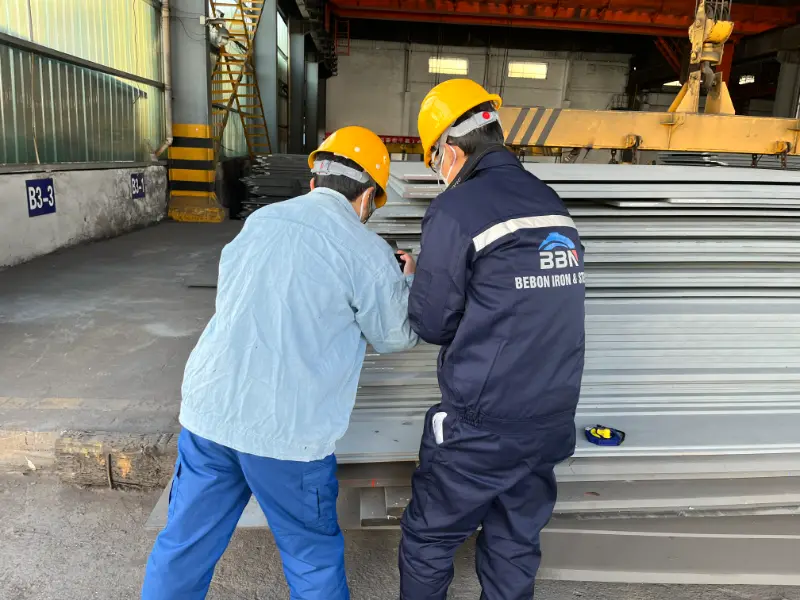
ASTM A572 Grade 42 (A572GR42) Carbon Steel Plate
ASTM A572 Grade 42 (A572GR42) Carbon Steel Plate - Properties, Data & Equivalents
Comprehensive material data for ASTM A572 Grade 42 high-strength low-alloy structural steel plate: chemical composition, mechanical & physical properties, thermal & electrical performance, international equivalents, and detailed application guide.
Hot rolling, normalizing, cold forming, machining, welding (preheating recommended for thick sections)
- Phone : +8618037372205
- Email : [email protected]
- WhatsApp: Contact via Whtsapp
- WeChat: +8618037372205
ASTM A572 Grade 42 Carbon Steel Plate Introduction
ASTM A572 Grade 42 is a high-strength low-alloy (HSLA) niobium-vanadium structural steel plate specified under ASTM A572/A572M. It provides a minimum yield strength of 42 ksi (290 MPa) and improved corrosion resistance compared to standard carbon steels, with excellent weldability and formability. This grade is widely used in welded structures—bridges, building frames, construction machinery, and transportation equipment—where weight reduction and structural integrity are crucial. Its fine-grain microstructure, achieved by microalloying elements, ensures consistent toughness and strength across thicknesses.
ASTM A572 Grade 42 Carbon Steel Plate Chemical Composition
The chemical composition of ASTM A572 Grade 42 is carefully controlled to balance strength, toughness, and weldability. Carbon is kept low (≤0.21%) to maintain weldability and formability. Manganese (≤1.35%) refines microstructure and contributes to strength. Microalloying elements (niobium, vanadium) may be added to achieve fine grain size and precipitation strengthening, but no minimums are specified for Grade 42. When copper is required, a minimum of 0.20% Cu provides enhanced atmospheric corrosion resistance.
| Element | Standard Value (max, %) | Remarks |
|---|---|---|
| C | 0.21 | Maximum allowed |
| Mn | 1.35 | Maximum for shapes group 1 (plates, bars) |
| P | 0.04 | Maximum |
| S | 0.05 | Maximum |
| Si | 0.40 | Maximum; can be exceeded under certain conditions per standard |
| Cu (when specified) | 0.20 min | Required only if copper-bearing steel is ordered |
ASTM A572 Grade 42 Carbon Steel Plate Thermal & Electrical Physical Properties
These physical properties are typical for high‑strength low‑alloy carbon steels and are suitable for design calculations. Actual values may vary slightly depending on exact composition and processing history. Density is used for weight estimations; modulus of elasticity and shear modulus are essential for structural analysis. Thermal expansion influences fit‑up and temperature‑induced stress, while thermal conductivity affect welding and heat‑transfer calculations. Electrical resistivity is provided for general reference.
| Property | Typical Value | Unit | Test Condition / Remarks |
|---|---|---|---|
| Density (ρ) | 7.85 | g/cm³ | At 20 °C |
| Modulus of Elasticity (E) | 200 | GPa | At 20 °C, tension |
| Shear Modulus (G) | 80 | GPa | Derived from E and ν |
| Poisson's Ratio (ν) | 0.3 | - | In the elastic range |
| Thermal Expansion Coefficient (α) | 12.0 × 10⁻⁶ | 1/°C | Mean value between 20 °C and 100 °C |
| Thermal Conductivity (λ) | 50 | W/(m·K) | At 20 °C |
| Specific Heat Capacity | 0.46 | J/(g·°C) | At 20 °C |
| Electrical Resistivity (ρ_e) | 0.15 × 10⁻⁶ | Ω·m | At 20 °C, typical for carbon steel |
ASTM A572 Grade 42 Carbon Steel Plate Mechanical Properties
Mechanical properties of ASTM A572 Grade 42 are determined in accordance with ASTM A6/A6M requirements. The steel exhibits a minimum yield strength of 290 MPa (42 ksi) and minimum tensile strength of 415 MPa (60 ksi). Elongation values are thickness-dependent and measured on an 8 in. (200 mm) gauge length. A bend test is used to evaluate ductility. Charpy V‑notch impact testing is not mandatory but can be ordered as a supplementary requirement (e.g., CVN at specific temperatures). All values are for the as‑rolled or normalized condition.
| Property | Specified Value | Unit | Test Condition / Remarks |
|---|---|---|---|
| Yield Strength (ReH) | 290 min | MPa (ksi) | For all thicknesses; 42 ksi min |
| Tensile Strength (Rm) | 415 min | MPa (ksi) | For all thicknesses; 60 ksi min |
| Elongation in 200 mm (8 in.), t ≤ 19.1 mm | 22 min | % | Thickness ≤ 0.75 in |
| Elongation in 200 mm (8 in.), 19.1 < t ≤ 38.1 mm | 20 min | % | 0.75 in < thickness ≤ 1.5 in |
| Elongation in 200 mm (8 in.), 38.1 < t ≤ 63.5 mm | 18 min | % | 1.5 in < thickness ≤ 2.5 in |
| Elongation in 200 mm (8 in.), 63.5 < t ≤ 102 mm | 17 min | % | 2.5 in < thickness ≤ 4 in |
| Bend Test (bend diameter) | 1 t | - | Thickness t ≤ 19 mm (0.75 in) |
| Bend Test (bend diameter) | 1.5 t | - | 19 mm < t ≤ 25 mm (0.75–1 in) |
| Bend Test (bend diameter) | 2 t | - | 25 mm < t ≤ 38 mm (1–1.5 in) |
| Bend Test (bend diameter) | 2.5 t | - | 38 mm < t ≤ 51 mm (1.5–2 in) |
| Bend Test (bend diameter) | 3 t | - | t > 51 mm (2 in) |
ASTM A572 Grade 42 Carbon Steel Plate Fully Equivalent Material Standards & Substitute Grades
| Country / Region | Standard | Grade | Remarks |
|---|---|---|---|
| USA | ASTM A572/A572M | Grade 42 | The original specification material |
| USA | ASTM A709/A709M | Grade 36 (≤305 mm) | A709 Gr.36 (yield 250 MPa) is lower strength; Gr.36T (290 MPa) may be used for bridges, closely matches A572 Gr.42 |
| International | ISO 4950‑1 | YS290 | Closest ISO yield strength designation; composition may differ slightly |
| Europe | EN 10025‑2 | S275JR / S275J0 | Yield 275 MPa (≈ 40 ksi), slightly lower; suitable substitution with strength check |
| Japan | JIS G3101 | SS490 | Yield 285 MPa (nominal), close match; verify test acceptance criteria |
| China | GB/T 1591‑2018 | Q345B | Yield 345 MPa, higher strength; equivalent to A572 Gr.50, over‑matches Gr.42 |
| Russia | GOST R 52927‑2008 | C255 (S255) | Yield 245‑255 MPa; lower strength, suitable for less critical parts |
ASTM A572 Grade 42 Carbon Steel Plate Application Introduction
ASTM A572 Grade 42 is designed for structural applications where moderate strength, good weldability, and lighter weight than plain carbon steels are needed. Typical industries and products include:
Product Applications: Welded bridge beams and box girders, Multi‑storey building frames and columns, Transmission line towers and poles, Excavator and loader arms, crane booms, Heavy‑duty truck chassis rails and cross members, Railway wagon underframes and bogies, Sheet piles (in conjunction with cold forming)
Processed into products: Base plates, stiffeners, gusset plates, Welded structural hollow sections, Bolted or riveted connections (angles, shear tabs), Bending‑resistant components like outriggers, Machined supports and mounting brackets
Application industries: Construction & Civil Engineering, Bridge & Infrastructure, Heavy Machinery Manufacturing, Transportation & Automotive (trailers, rail cars), Energy & Transmission Towers, Shipbuilding (secondary structures)
ASTM A572 Grade 42 Carbon Steel Plate Similar / Alternative Structural Steels
| Country / Region | Standard | Grade | Remarks |
|---|---|---|---|
| USA | ASTM A572/A572M | Grade 45 / 50 / 55 | Higher yield strengths (45 ksi, 50 ksi, 55 ksi). Grade 50 is the most common substitute for Grade 42 in heavier sections. |
| USA | ASTM A36/A36M | Grade 36 | Yield 250 MPa (36 ksi). Lower strength, widely used carbon structural steel; economical substitute if higher strength not required. |
| USA | ASTM A992/A992M | Grade 50 | Yield 345‑450 MPa. Used mainly for wide‑flange shapes; superior to Grade 42 in strength. |
| Europe | EN 10025‑2 | S355JR / S355J2 | Yield 355 MPa. Hot‑rolled structural steel with higher strength and good weldability, suitable upgrade. |
| Europe | EN 10025‑4 | S275M / S275ML | Thermomechanically rolled. Yield 275 MPa, improved toughness; can replace Grade 42 with thickness reduction consideration. |
| China | GB/T 1591‑2018 | Q345C / Q345D | Higher strength, better low‑temperature toughness options for bridges and offshore structures. |
Notes:
ASTM A572 Grade 42 plates can be supplied with optional Charpy V‑notch impact requirements (e.g., CVN 20 ft‑lb at 0 °F/−18 °C) per supplementary specification S5. For copper‑bearing grades (>0.20 %Cu), the material offers twice the atmospheric corrosion resistance of plain carbon steel. Welding precautions: Preheating is typically not required for plates up to 25 mm thickness; for thicker sections, a minimum preheat of 50–100 °C is suggested for low‑hydrogen processes. The steel is compatible with all common arc welding methods (SMAW, GMAW, FCAW, SAW).
- Share



