
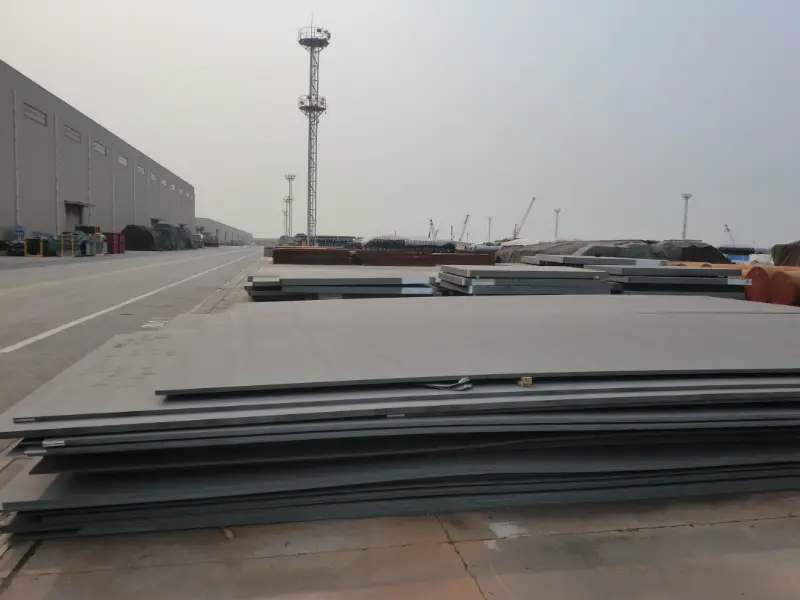
ASTM A572 Grade 50 Carbon Steel Plate
ASTM A572 Grade 50 HSLA Steel Plate: Composition, Properties & Equivalents
Complete material data for ASTM A572 Grade 50 carbon steel plate: chemical composition, mechanical and thermal properties, international equivalents, and application guidelines.
Hot rolling, controlled rolling, normalizing, thermo-mechanical controlled processing (TMCP)
- Phone : +8618037372205
- Email : [email protected]
- WhatsApp: Contact via Whtsapp
- WeChat: +8618037372205
ASTM A572 Grade 50 Carbon Steel Plate Introduction
ASTM A572 Grade 50 is a high-strength low-alloy (HSLA) structural steel plate specified under ASTM A572/A572M. It offers a minimum yield strength of 50 ksi (345 MPa) and improved weldability and notch toughness compared to plain carbon steels. This grade is widely used in structural applications such as buildings, bridges, and machinery due to its excellent strength-to-weight ratio and good formability.
Key features include:
- High strength with good ductility
- Excellent weldability using conventional methods
- Available in various delivery conditions (hot-rolled, normalized, controlled-rolled)
- Often microalloyed with niobium or vanadium for grain refinement
ASTM A572 Grade 50 Carbon Steel Plate Chemical Composition
Typical chemical composition limits according to ASTM A572/A572M for Grade 50 plates up to 4 in. (100 mm) thickness. The steel is fully killed and fine-grained, often microalloyed with niobium, vanadium, or titanium to achieve mechanical properties. Silicon and aluminum are used for deoxidation.
| Chemical Element | Required Value (max, unless range) | Remarks |
|---|---|---|
| Carbon (C) | 0.23% | For plates ≤4 in. (100 mm) |
| Manganese (Mn) | 1.35% | May be 1.50% for plates ≤1.5 in. |
| Phosphorus (P) | 0.04% | Maximum |
| Sulfur (S) | 0.05% | Maximum |
| Silicon (Si) | 0.15 – 0.40% | For killed steel; optional if not specified |
| Columbium (Niobium, Nb) | Optional; typically 0.005 – 0.05% | Used for grain refinement and strengthening |
| Vanadium (V) | Optional; typically 0.01 – 0.15% | May be added alone or in combination |
| Titanium (Ti) | Optional; typically 0.005 – 0.05% | May be added |
| Nitrogen (N) | 0.015% (max) | Typical limit for fine-grain practice |
| Copper (Cu) (when specified) | 0.20% min if required | For atmospheric corrosion resistance, by agreement |
ASTM A572 Grade 50 Carbon Steel Plate Thermal and Electrical Physical Properties
Properties are for carbon and low-alloy steels at room temperature unless otherwise noted. Actual values may vary slightly with composition and heat treatment. Data are representative for ASTM A572 Grade 50.
| Property | Typical Value | Unit | Test Condition / Remarks |
|---|---|---|---|
| Density (ρ) | 7.85 | g/cm³ | At 20°C (68°F) |
| Modulus of Elasticity (E) | 200 | GPa | At 20°C |
| Shear Modulus (G) | 80 | GPa | At 20°C, calculated |
| Poisson's Ratio (ν) | 0.30 | — | At 20°C |
| Coefficient of Thermal Expansion (α) | 11.7 | µm/m·°C (×10⁻⁶/°C) | Between 20–100°C (68–212°F) |
| Coefficient of Thermal Expansion (α) | 12.5 | µm/m·°C (×10⁻⁶/°C) | Between 20–200°C (68–392°F) |
| Coefficient of Thermal Expansion (α) | 13.5 | µm/m·°C (×10⁻⁶/°C) | Between 20–400°C (68–752°F) |
| Thermal Conductivity (λ) | 51.9 | W/m·K | At 20°C |
| Specific Heat Capacity (c) | 486 | J/kg·K | At 20°C |
| Electrical Resistivity (ρₑ) | 0.15 – 0.25 | µΩ·m | At 20°C, typical for carbon steel |
ASTM A572 Grade 50 Carbon Steel Plate Mechanical Properties
Properties are for A572 Grade 50 plates in as-rolled or normalized condition, tested at room temperature. Elongation values depend on specimen gauge length and plate thickness. Bending test parameters are per ASTM A6/A6M. Impact test results apply only when supplementary requirements (such as Charpy V-notch) are specified.
| Property | Required Value | Unit | Test Condition / Remarks |
|---|---|---|---|
| Yield Strength (ReH) | ≥ 50 (345) | ksi (MPa) | For plates ≤4 in. (100 mm) |
| Tensile Strength (Rm) | ≥ 65 (450) | ksi (MPa) | All thicknesses |
| Elongation (A) in 8 in. (200 mm) | ≥ 18% | % | Plates ≤3/4 in. (20 mm) |
| Elongation (A) in 8 in. (200 mm) | ≥ 18% | % | Plates >3/4 to 1.5 in. (20–40 mm) |
| Elongation (A) in 2 in. (50 mm) | ≥ 21% | % | Plates ≤3/4 in. (20 mm); alternative gauge |
| Elongation (A) in 2 in. (50 mm) | ≥ 21% | % | Plates >3/4 to 1.5 in. (20–40 mm) |
| Elongation (A) in 2 in. (50 mm) | ≥ 21% | % | Plates >1.5 to 4 in. (40–100 mm) |
| Bend Test (180°), ratio d=t (d: diameter, t: thickness) | d = 1.5t | — | Plates ≤3/4 in. (20 mm) |
| Bend Test (180°) | d = 2.0t | — | Plates >3/4 to 1 in. (20–25 mm) |
| Bend Test (180°) | d = 2.5t | — | Plates >1 to 1.5 in. (25–40 mm) |
| Bend Test (180°) | d = 3.0t | — | Plates >1.5 to 2 in. (40–50 mm) |
| Bend Test (180°) | d = 3.5t | — | Plates >2 to 4 in. (50–100 mm) |
| Charpy V-Notch (when specified) | Typically ≥20 ft·lbf (27 J) at 0°F (-18°C) | ft·lbf (J) | Dependent on supplementary requirement; Grade 50S or 50W may have different values |
ASTM A572 Grade 50 Carbon Steel Plate Exact Equivalent Materials and Substitutable Grades
| Country / Region | Standard | Grade | Remarks |
|---|---|---|---|
| Europe | EN 10025-2 | S355JR, S355J0, S355J2 | Mechanical and chemical equivalents; impact requirements differ (J0: 0°C, J2: -20°C) |
| International | ISO 630-2 | Fe 510 (S355) | Comparable strength level |
| China | GB/T 1591 | Q345B, Q345C, Q345D | Equivalent yield strength; Q345C/D for improved low-temperature toughness |
| Japan | JIS G 3106 | SM490A, SM490B, SM490C | Similar strength; SM490B/C for higher toughness |
| India | IS 2062 | E350 (Fe 490) | Grade E350 BR/C are closest matches |
| Russia | GOST 19281 | 17G1S (17Г1С) | Common high-strength structural steel |
| Australia / New Zealand | AS/NZS 3678 | G350 | Comparable yield strength; chemical limits differ slightly |
| Brazil | NBR 7007 | MR-250 | Strength equivalent; chemical requirements may vary |
ASTM A572 Grade 50 Carbon Steel Plate Application Introduction
ASTM A572 Grade 50 is a versatile structural steel used extensively in construction, heavy equipment, and transportation. Its high strength allows for lighter structures, reduced material costs, and improved payload capacity. The steel exhibits good weldability with common processes (SMAW, GMAW, FCAW, SAW), provided proper preheat and interpass temperatures are maintained for thicker sections.
- Commonly used in welded, bolted, and riveted structures
- Suitable for hot-dip galvanizing
- Can be cold formed with adequate radii to prevent cracking
- A572 Gr 50 can be supplied with improved atmospheric corrosion resistance when a minimum copper content (0.20%) is specified
Product Applications: Structural beams, columns, and girders, Bridge deck plates and bridge bearing assemblies, Offshore platform topsides and jackets, Dump truck bodies, excavator arms, and loader buckets, Railway wagon frames and bogie components, Telescopic boom sections for mobile cranes, Wind turbine tower sections and flanges, Guardrail posts and highway sign structures, Storage tanks (above ground)
Processed into products: Flanges and webs for built-up girders, End plates and splice plates, Heavy-duty brackets and mounting plates, Gusset plates and stiffeners, Cutouts and welded assemblies in pressure vessels (non-pressure parts), Wheel rims and rim bases for heavy vehicles, Crane rail beams and runway girders, Pile points and connectors for foundation piles, Load-bearing frames for industrial machinery
Application industries: Building and construction, Bridge engineering, Offshore and marine structures, Mining and earth-moving equipment, Transportation (railway cars, truck trailers), Crane and lifting equipment, Power transmission and telecommunications towers, Agricultural machinery, Shipbuilding (limited, non-primary structure)
ASTM A572 Grade 50 Carbon Steel Plate Similar / Comparable Material Recommendations
| Country / Region | Standard | Grade | Remarks |
|---|---|---|---|
| United States | ASTM A572 | Grade 42, Grade 55, Grade 60, Grade 65 | Lower or higher strength grades within the same standard; careful weldability and formability adjustments |
| United States | ASTM A36 | A36 | Lower yield strength (36 ksi); slightly different chemical limits; often used where strength of Grade 50 is not required |
| United States | ASTM A572 | Grade 50S (with supplementary requirements) | Improved notch toughness (Charpy V-notch) and/or fine-grain practice |
| United States | ASTM A588 | Grade A, Grade B | Weathering steel with comparable strength; provides atmospheric corrosion resistance |
| United States | ASTM A709 | Grade 50, Grade 50S, Grade 50W | Structural steel for bridges; similar base properties with additional toughness or weathering requirements |
| Europe | EN 10025-3 | S355N/NL | Normalized/normalized rolled fine-grain steel with improved toughness |
| China | GB/T 1591 | Q345E, Q345q (bridge steel) | For low-temperature or bridge applications |
Notes:
- For thicknesses above 4 in. (100 mm), consult ASTM A572 for slightly modified chemical requirements (C max 0.25, Mn 0.85–1.20).
- Supplementary requirements (e.g., S5 – Charpy V-notch impact test, S18 – maximum carbon equivalent) can be specified to tailor the material for critical applications.
- Typical carbon equivalent (CE) values range from 0.38 to 0.43, providing good weldability.
- Preheating may be necessary for thicknesses above 1.5 in. (40 mm) or when welding under high restraint.
- Contact the manufacturer for exact microalloying practice, as it can affect mechanical properties and welding parameters.
- Share



