
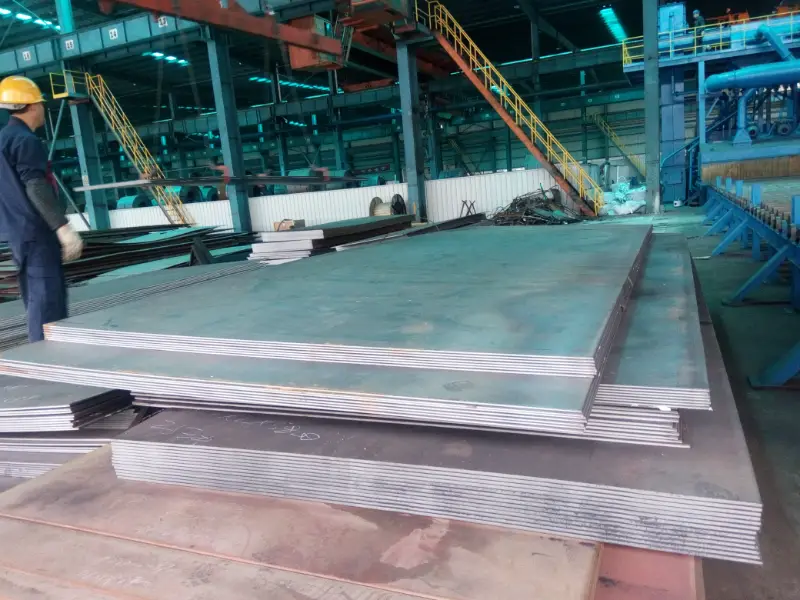
ASTM A572 Grade 55 Steel Plate
ASTM A572 Grade 55 Steel Plate: High-Strength Low-Alloy Structural Material Data
Complete datasheet for ASTM A572 Grade 55 carbon steel including composition, mechanical properties, thermal and electrical properties, international equivalents, and application guide.
Hot rolling, controlled rolling, normalizing, normalizing rolling, thermomechanical controlled processing (TMCP)
- Phone : +8618037372205
- Email : [email protected]
- WhatsApp: Contact via Whtsapp
- WeChat: +8618037372205
ASTM A572 Grade 55 Steel Plate Introduction
ASTM A572 Grade 55 is a high-strength low-alloy (HSLA) structural steel specified in ASTM A572/A572M. It delivers a minimum yield strength of 55 ksi (380 MPa) and is designed for structural applications where higher strength permits weight reduction. The grade is characterized by
- excellent weldability and formability
- good notch toughness at low temperatures
- microalloying with Nb, V, or Ti to achieve the required mechanical properties
Typically supplied in as-rolled or normalized condition, it is suitable for bolted, riveted, and welded construction. Compared to plain carbon steels such as A36, Grade 55 offers a superior strength-to-weight ratio, enabling lighter and more economical structural designs without sacrificing performance.
ASTM A572 Grade 55 Steel Plate Chemical Composition
The following limits are taken from ASTM A572/A572M for Grade 55. The steel may contain small amounts of niobium (columbium), vanadium, or titanium to meet the required mechanical properties, but these elements are not mandatorily specified by the standard and are added at the producer's discretion.
| Element | Standard Value (max, unless range) | Remarks |
|---|---|---|
| Carbon, C | 0.25 | For plates and shapes ≤ 40 mm (1.5 in.) |
| Manganese, Mn | 1.35 | For plates ≤ 40 mm (1.5 in.); for shapes all thicknesses |
| Phosphorus, P | 0.04 | |
| Sulfur, S | 0.05 | |
| Silicon, Si | 0.40 | For killed steel; may be higher in some structural shapes |
ASTM A572 Grade 55 Steel Plate Thermal and Electrical Physical Properties
The values listed are typical for carbon-manganese low-alloy structural steels at room temperature unless otherwise noted. They are not specified in ASTM A572/A572M but are useful for design calculations and thermal analyses. Slight variations may occur depending on the actual heat chemistry and processing.
| Property | Standard Value | Unit | Test Condition |
|---|---|---|---|
| Density, ρ | 7.85 | g/cm³ | Ambient temperature |
| Modulus of elasticity, E | 200 | GPa | Ambient temperature |
| Shear modulus, G | 80 | GPa | Ambient temperature |
| Poisson's ratio, ν | 0.3 | – | Ambient temperature |
| Coefficient of thermal expansion, α | 11.7 | ×10⁻⁶/°C | 20°C to 100°C |
| Thermal conductivity, λ | 51.9 | W/(m·K) | At 100°C |
| Specific heat capacity, c | 486 | J/(kg·K) | Ambient temperature |
| Electrical resistivity, ρ_e | 0.16 | µΩ·m | At 20°C |
ASTM A572 Grade 55 Steel Plate Mechanical Properties
Tensile requirements apply to plates, shapes, and bars in accordance with ASTM A572/A572M. Elongation is measured on standard test specimens according to ASTM A370. Bend test is optional and usually agreed upon at the time of order.
| Property | Standard Value | Unit | Test Condition |
|---|---|---|---|
| Yield Strength, ReH | 55 (380) | ksi (MPa) | For thicknesses up to 100 mm (4 in.) |
| Tensile Strength, Rm | 70 – 90 (485 – 620) | ksi (MPa) | All thicknesses |
| Elongation A, 200 mm (8 in.) gauge | 17 min | % | Thickness ≤ 20 mm (¾ in.), longitudinal |
| Elongation A, 200 mm (8 in.) gauge | 16 min | % | Thickness > 20 to 40 mm (¾ to 1½ in.) |
| Elongation A, 50 mm (2 in.) gauge | 21 min | % | Thickness ≤ 20 mm (¾ in.) |
| Elongation A, 50 mm (2 in.) gauge | 20 min | % | Thickness > 20 to 40 mm (¾ to 1½ in.) |
| Elongation A, 50 mm (2 in.) gauge | 18 min | % | Thickness > 40 to 100 mm (1½ to 4 in.) |
| Bend Test | As specified in ASTM A6/A6M | – | When required by purchase order |
ASTM A572 Grade 55 Steel Plate Fully Equivalent Material Standards and Replaceable Grades
| Country / Region | Standard | Grade | Remarks |
|---|---|---|---|
| USA | ASTM A529/A529M | Grade 55 | Same minimum yield (55 ksi) and tensile range; carbon and manganese limits differ (C max 0.27, Mn max 1.20) |
ASTM A572 Grade 55 Steel Plate Application Introduction
ASTM A572 Grade 55 excels in structural applications where high strength allows for reduced section sizes and overall weight. It can be welded by standard processes (SMAW, GMAW, SAW) with low-hydrogen practices, and it exhibits good machinability. Typical uses span heavy civil construction, transportation equipment, and industrial machinery. Careful consideration of preheating and interpass temperature is recommended for thicker sections to avoid cold cracking.
Product Applications: Structural beams (I, H, wide flange), Bridge girders and deck plates, Truck chassis, frames, and reinforcement members, Crane booms and lattice towers, Heavy-duty floor and deck plates, Steel piling and sheet piling, Transmission tower legs and cross-arms
Processed into products: Hot-rolled I-beams and H-beams, Channels and angles for bracing, Cut and welded gusset plates, stiffeners, and splice plates, Welded built-up box sections, Bolted and riveted structural connections, Excavator buckets, blades, and ripper shanks, Machine frames and support pedestals
Application industries: Building and construction, Bridge engineering, Heavy equipment and machinery, Automotive and truck manufacturing, Shipbuilding and marine structures, Transmission towers and communication poles, Mining and earthmoving equipment
ASTM A572 Grade 55 Steel Plate Materials with Comparable Mechanical Properties
| Country / Region | Standard | Grade | Remarks |
|---|---|---|---|
| USA | ASTM A572/A572M | Grade 50 | Lower yield strength (50 ksi / 345 MPa); similar weldability and widely used |
| China | GB/T 1591 | Q390C/D/E | Min. yield 390 MPa; HSLA structural steel with comparable carbon equivalent |
| European | EN 10025-2 | S355J2+N | Yield 355 MPa; widely used structural steel, slightly lower strength |
| European | EN 10025-3 | S420N/NL | Yield 420 MPa; normalized fine-grain steel with improved toughness |
| Japan | JIS G3106 | SM490A/B/C | Yield 325–365 MPa; common structural steel for welded structures |
| International | ISO 630-2 | S355 | Yield 355 MPa; general-purpose structural steel |
Notes:
Supplementary requirements such as Charpy V-notch impact testing (e.g., at -20°C or -40°C), ultrasonic examination, or fine-grain practice may be added to the purchase order. The material is typically delivered in the as-rolled condition; controlled rolling, normalizing, or TMCP can be specified for enhanced toughness. Surface quality, flatness, and edge condition should conform to ASTM A6/A6M. For improved atmospheric corrosion resistance, consider high-strength weathering steels like ASTM A588 or A709 Grade 50W. Welding: Preheat and low-hydrogen consumables are advised for sections over 25 mm to mitigate hydrogen-induced cracking. Machining: Reduced cutting speeds and carbide tooling are recommended due to the higher strength of the material compared to mild steel.
- Share



