
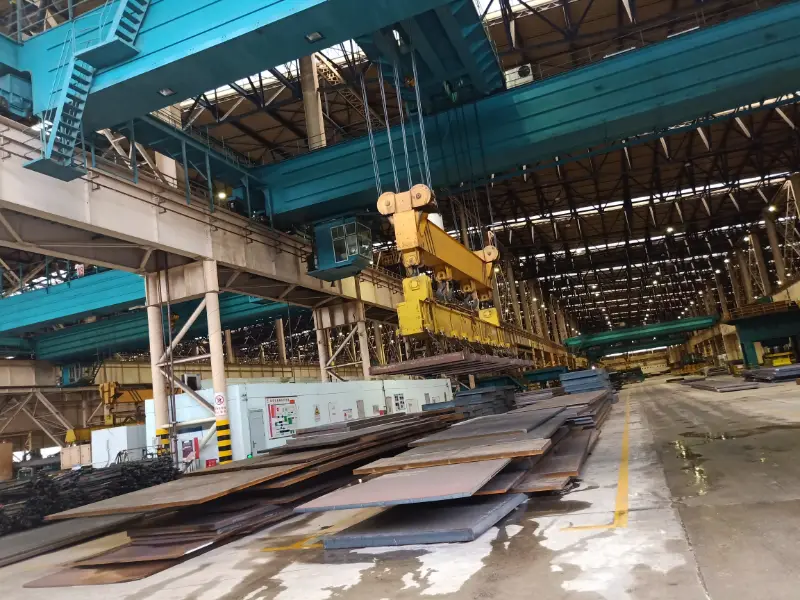
ASTM A572 Grade 60 (A572GR60) High-Strength Low-Alloy Carbon Steel Plate
ASTM A572 Grade 60 (A572GR60) High-Strength Low-Alloy Carbon Steel Plate for Structural Applications
Comprehensive material data sheet and engineering properties of ASTM A572 Grade 60 carbon steel plate for structural fabrication.
As-rolled, normalized, quenched and tempered (optional), stress-relieved, cut to shape, welded fabrication
- Phone : +8618037372205
- Email : [email protected]
- WhatsApp: Contact via Whtsapp
- WeChat: +8618037372205
ASTM A572 Grade 60 High-Strength Low-Alloy Carbon Steel Plate Introduction
ASTM A572 Grade 60 (A572GR60) is a high-strength low-alloy (HSLA) structural carbon steel plate specified by ASTM International. It is designed for construction and engineering applications requiring a minimum yield strength of 60 ksi (415 MPa). This grade offers an excellent balance of strength, weldability, and notch toughness, making it suitable for welded bridges, buildings, and heavy machinery. Typical delivery condition is as-rolled, but normalized or quenched and tempered treatments may be applied. The steel is produced to a fine-grain practice and may contain microalloying elements such as columbium (niobium), vanadium, or titanium to enhance mechanical properties without significantly increasing carbon content. Compared to standard carbon steels, A572GR60 provides higher strength-to-weight ratios, enabling lighter structural designs while maintaining good formability and ductility.
ASTM A572 Grade 60 High-Strength Low-Alloy Carbon Steel Plate Chemical Composition
The chemical requirements for ASTM A572 Grade 60 are defined in ASTM A572/A572M Table 1. The steel is produced to a coarse-grain melting practice and may include microalloying elements to achieve the required mechanical properties. Below are the maximum allowable limits for heat analysis; product analysis limits may differ slightly.
| Chemical Element | Standard Value (Max % unless noted) | Remarks |
|---|---|---|
| Carbon (C) | 0.26 | Applicable to plates and bars up to 4 in. (100 mm) thickness |
| Manganese (Mn) | 1.35 | If carbon content is ≤0.20%, Mn up to 1.60% may be allowed by agreement |
| Phosphorus (P) | 0.040 | Maximum for all products |
| Sulfur (S) | 0.050 | Maximum for all products |
| Silicon (Si) | 0.40 | When required; may not be specified for plates intended for painted structures |
ASTM A572 Grade 60 High-Strength Low-Alloy Carbon Steel Plate Thermal and Electrical Physical Properties
The values below are typical for low-carbon and microalloyed structural carbon steels such as ASTM A572 Grade 60. These properties are not part of the ASTM specification but are widely accepted for engineering calculations. Variations may occur with temperature and exact heat composition.
| Property | Typical Value | Unit | Test Condition / Remarks |
|---|---|---|---|
| Density (ρ) | 7850 | kg/m³ | At room temperature |
| Elastic Modulus (E) | 200 | GPa | Tension, room temperature |
| Shear Modulus (G) | 80 | GPa | Calculated from E and ν |
| Poisson's Ratio (ν) | 0.30 | - | Within elastic range |
| Thermal Expansion Coeff. (α) | 12.0 | ×10⁻⁶/K | 20–100°C range |
| Thermal Conductivity (λ) | 50 | W/(m·K) | At 20°C |
| Specific Heat Capacity | 450 | J/(kg·K) | At 20°C |
| Electrical Resistivity (ρ_e) | 0.15 | µΩ·m | At 20°C |
ASTM A572 Grade 60 High-Strength Low-Alloy Carbon Steel Plate Mechanical Properties
Mechanical properties are determined on transverse specimens taken from plates in the as-rolled condition. Values depend on specimen thickness and orientation. Elongation requirements are based on a 2 in. (50 mm) gauge length. Charpy impact testing is not mandatory unless specified by supplementary requirements (e.g., S5).
| Property | Standard Requirement (Min unless noted) | Unit | Test Condition / Thickness Range |
|---|---|---|---|
| Yield Strength (ReH) | 60 | ksi | Thickness ≤ 4 in. (100 mm) |
| Yield Strength (ReH) | 55 | ksi | Thickness > 4 in. (100 mm) |
| Tensile Strength (Rm) | 75 | ksi | Thickness ≤ 4 in. (100 mm) |
| Tensile Strength (Rm) | 65 | ksi | Thickness > 4 in. (100 mm) |
| Elongation (A) in 2 in. (50 mm) | 18 | % | Thickness ≤ 3/4 in. (19.0 mm) |
| Elongation (A) in 2 in. (50 mm) | 17 | % | Thickness > 3/4 to 1.5 in. (38.1 mm) |
| Elongation (A) in 2 in. (50 mm) | 16 | % | Thickness > 1.5 to 3 in. (76.2 mm) |
| Bend Test (optional) | Diameter = 3t (180°) | - | When specified for plates, t=thickness |
ASTM A572 Grade 60 High-Strength Low-Alloy Carbon Steel Plate Fully Equivalent Material Standards and Replacement Grades
| Country/Region | Standard | Grade | Remarks |
|---|---|---|---|
| USA | ASTM A572/A572M | Grade 60 | Original standard; minimum yield 60 ksi (415 MPa) |
| Europe | EN 10025-3 | S420N / S420NL | Normalized/normalized rolled; minimum yield 420 MPa, very close match |
| China | GB/T 1591 | Q420C | 420 MPa yield class; available in normalized or TMCP; often directly substituted |
| International | ISO 630-2 | S420N | Identical to EN 10025-3 requirements for normalized structural steel |
| Japan | JIS G3106 | SM570 | Higher strength (yield ≥460 MPa) but often used as upgrade substitution; not exact |
ASTM A572 Grade 60 High-Strength Low-Alloy Carbon Steel Plate Application Introduction
ASTM A572 Grade 60 is a versatile structural steel suited for a wide range of heavy civil and mechanical engineering applications. Its high strength and good weldability allow lighter designs with improved load-bearing capacity. Common processing includes gas cutting, drilling, cold and hot forming, and welding with low-hydrogen electrodes or wire. Preheating is generally not required for thicknesses below 50 mm, but attention to hydrogen control is necessary for thicker sections.
Product Applications: Welded I-beams and H-piles, Box columns and heavy truss members, Crane runway girders, Bridge deck panels and stiffeners, Pressure vessel support skirts, Offshore platform legs and bracings (with supplementary testing)
Processed into products: Fabricated base plates and connection gussets, Stiffeners and diaphragms in box girders, Boom sections for mobile cranes, Welded support brackets and bearing plates, Machinery frames and bed plates, Heavy-duty trailer chassis rails
Application industries: Bridge and highway construction, Commercial and Industrial building structural frames, Offshore and marine structural components (non-critical), Mining and earthmoving equipment, Railway and truck trailers, Wind turbine tower sections and support structures
ASTM A572 Grade 60 High-Strength Low-Alloy Carbon Steel Plate Similar or Alternative Material Recommendations
| Country/Region | Standard | Grade | Remarks |
|---|---|---|---|
| USA | ASTM A656 | Grade 60 | HSLA plate with improved formability; similar yield but different chemistry |
| USA | ASTM A572 | Grade 65 | Higher strength (65 ksi yield) option; weldable with adjusted procedures |
| Europe | EN 10025-4 | S460M/ML | Thermomechanically rolled; minimum yield 460 MPa; higher strength alternative |
| Russia | GOST 19281 | 09G2S | Approximate equivalent for 415–450 MPa yield; widely used in CIS |
| India | IS 2062 | E410 | 410 MPa minimum yield structural steel; similar weldable HSLA category |
Notes:
- For plates > 100 mm thick, mechanical properties may be negotiated with the manufacturer.
- Supplementary requirements (e.g., Charpy V-notch, ultrasonic testing, limited sulfur content) must be specified in the purchase order.
- Weathering characteristic (Corten equivalent) is not inherent; specify ASTM A588 if atmospheric corrosion resistance is needed.
- Post-weld heat treatment (PWHT) may be applied to relieve residual stresses but could slightly reduce mechanical properties.
- Share



