
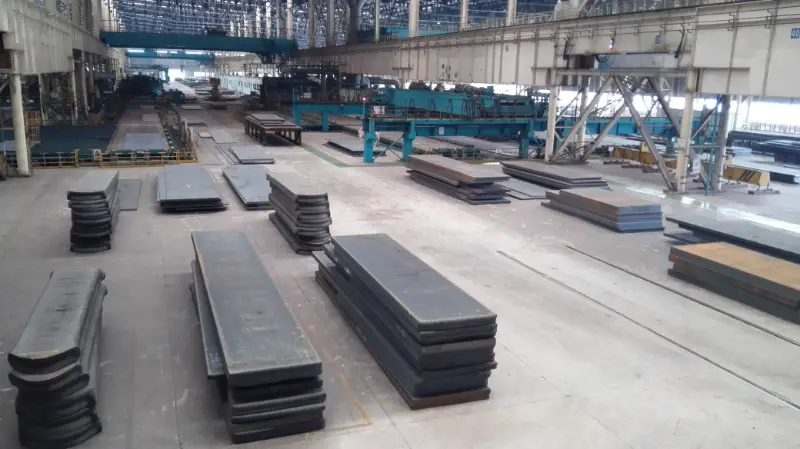
ASTM A514 Grade T (A514GRT) Quenched & Tempered Alloy Steel Plate
ASTM A514 Grade T (A514GRT) High-Strength Quenched and Tempered Alloy Steel Plate
Comprehensive material data for ASTM A514 Grade T carbon steel plate: chemical composition, mechanical and thermal properties, international equivalents, and applications.
Cutting, welding, forming (limited to cold forming with large radii), machining, drilling
- Phone : +8618037372205
- Email : [email protected]
- WhatsApp: Contact via Whtsapp
- WeChat: +8618037372205
ASTM A514 Grade T Quenched & Tempered Alloy Steel Plate Introduction
ASTM A514 Grade T (A514GRT) is a high-strength, quenched and tempered alloy steel plate designed for structural applications requiring exceptional strength, good weldability, and moderate toughness. It belongs to the ASTM A514 family and guarantees a minimum yield strength of 100 ksi (690 MPa) in thicknesses up to 2.5 inches (63.5 mm). The grade is microalloyed with vanadium, titanium, and boron to achieve deep hardenability and consistent mechanical properties across thick sections. Typical uses include heavy-duty machinery, bridge construction, pressure vessels, and offshore structures. The plate is supplied in the quenched and tempered condition, offering an excellent strength-to-weight ratio for weight-sensitive engineering designs.
ASTM A514 Grade T Quenched & Tempered Alloy Steel Plate Chemical Composition
The chemical composition of A514 Grade T is precisely controlled to achieve high strength and weldability. The alloy design relies on carbon, manganese, chromium, molybdenum, vanadium, titanium, and a small boron addition for improved hardenability. Phosphorus and sulfur are kept low to enhance ductility and toughness.
- Boron (0.0005–0.005%) is intentionally added to increase hardenability.
- Titanium (0.01–0.10%) fixes nitrogen and protects boron.
| Element | Specification (wt%) | Remarks |
|---|---|---|
| Carbon (C) | 0.12 – 0.21 | |
| Manganese (Mn) | 0.95 – 1.30 | |
| Phosphorus (P) | ≤ 0.030 | |
| Sulfur (S) | ≤ 0.030 | |
| Silicon (Si) | 0.20 – 0.35 | |
| Chromium (Cr) | 0.40 – 0.65 | |
| Molybdenum (Mo) | 0.40 – 0.60 | |
| Vanadium (V) | 0.03 – 0.08 | |
| Titanium (Ti) | 0.01 – 0.10 | |
| Boron (B) | 0.0005 – 0.005 | Required for hardenability |
ASTM A514 Grade T Quenched & Tempered Alloy Steel Plate Thermal and Electrical Physical Properties
The following physical properties are typical for A514 Grade T steel at room temperature. They serve as engineering design references and may vary slightly depending on the exact heat treatment and composition.
- Density is approx. 7.85 g/cm³.
- Elastic modulus is about 205 GPa, typical for alloy steels.
- Thermal expansion coefficient is 11.7 × 10⁻⁶/K between 20°C and 100°C.
| Property | Typical Value | Unit | Test Condition |
|---|---|---|---|
| Density (ρ) | 7.85 | g/cm³ | at 20 °C |
| Elastic Modulus (E) | 205 | GPa | at 20 °C |
| Shear Modulus (G) | 80 | GPa | at 20 °C |
| Poisson's Ratio (ν) | 0.28 | — | at 20 °C |
| Thermal Expansion Coeff. (α) | 11.7 | 10⁻⁶/K | 20–100 °C |
| Thermal Conductivity (λ) | 50 | W/(m·K) | at 20 °C |
| Specific Heat Capacity (c) | 450 | J/(kg·K) | at 20 °C |
| Electrical Resistivity (ρe) | 0.20 | μΩ·m | at 20 °C |
ASTM A514 Grade T Quenched & Tempered Alloy Steel Plate Mechanical Properties
Mechanical properties are valid for plate thickness up to 2.5 in. (63.5 mm). Requirements are identical for all thicknesses ≤ 2.5 in. except the bend test mandrel diameter, which varies with thickness.
- Minimum yield strength is 690 MPa (100 ksi).
- Tensile strength must fall in the range 760–895 MPa (110–130 ksi).
- Elongation in 2 in. (50 mm) gauge length is 18% minimum.
- Bend tests require 180° bending without cracking; the mandrel diameter depends on plate thickness.
| Property | Specified Value | Unit | Test Condition |
|---|---|---|---|
| Yield Strength (0.2% offset) | ≥ 690 | MPa | Plate thickness ≤ 63.5 mm |
| Tensile Strength | 760 – 895 | MPa | Plate thickness ≤ 63.5 mm |
| Elongation (2 in. or 50 mm gauge) | ≥ 18 | % | Plate thickness ≤ 63.5 mm |
| Bend Test (mandrel diameter) | 2t (t ≤ 19.0 mm); 3t (19.0 < t ≤ 31.8 mm); 3.5t (31.8 < t ≤ 63.5 mm) | — | 180° bend |
ASTM A514 Grade T Quenched & Tempered Alloy Steel Plate Completely Equivalent Material Standards and Replaceable Grades
| Country/Region | Standard | Grade | Remarks |
|---|
ASTM A514 Grade T Quenched & Tempered Alloy Steel Plate Application Introduction
ASTM A514 Grade T is widely used in demanding structural applications where high strength, toughness, and weight savings are essential. Typical design and fabrication include:
- Heavy equipment and mobile cranes: telescopic booms, outrigger beams, chassis frames.
- Bridge construction: structural beams, bearing plates, and welded girders.
- Pressure vessels and storage tanks: shells and heads designed per ASME codes (with specified impact requirements).
- Offshore platforms: structural nodes, decks, and support members.
Product Applications: Mobile cranes (telescopic booms), Bridges (structural plates and girders), Pressure vessels and storage tanks, Offshore platform structural members, Heavy transport trailers
Processed into products: Telescopic crane booms and extensions, Chassis frames for heavy trucks, Welded structural nodes, Support plates and bearing pads, Piles and foundation elements
Application industries: Construction & Infrastructure, Transportation & Mobility, Mining & Heavy Machinery, Offshore & Marine, Energy & Petrochemical
ASTM A514 Grade T Quenched & Tempered Alloy Steel Plate Similar / Comparable Substitute Materials
| Country/Region | Standard | Grade | Remarks |
|---|---|---|---|
| Europe | EN 10025-6 | S690Q / S690QL | Similar yield and tensile strength; not identical in composition (no B/V specified). May substitute with qualified welding procedure. |
| Japan | JIS G 3128 | SHY685 | High tensile strength steel for welded structures; comparable mechanical properties but different alloy approach. |
| China | GB/T 1591 | Q690D / Q690E | High-strength structural steel with similar strength grade; delivery condition and impact requirements differ. |
Notes:
Supplementary requirements: Impact testing (Charpy V‑notch) may be specified according to ASTM A514/A514M Supplementary Requirements (S1 to S9). Welding: Low‑hydrogen practices and controlled heat input are essential; consult steel producer for preheat and post‑weld heat treatment recommendations. Forming: Cold forming should be limited to large radii to avoid cracking; hot forming may require re‑heat‑treatment to restore mechanical properties. Availability: A514 Grade T plate is typically produced in thicknesses up to 2 in. (50.8 mm); thicker gauges may be subject to separate agreement.
- Share



