
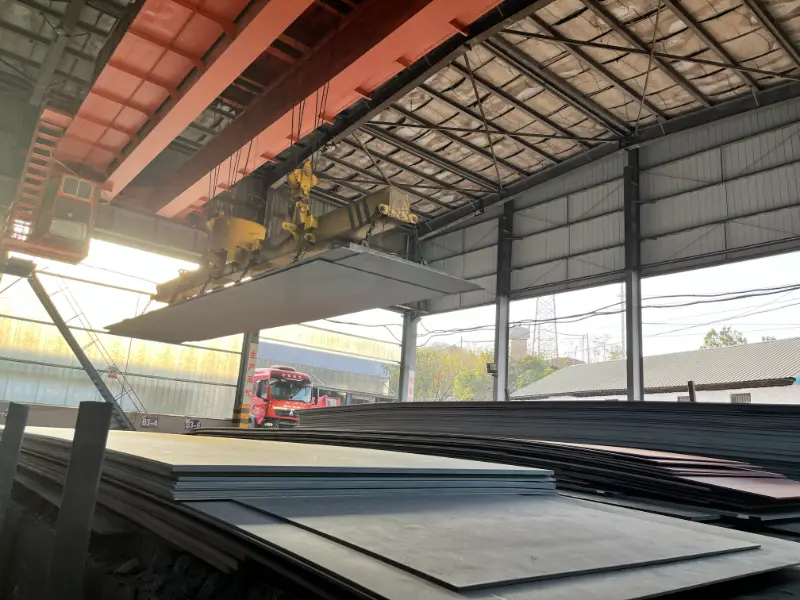
ASTM A283 Grade A (A283GRA) Carbon Steel Plate
ASTM A283 Grade A (A283GRA) Carbon Steel Plate - Properties, Composition & International Equivalents
Comprehensive material data for ASTM A283 Grade A (A283GRA) carbon steel plate: chemical composition, mechanical and physical properties, thermal/electrical data, international equivalent standards, and application guidance.
Hot rolling, cold rolling (for thin gauges), welding, forming, shearing, gas cutting, machining (drilling, milling).
- Phone : +8618037372205
- Email : [email protected]
- WhatsApp: Contact via Whtsapp
- WeChat: +8618037372205
ASTM A283 Grade A Carbon Steel Plate Introduction
ASTM A283 Grade A (A283GRA) is a low-to-intermediate tensile strength carbon steel plate covered by the ASTM A283/A283M Standard Specification for Low and Intermediate Tensile Strength Carbon Steel Plates. It is intended for general structural applications where moderate strength and good weldability are required. This grade offers a minimum yield strength of 165 MPa (24 ksi) and tensile strength in the range of 310–415 MPa (45–60 ksi). The carbon content is limited to 0.14% max, ensuring decent formability and weldability without the need for complex pre- or post-heat treatments. Typical delivery conditions are as-rolled or normalized rolling, predominantly in plate form, but also available as sheet and strip. It serves as an economical choice for structural components, storage tanks, and bridges under low to moderate loads, where high toughness or enhanced atmospheric corrosion resistance are not critical.
ASTM A283 Grade A Carbon Steel Plate Chemical Composition
The chemical composition limits for ASTM A283 Grade A as per the latest edition of ASTM A283/A283M are given below. Silicon is not mandatory but may be reported for deoxidation practice. Copper may be specified when required for corrosion resistance (min 0.20%). All values are maximum unless a range or minimum is indicated.
| Element | Specified Value (max, unless noted) | Remarks |
|---|---|---|
| Carbon (C) | 0.14 | Max. For thickness > 12.5 mm, the carbon may increase by 0.01% per each 12.5 mm reduction in thickness, but shall not exceed 0.18%. |
| Manganese (Mn) | 0.90 | Max. For plates over 25 mm in thickness, Mn max is 1.00%. |
| Phosphorus (P) | 0.040 | Max. |
| Sulfur (S) | 0.050 | Max. |
| Silicon (Si) | 0.15–0.30 (for fully killed) or up to 0.30 max (for semi-killed) | Optional for killed steel practice; not a mandatory limit unless ordered as killed or Si-added. |
| Copper (Cu) | 0.20 min. when specified | When copper is specified for atmospheric corrosion resistance, 0.20% min. |
ASTM A283 Grade A Carbon Steel Plate Thermal and Electrical Physical Properties
The physical properties listed are typical for carbon steel of this grade and are not specified in ASTM A283/A283M. They serve as engineering guidance for design calculations. Values can vary slightly depending on exact composition and heat treatment. Properties are at room temperature (20–25°C) unless indicated otherwise.
| Property | Typical Value | Unit | Test Condition / Remarks |
|---|---|---|---|
| Density (ρ) | 7.85 | g/cm³ | At 20°C |
| Elastic Modulus (E) | 200–210 | GPa | At 20°C, typical for mild steel |
| Shear Modulus (G) | 80 | GPa | At 20°C, calculated from E and Poisson's ratio |
| Poisson's Ratio (ν) | 0.26–0.29 | – | At 20°C |
| Thermal Expansion Coefficient (α) | 11.7 × 10⁻⁶ | K⁻¹ | Between 20°C and 100°C |
| Thermal Expansion Coefficient (α) | 12.5 × 10⁻⁶ | K⁻¹ | Between 20°C and 200°C |
| Thermal Expansion Coefficient (α) | 13.7 × 10⁻⁶ | K⁻¹ | Between 20°C and 300°C |
| Thermal Conductivity (λ) | 51.9–53.0 | W/(m·K) | At 20°C |
| Thermal Conductivity (λ) | 49.8 | W/(m·K) | At 100°C |
| Thermal Conductivity (λ) | 43.4 | W/(m·K) | At 200°C |
| Thermal Conductivity (λ) | 38.5 | W/(m·K) | At 300°C |
| Specific Heat Capacity (cp) | 486 | J/(kg·K) | At 20–100°C |
| Electrical Resistivity (ρ_e) | 0.142–0.174 × 10⁻⁶ | Ω·m | At 20°C |
ASTM A283 Grade A Carbon Steel Plate Mechanical Properties
The mechanical property requirements for ASTM A283 Grade A plates are determined by tensile and bend tests. Yield strength corresponds to upper yield point (ReH) when a sharp yield is present, otherwise 0.2% offset (Rp0.2). Elongation is measured on a 200 mm (8 in) gauge length. Bend tests at 180° are performed on a mandrel diameter related to plate thickness. Impact toughness is not mandated by this standard.
| Property | Required Value | Unit | Test Condition / Remarks |
|---|---|---|---|
| Tensile Strength (Rm) | 310–415 (45–60) | MPa (ksi) | Transverse or longitudinal direction, at room temperature |
| Yield Strength (ReH / Rp0.2) | ≥165 (24) | MPa (ksi) | Transverse or longitudinal; if yield point not defined, use 0.2% offset |
| Elongation (A) in 200 mm (8 in.) | ≥25 | % | Thickness ≤20 mm (0.75 in.) |
| Elongation (A) in 200 mm (8 in.) | ≥23 | % | Thickness 20–40 mm (0.75–1.5 in.) |
| Elongation (A) in 200 mm (8 in.) | ≥21 | % | Thickness >40–75 mm (1.5–3 in.) |
| Elongation (A) in 50 mm (2 in.) | ≥30 (typical, for reference) | % | When tested in 50 mm gauge, often reported; not specified in standard for this grade but common |
| Bend Test (180°) | Bend radius = 1×t | mm | t = plate thickness, ≤20 mm; >20–40 mm use 1.5t; >40–75 mm use 2t. No cracks on outside of bent portion. |
ASTM A283 Grade A Carbon Steel Plate Direct Equivalent Standards and Substitute Grades
| Country/Region | Standard & Grade | Material Designation | Remarks |
|---|
ASTM A283 Grade A Carbon Steel Plate Application Introduction
ASTM A283 Grade A is widely utilized in structural and general engineering applications where moderate strength and easy fabrication are paramount. Its low carbon content ensures good weldability without preheating under typical conditions, and it can be formed, cut, and machined with standard equipment. The material is not recommended for low-temperature service or highly corrosive environments unless protected.
Product Applications: Structural beams, columns, and girders, Bridge decks and supports, Floor plates and platform grating, Welded storage tanks (for water, fuel, chemicals at ambient temperature), Farm machinery frames and parts, Brackets, stiffeners, and base plates
Processed into products: Rolled steel sections cut from plate: I-beams, channels, angles (when fabricated), Tank shell plates and bottom plates, Gusset plates and splice plates, Machine frames, base plates, and mounting brackets, Truck trailer frames and dump body components, Pipe supports and saddles, Stair stringers and handrail brackets
Application industries: Construction & Civil Engineering, Bridge and Highway Infrastructure, Storage Tanks and Silos (atmospheric, ambient temperature), Agricultural and Off-Highway Equipment, Light Machinery and Structural Frames, Shipbuilding (secondary structural members)
ASTM A283 Grade A Carbon Steel Plate Similar / Comparable Substitution Materials
| Country/Region | Standard & Grade | Material Designation | Remarks |
|---|---|---|---|
| China | GB/T 700 | Q235B | Similar C, Mn limits. Yield ≥235 MPa, tensile 370–500 MPa. Q235B has slightly higher strength; may need minor thickness adjustment. |
| European Union | EN 10025-2 | S235JR | Yield ≥235 MPa, tensile 360–510 MPa. Suitable substitution with slightly higher strength. |
| Japan | JIS G3101 | SS400 | Tensile 400–510 MPa, yield ≥245 MPa. Readily available and widely used for structural steel. |
| India | IS 2062 | E250 (Fe 410 W A/B) | Tensile min 410 MPa, yield min 250 MPa. Not a direct match but acceptable with design adjustments. |
| United States | ASTM A36/A36M | A36 | Yield ≥250 MPa (36 ksi), tensile 400–550 MPa. Often used interchangeably where higher strength is acceptable. |
| United States | ASTM A285/A285M | Grade A (A285GRA) | For pressure vessel plates. Similar tensile range (310–450 MPa), with superior weldability; may be over-specified for structural use. |
Notes:
When ordering ASTM A283 Grade A plates, specify the standard and grade (e.g., ASTM A283/A283M Grade A), desired dimensions, and any supplementary requirements such as copper addition (min 0.20% Cu) for improved atmospheric corrosion resistance. If the material is intended for pressure vessel applications, ensure compliance with the relevant construction code, which may impose additional testing (e.g., impact tests) or restrict maximum thickness. The values provided for physical properties are typical for hot-rolled carbon steel and may vary with product form and thickness. For critical designs, request mill test certificates (MTC) with actual heat analysis and mechanical test results.
- Share



