
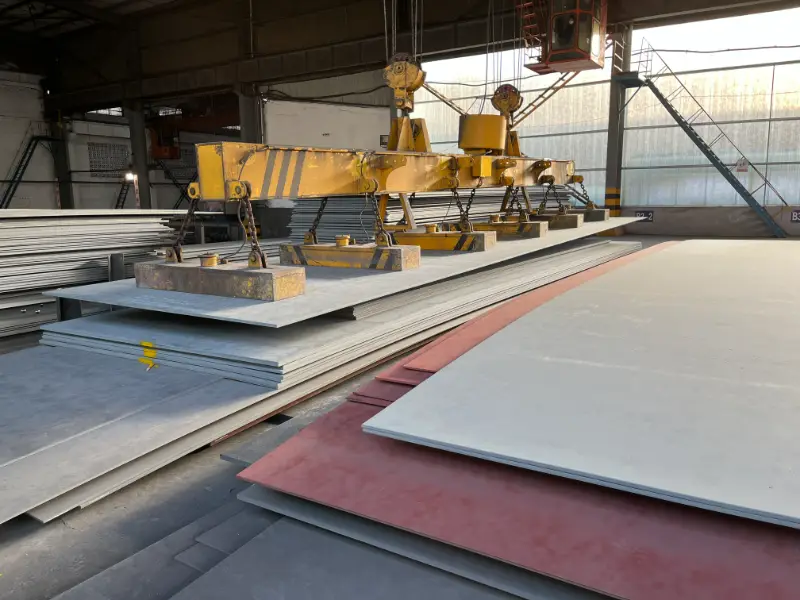
ASTM A514 Grade S (A514GRS) High-Strength Quenched & Tempered Carbon Steel Plate
ASTM A514 Grade S (A514GRS) High-Strength Quenched & Tempered Carbon Steel Plate
ASTM A514 Grade S is a high-yield, quenched and tempered alloy steel plate intended for structural applications requiring superior strength and toughness. It offers a minimum yield strength of 100 ksi (690 MPa).
Welding, bending, machining, cutting, forming (with appropriate procedures due to high strength)
- Phone : +8618037372205
- Email : [email protected]
- WhatsApp: Contact via Whtsapp
- WeChat: +8618037372205
ASTM A514 Grade S High-Strength Quenched & Tempered Carbon Steel Plate Introduction
ASTM A514 Grade S is a low-carbon, boron-treated, quenched and tempered alloy steel that provides excellent combination of high strength, toughness, and weldability. It is primarily used in structural applications where weight savings are critical, such as in heavy-duty machinery, bridges, and offshore structures. The steel achieves its properties through a controlled heat treatment process of quenching and tempering. Key features:
- Minimum yield strength of 690 MPa (100 ksi) up to 63.5 mm thickness
- Good notch toughness at low temperatures
- Excellent weldability with proper procedures
- Suitable for cold bending and forming
ASTM A514 Grade S High-Strength Quenched & Tempered Carbon Steel Plate Chemical Composition
The chemical composition of ASTM A514 Grade S is carefully controlled to ensure deep hardenability and consistent high-strength properties. Boron is added to enhance hardenability, while nickel and chromium contribute to toughness and strength. All values are maximum unless a range is indicated.
| Element | Standard Value (Weight %) | Remarks |
|---|---|---|
| Carbon (C) | 0.12 – 0.21 | Range |
| Manganese (Mn) | 0.60 – 1.00 | Range |
| Phosphorus (P) | ≤ 0.030 | Max |
| Sulfur (S) | ≤ 0.030 | Max |
| Silicon (Si) | 0.20 – 0.35 | Range |
| Nickel (Ni) | 1.20 – 1.60 | Range |
| Chromium (Cr) | 0.40 – 0.65 | Range |
| Molybdenum (Mo) | 0.15 – 0.25 | Range |
| Vanadium (V) | 0.02 – 0.08 | Range |
| Boron (B) | 0.0005 – 0.005 | Range |
| Copper (Cu) | ≤ 0.50 | Residual |
ASTM A514 Grade S High-Strength Quenched & Tempered Carbon Steel Plate Thermal and Electrical Physical Properties
These values are typical for quenched and tempered low-alloy steels similar to A514 Grade S. Actual properties may vary slightly with composition and heat treatment condition.
| Property | Typical Value | Unit | Test Condition / Temperature |
|---|---|---|---|
| Density (ρ) | 7.85 | g/cm³ | Room temperature |
| Modulus of Elasticity (E) | 207 | GPa | Room temperature |
| Shear Modulus (G) | 80 | GPa | Room temperature |
| Poisson's Ratio (ν) | 0.30 | — | Room temperature |
| Thermal Expansion Coefficient (α) | 11.7 | µm/m·°C | 20 – 100°C |
| Thermal Expansion Coefficient (α) | 12.2 | µm/m·°C | 20 – 200°C |
| Thermal Expansion Coefficient (α) | 12.8 | µm/m·°C | 20 – 300°C |
| Thermal Expansion Coefficient (α) | 13.3 | µm/m·°C | 20 – 400°C |
| Thermal Expansion Coefficient (α) | 13.9 | µm/m·°C | 20 – 500°C |
| Thermal Conductivity (λ) | 45 | W/m·K | 20°C |
| Thermal Conductivity (λ) | 40 | W/m·K | 200°C |
| Thermal Conductivity (λ) | 35 | W/m·K | 400°C |
| Specific Heat Capacity (c) | 460 | J/kg·K | 20°C |
| Specific Heat Capacity (c) | 500 | J/kg·K | 200°C |
| Specific Heat Capacity (c) | 540 | J/kg·K | 400°C |
| Electrical Resistivity (ρ_e) | 0.20 | µΩ·m | Room temperature |
ASTM A514 Grade S High-Strength Quenched & Tempered Carbon Steel Plate Mechanical Properties
Mechanical properties are valid for plates in the quenched and tempered condition, tested in accordance with ASTM A370. The minimum yield and tensile strengths apply to longitudinal specimens. Bend test requirements are for transverse specimens. Values depend on plate thickness.
| Property | Standard Requirement | Unit | Test Condition / Remarks |
|---|---|---|---|
| Yield Strength (ReH) | ≥ 690 | MPa | Plate thickness ≤ 63.5 mm (2.5 in) |
| Yield Strength (ReH) | ≥ 100 | ksi | Plate thickness ≤ 2.5 in |
| Tensile Strength (Rm) | 760 – 895 | MPa | Plate thickness ≤ 63.5 mm |
| Tensile Strength (Rm) | 110 – 130 | ksi | Plate thickness ≤ 2.5 in |
| Elongation (A) | ≥ 18 | % | Gauge length 50 mm (2 in); plate thickness ≤ 63.5 mm |
| Bend Test (180°) – inside diameter | 2 × plate thickness | — | Thickness ≤ 12.5 mm (0.5 in) |
| Bend Test (180°) | 2.5 × plate thickness | — | 12.5 < t ≤ 25 mm (0.5 – 1.0 in) |
| Bend Test (180°) | 3 × plate thickness | — | 25 < t ≤ 38 mm (1.0 – 1.5 in) |
| Bend Test (180°) | 3.5 × plate thickness | — | 38 < t ≤ 50 mm (1.5 – 2.0 in) |
| Bend Test (180°) | 4 × plate thickness | — | 50 < t ≤ 63.5 mm (2.0 – 2.5 in) |
ASTM A514 Grade S High-Strength Quenched & Tempered Carbon Steel Plate Completely Equivalent Material Standards and Substitutable Grades
| Country/Region | Standard | Grade/Designation | Remarks |
|---|---|---|---|
| Europe | EN 10025-6 | S690QL (1.8928), S690Q (1.8931) | Quenched and tempered structural steel, similar chemical composition, min. yield 690 MPa |
| Europe | EN 10137-2 | S690Q | Plates and wide flats, high yield strength structural steels |
| Japan | JIS G 3128 | SHY685NS | High yield strength steel plate for welded structures, 685 MPa min. yield |
| China | GB/T 16270 | Q690D / Q690E | Quenched and tempered high strength structural steel, 690 MPa min. yield |
| Australia/New Zealand | AS/NZS 3678 | Grade 700 | Hot-rolled structural steel plate with minimum 700 MPa yield |
ASTM A514 Grade S High-Strength Quenched & Tempered Carbon Steel Plate Application Introduction
ASTM A514 Grade S is ideal for heavy-duty structural applications where high strength-to-weight ratio is critical. It is widely used in mobile equipment, lifting devices, and infrastructure projects. Welding procedures must be carefully controlled to avoid hydrogen-induced cracking; low hydrogen consumables and preheating are essential. Post-weld heat treatment is generally not recommended for this steel, as it may degrade mechanical properties. Cold forming is possible but requires sufficient force due to high yield strength; minimum bending radii must be observed.
Product Applications: Crane booms and lattice sections, Heavy-duty truck chassis and frames, Mining dump bodies and excavator buckets, Offshore platform structural members, Bridge structural components, Pressure vessel shells and heads (when using A517 Grade S equivalent), Load-bearing structural beams and columns
Processed into products: Crane boom chords and lacings, Telescopic booms, Mining truck frames, Excavator arms and booms, Chassis side rails and cross-members, Lifting lugs and padeyes, High-strength bolted and welded connections, Structural stiffeners and support brackets, Wind turbine tower flanges and transition pieces
Application industries: Construction & Infrastructure, Heavy Machinery & Mining, Transportation & Automotive (truck frames, trailers), Offshore & Shipbuilding, Crane & Lifting Equipment, Renewable Energy (wind turbine foundations, etc.)
ASTM A514 Grade S High-Strength Quenched & Tempered Carbon Steel Plate Similar / Alternative Materials with Comparable Properties
| Country/Region | Standard | Grade/Designation | Remarks |
|---|---|---|---|
| USA | ASTM A514 | Grade B, H, F, Q | Other A514 grades with slightly different chemistries but same strength class |
| USA | ASTM A517 | Grade S | Pressure vessel quality version of A514 Grade S; same chemical and mechanical requirements but with additional restrictions |
| Europe | EN 10025-6 | S690QL/S690QL1 | S690QL1 provides improved toughness; quenched and tempered condition |
| International | SSAB | WELDOX 700 / HARDOX 700 | Commercial brands of high-strength structural and wear-resistant plates, approximately equivalent in strength |
| International | voestalpine | ALFORM 700 / ALDUR 700 | High-strength plate grades with similar yield strength |
Notes:
Welding Considerations: Preheating to 150–200°C is recommended depending on thickness. Use low hydrogen electrodes (AWS E11018 or equivalent) and maintain strict heat input control. Avoid high restraint and delayed cracking. Supply Condition: Plates are delivered in quenched and tempered condition; edges are often sheared or thermally cut. Special attention to edge quality is needed for subsequent welding or forming. Storage: Store in dry conditions to prevent corrosion; light oiling may be applied. Tolerances: Dimensional tolerances follow ASTM A6/A6M for plates. Testing: Mechanical tests are performed on each heat and lot; supplementary Charpy V-notch testing can be specified at low temperatures (eg, –40°C) per Supplementary Requirement S5 of ASTM A514.
- Share



