
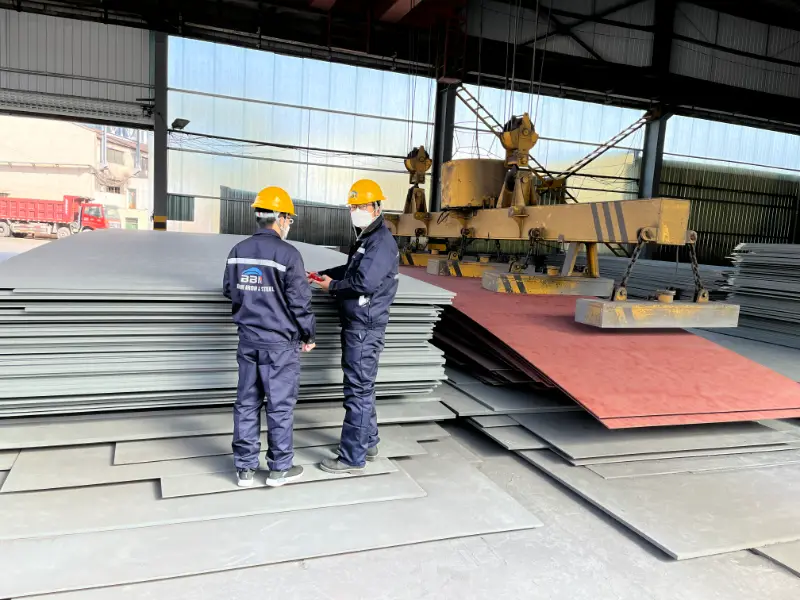
ASTM A514 Grade K (A514Gr.K) Quenched & Tempered High-Strength Steel Plate
ASTM A514 Grade K (A514Gr.K) | Quenched & Tempered High-Strength Steel Plate - Full
Comprehensive material properties, chemical composition, mechanical and thermal data for ASTM A514 Grade K (A514Gr.K) carbon steel plate. Ideal for heavy machinery, cranes, and structural applications requiring 100 ksi yield strength.
Hot rolling, quenching, tempering, cold forming (limited), welding (low-hydrogen practices), thermal cutting, machining
- Phone : +8618037372205
- Email : [email protected]
- WhatsApp: Contact via Whtsapp
- WeChat: +8618037372205
ASTM A514 Grade K Quenched & Tempered High-Strength Steel Plate Introduction
ASTM A514 Grade K (A514Gr.K) is a low-carbon, quenched and tempered alloy steel plate renowned for its high yield strength (minimum 100 ksi / 690 MPa) combined with good weldability and toughness. It belongs to the ASTM A514/A514M specification family, designed for structural applications where weight savings and durability are critical. The Grade K composition is optimized with controlled additions of chromium, molybdenum, and boron to achieve deep hardenability and uniform mechanical properties across thicknesses up to 2.5 inches (63.5 mm). Typical delivery condition is quenched and tempered, providing a tempered martensitic/bainitic microstructure. Its high strength-to-weight ratio makes it a preferred choice for mobile equipment, crane booms, and heavy-duty structural components subjected to dynamic loads.
ASTM A514 Grade K Quenched & Tempered High-Strength Steel Plate Chemical Composition
The chemical composition of ASTM A514 Grade K is tightly controlled to ensure high strength and weldability. Limits vary depending on plate thickness. Maxima are specified for phosphorus and sulfur to maintain cleanliness and toughness. Boron is added in trace amounts to improve hardenability. The table reflects the most common thickness ranges per ASTM A514/A514M.
| Element | Weight % (≤ 3/4 in. / 20 mm) | Weight % (> 3/4 in. to 2.5 in. / 20-63.5 mm) | Notes |
|---|---|---|---|
| Carbon (C) | 0.10–0.20 | 0.13–0.20 | Key hardenability element |
| Manganese (Mn) | 0.50–1.00 | 0.60–1.10 | Increases strength and toughness |
| Phosphorus (P) | 0.025 max | 0.025 max | Residual; kept low for ductility |
| Sulfur (S) | 0.025 max | 0.025 max | Residual; kept low for toughness |
| Silicon (Si) | 0.15–0.35 | 0.15–0.35 | Deoxidizer |
| Nickel (Ni) | 0.75 max | 0.75 max | Improves toughness |
| Chromium (Cr) | 0.40–0.70 | 0.40–0.70 | Increases hardenability |
| Molybdenum (Mo) | 0.15–0.25 | 0.15–0.25 | Prevents temper embrittlement |
| Vanadium (V) | 0.02–0.06 | 0.02–0.06 | Grain refinement |
| Boron (B) | 0.0005–0.005 | 0.0005–0.005 | Powerful hardenability enhancer |
| Copper (Cu) | 0.50 max | 0.50 max | Residual |
| Titanium (Ti) | 0.06 max | 0.06 max | Optional; grain refining |
ASTM A514 Grade K Quenched & Tempered High-Strength Steel Plate Thermal and Electrical Physical Properties
These values are typical for quenched and tempered low-alloy steels similar to A514 Grade K. They are not part of the ASTM A514 delivery requirements but are useful for design calculations. Slight variations may occur due to exact composition and heat treatment condition.
| Property | Typical Value | Unit | Test Condition / Remarks |
|---|---|---|---|
| Density (ρ) | 7.85 | g/cm³ | At room temperature |
| Elastic Modulus (E) | 200 | GPa | At room temperature |
| Elastic Modulus (E) | 29.0 × 10³ | ksi | At room temperature |
| Shear Modulus (G) | 77 | GPa | Calculated from E and Poisson's ratio |
| Poisson's Ratio (ν) | 0.30 | – | In elastic range |
| Thermal Expansion Coefficient (α) | 11.7 × 10⁻⁶ | /°C | Average between 20°C and 100°C (68–212°F) |
| Thermal Expansion Coefficient (α) | 6.5 × 10⁻⁶ | /°F | Average between 68–212°F |
| Thermal Conductivity (λ) | 46 | W/(m·K) | At 100°C (212°F) |
| Thermal Conductivity (λ) | 26.5 | BTU/(hr·ft·°F) | At 212°F |
| Specific Heat Capacity (c_p) | 475 | J/(kg·K) | At room temperature |
| Electrical Resistivity (ρ_e) | 0.22 × 10⁻⁶ | Ω·m | At room temperature, typical for low-alloy steel |
ASTM A514 Grade K Quenched & Tempered High-Strength Steel Plate Mechanical Properties
Mechanical properties are guaranteed by the quenched and tempered condition for all thicknesses covered by the standard. Values are minimum unless a range is given. The bend test requirement is a function of the plate thickness and the bend angle (180°). Impact toughness is not mandatory for Grade K but may be agreed upon; shown here for reference. All values conform to ASTM A514/A514M.
| Property | Requirement | Unit | Test Condition / Remarks |
|---|---|---|---|
| Yield Strength (0.2% offset, ReH) | ≥ 100 | ksi | Transverse or longitudinal, at 0.2% offset |
| Yield Strength (0.2% offset, ReH) | ≥ 690 | MPa | Transverse or longitudinal |
| Tensile Strength (Rm) | 110–130 | ksi | Transverse or longitudinal |
| Tensile Strength (Rm) | 760–895 | MPa | Transverse or longitudinal |
| Elongation (A) in 2 in. (50 mm) | ≥ 18 | % | Transverse; for plates ≤ 3/4 in. (20 mm) |
| Elongation (A) in 2 in. (50 mm) | ≥ 18 | % | Transverse; for plates > 3/4 in. to 2.5 in. |
| Reduction of Area | ≥ 40 (for plate) | % | Round specimen; informative only |
| Bend Test (180° bend) | d = 2.5T (≤ 3/4 in.) | – | Bend diameter related to plate thickness T |
| Bend Test (180° bend) | d = 3.0T (> 3/4 in. to 2.5 in.) | – | No cracks on outside of bent portion |
| Charpy V-notch Impact (typical) | ≥ 20 (at -40°F / -40°C) | ft·lbs / J | Agreed upon; not mandatory per basic spec |
ASTM A514 Grade K Quenched & Tempered High-Strength Steel Plate Complete Equivalent Material Standards & Direct Substitutes
| Country / Region | Standard & Grade | Equivalent Designation | Remarks |
|---|---|---|---|
| USA | ASME SA514 Grade K | SA514 Gr.K | Identical to ASTM A514 Grade K; approved for ASME pressure vessel applications where applicable. |
| USA | ASTM A514/A514M | Grade K (UNS K11625) | Primary specification. UNS number K11625 uniquely identifies this grade. |
| – | – | – | No other international standard carries an exactly matching chemical and mechanical specification. |
ASTM A514 Grade K Quenched & Tempered High-Strength Steel Plate Application Introduction
ASTM A514 Grade K excels in welded structural applications where high strength permits reduced section thicknesses and weight savings. Its excellent toughness at low temperatures makes it suitable for severe service conditions. Common products range from mobile crane telescopic booms to heavy-duty truck chassis. Machining is best performed in the tempered condition, and flame cutting requires preheating for thicker sections to avoid edge cracking. Welding must follow low-hydrogen practices with appropriate filler metals to match the base metal strength.
Product Applications: Mobile crane booms and outriggers, Mining truck frames and buckets, Excavator arms and boom sections, Heavy-duty trailer frames, Structural beams and columns for high-rise buildings (when Specs require high strength), Bridge deck support components, Press frames and die holders
Processed into products: Telescopic crane sections (machined and welded), Load-bearing pins and bushings (after further machining), Welded box sections for chassis rails, Flame-cut structural gusset plates, Drill mast components, Excavator bucket lip reinforcements, Heavy-equipment undercarriage components (e.g., track frames)
Application industries: Heavy Equipment & Machinery Manufacturing, Construction & Infrastructure, Mining & Mineral Processing, Transportation (heavy trucks, trailers), Energy (onshore & offshore structures, pressure vessels with code approval), Military & Defense (armor plates, vehicle structures)
ASTM A514 Grade K Quenched & Tempered High-Strength Steel Plate Similar / Comparable Material Recommendations
| Country / Region | Standard & Grade | Designation | Remarks |
|---|---|---|---|
| Europe | EN 10025-6 | S690Q / S690QL | Similar minimum yield strength (690 MPa) but different chemistry (higher Mn, no B). Requires careful welding procedure comparison. |
| Japan | JIS G 3128 | SHY685 / SHY685NS | High yield strength (685 MPa) quenched and tempered steel; chemistry differs for Japanese market. Equivalent strength level. |
| China | GB/T 16270 | Q690D / Q690E | Similar strength grade in Chinese standard for high strength structural steel. Composition not identical; verify weldability. |
| Germany (historic) | DIN EN 10137-2 | S690Q (withdrawn) | Previously used S690Q in Europe; comparable mechanical properties but obsolete; replaced by EN 10025-6. |
| USA | ASTM A517 Grade K | A517 Gr.K | Same chemical composition as A514 Grade K but intended for pressure vessel plates. Mechanically identical, with additional quality requirements. |
Notes:
Welding recommendations: Use low-hydrogen electrodes (AWS E11018-M or similar) with preheat temperatures typically between 150°F and 300°F (65–150°C) depending on plate thickness. Post-weld heat treatment (PWHT) is generally not required but may be specified for stress relief; caution is needed to avoid temper embrittlement.
Forming: Cold forming of Grade K is limited due to high strength; hot forming should be followed by re-quenching and tempering to restore mechanical properties.
Certification: Mill test reports normally include chemical analysis, tensile results, and bend tests. Charpy impact testing is supplementary and must be agreed upon at the time of order.
Availability: Thicknesses up to 2.5 in. (63.5 mm) standard; wider dimensions and plate widths depend on mill capabilities. Condition as delivered is Q&T; surface is typically as-rolled and descaled.
- Share



