
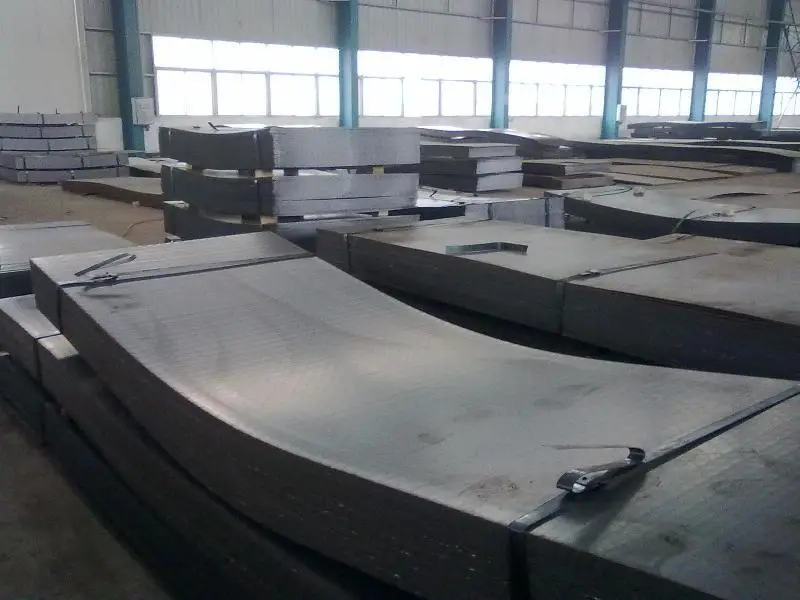
ASTM A514 Grade M (A514GRM) High-Strength Quenched and Tempered Steel Plate
ASTM A514 Grade M (A514GRM) High-Strength Quenched and Tempered Steel Plate - Complete Technical Data
In-depth technical profile of ASTM A514 Grade M (A514GRM) carbon steel plate: chemical composition, mechanical properties, physical properties, international equivalents, and application guidance.
Welding, machining, thermal cutting, cold forming (limited), hot forming
- Phone : +8618037372205
- Email : [email protected]
- WhatsApp: Contact via Whtsapp
- WeChat: +8618037372205
ASTM A514 Grade M High-Strength Quenched and Tempered Steel Plate Introduction
ASTM A514 Grade M (A514GRM) is a high-strength, low-alloy structural steel plate supplied in the quenched and tempered condition. It is part of the ASTM A514/A514M family of grades designed for structural applications where weight savings and high load capacity are critical. Grade M offers a minimum yield strength of 690 MPa (100 ksi) and a tensile strength range of 760–895 MPa (110–130 ksi). The steel is characterized by its good weldability, formability, and notch toughness, making it suitable for heavy-duty structures, earthmoving equipment, crane booms, bridges, and offshore platforms. The alloy design relies on a balanced composition of carbon, manganese, chromium, molybdenum, vanadium, and boron to achieve deep hardenability and consistent mechanical properties after heat treatment. Typical thickness availability ranges up to 63.5 mm (2.5 in.), with delivery condition as quenched and tempered.
ASTM A514 Grade M High-Strength Quenched and Tempered Steel Plate Chemical Composition
The chemical composition of ASTM A514 Grade M steel as specified in ASTM A514/A514M. This precise combination of elements ensures deep hardenability and high strength after quenching and tempering. Boron is intentionally added to enhance hardenability, while chromium and molybdenum provide high-temperature strength and tempering resistance.
| Chemical Element | Standard Value | Remarks |
|---|---|---|
| Carbon (C) | 0.12 – 0.21 | Max 0.21% for product analysis |
| Manganese (Mn) | 0.45 – 0.70 | |
| Silicon (Si) | 0.20 – 0.35 | |
| Phosphorus (P) | ≤ 0.025 | Max |
| Sulfur (S) | ≤ 0.010 | Max |
| Chromium (Cr) | 0.85 – 1.20 | |
| Molybdenum (Mo) | 0.15 – 0.25 | |
| Vanadium (V) | 0.03 – 0.08 | |
| Boron (B) | 0.001 – 0.005 | |
| Iron (Fe) | Balance | Approximately 97–98% |
ASTM A514 Grade M High-Strength Quenched and Tempered Steel Plate Thermal and Electrical Physical Properties
Typical physical properties for quenched and tempered A514 Grade M steel. These values are derived from general engineering handbooks and represent averages for high-strength low-alloy steels. Density, elastic modulus, and thermal conductivity are essential for structural calculations. Actual values may vary slightly with exact composition, heat treatment, and temperature.
| Property | Typical Value | Unit | Test Condition |
|---|---|---|---|
| Density (ρ) | 7.85 | g/cm³ | Room temperature (20 °C) |
| Elastic Modulus (E) | 205 | GPa | Room temperature |
| Shear Modulus (G) | 80 | GPa | Room temperature, calculated from E and ν |
| Poisson's Ratio (ν) | 0.28 | – | Room temperature, elastic range |
| Thermal Expansion Coefficient (α) | 11.7 × 10⁻⁶ | /°C | 20 °C to 100 °C |
| Thermal Expansion Coefficient (α) | 12.5 × 10⁻⁶ | /°C | 20 °C to 200 °C |
| Thermal Conductivity (λ) | 38 | W/m·K | At 20 °C |
| Specific Heat Capacity | 475 | J/kg·K | At 20 °C |
| Electrical Resistivity (ρ_e) | 0.22 × 10⁻⁶ | Ω·m | At 20 °C |
ASTM A514 Grade M High-Strength Quenched and Tempered Steel Plate Mechanical Properties
Mechanical properties for ASTM A514 Grade M steel plates up to 63.5 mm (2.5 in.) thickness, tested in accordance with ASTM A514/A514M. The values are guaranteed minimums unless a range is indicated. Yield strength and tensile strength ensure high load capacity, while minimum elongation and bend test confirm adequate ductility.
| Property | Standard Value | Unit | Test Condition |
|---|---|---|---|
| Yield Strength (ReH) | ≥ 690 | MPa | 0.2% offset, transverse specimen, all thicknesses |
| Tensile Strength (Rm) | 760 – 895 | MPa | Transverse specimen, all thicknesses |
| Elongation (A) | ≥ 18 | % | Gauge length 2 in. (50 mm), thickness ≤ ¾ in. (20 mm) |
| Elongation (A) | ≥ 18 | % | Gauge length 2 in. (50 mm), thickness > ¾ in. to 2.5 in. (60.3 mm) |
| Bend Test | 2t | Bend diameter | 180° bend, t = plate thickness, for thickness ≤ ¾ in. (20 mm) |
| Bend Test | 2.5t | Bend diameter | 180° bend, t = plate thickness, for thickness > ¾ in. to 2.5 in. |
ASTM A514 Grade M High-Strength Quenched and Tempered Steel Plate Direct Equivalent Standards and Replaceable Grades
| Country/Region | Standard | Grade | Remarks |
|---|---|---|---|
| International | ISO 4950-2 | E690QL | Similar strength level (min. 690 MPa yield), quenched and tempered; chemical composition differs, but often mutually accepted with engineering agreement. |
| Europe | EN 10025-6 | S690QL / S690QL1 | Very close performance, same minimum yield strength; requires verification of chemical limits and delivery condition for direct substitution. |
| Japan | JIS G 3128 | SHY685 / SHY685N | High yield strength steel for welded structures; comparable properties but different alloying approach; often used as substitute in engineering practice. |
| China | GB/T 16270 | Q690D / Q690E | Quenched and tempered structural steel with min. 690 MPa yield; similar application range; chemical requirements not identical but can be specified for replacement. |
ASTM A514 Grade M High-Strength Quenched and Tempered Steel Plate Application Introduction
ASTM A514 Grade M is designed for structural applications that demand high strength, weldability, and toughness. Its high yield strength allows weight reduction in large structures, leading to cost savings in transport and erection. It is widely used in heavy engineering sectors.
Key considerations:
- Preheating and interpass temperature control during welding are necessary to avoid hydrogen cracking.
- Post-weld heat treatment (PWHT) may alter mechanical properties; consult the steel supplier.
- Forming should be done with adequate bending radii to avoid cracking.
- Impact toughness can be enhanced by specifying supplementary requirements (e.g., Charpy V-notch).
Product Applications: Bridge girders and arch structural members, Offshore platform legs and decks, Heavy-duty truck chassis and frames, Crane booms, outriggers, and turntables, Mining excavator buckets, blades, and dump bodies, High-strength bolted and welded assemblies, Wind turbine tower flanges and tubular structures
Processed into products: Welded built-up beams and columns, Crane boom sections and lacing members, Excavator arms and bucket shells, Offshore wind turbine foundation transition pieces, Pressure vessel shell courses and heads, High-strength pin connectors and clevises, Structural brackets and stiffeners for heavy machinery
Application industries: Heavy Construction and Infrastructure, Mining and Earthmoving Equipment, Offshore and Marine Structures, Bridge Building, Crane and Lifting Equipment Manufacturing, Pressure Vessel and Storage Tank Production, Transportation (heavy-haul trailers, railway cars)
ASTM A514 Grade M High-Strength Quenched and Tempered Steel Plate Similar/Comparable Alternative Materials
| Country/Region | Standard | Grade | Remarks |
|---|---|---|---|
| USA | ASTM A514 | Grade B, H, Q, F | Same ASTM family, identical mechanical properties but different chemical compositions; can be considered alternate grades based on availability. |
| USA | ASTM A709 | Grade 690 (when provided as A514) | Structural steel for bridges; often supplied to A514 requirements; equivalent strength level. |
| Europe | EN 10025-6 | S690Q, S690QL, S690QL1 | Quenched and tempered grades with 690 MPa minimum yield; widely used in construction and machinery. |
| Europe | EN 10149-2 | S700MC | High-strength thermomechanically rolled steel (up to 700 MPa tensile), but not quenched and tempered; used for cold forming. |
| Japan | JIS G 3128 | SHY685, SHY685N | High yield strength steel for building and civil engineering; quenched and tempered. |
| China | GB/T 16270 | Q690C/D/E/F | Quenched and tempered structural steel plates; equivalent strength class, widely used in heavy machinery. |
| Australia/New Zealand | AS/NZS 3678 | Grade 700 | Hot-rolled structural steel plate with 700 MPa tensile; similar strength, but may be supplied in as-rolled or normalised condition. |
Notes:
The technical data provided are based on ASTM A514/A514M standard requirements and typical engineering references. For critical applications, users are advised to obtain a certified mill test certificate and verify that the material meets all specified supplementary requirements (e.g., Charpy impact, ultrasonic testing). Heat treatment temperatures, welding procedures, and forming limits should be discussed with the material supplier to ensure service performance. The values listed as 'Typical Reference Values' may show minor variations across different producers and thicknesses.
- Share



