
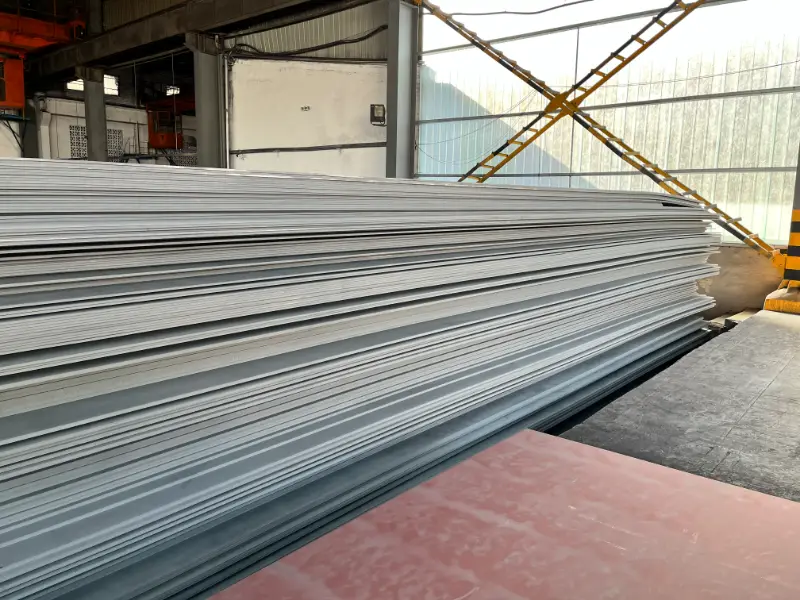
ASTM A514 Grade J (A514GRJ) High-Strength Quenched & Tempered Carbon Steel Plate
ASTM A514 Grade J (A514GRJ) High-Strength Quenched & Tempered Carbon Steel Plate
Explore the advanced mechanical and thermal properties of ASTM A514 Grade J steel plate. A high-yield, weldable quenched and tempered alloy for demanding structural applications.
Hot rolling, quenching and tempering, cutting, welding, forming
- Phone : +8618037372205
- Email : [email protected]
- WhatsApp: Contact via Whtsapp
- WeChat: +8618037372205
ASTM A514 Grade J High-Strength Quenched & Tempered Carbon Steel Plate Introduction
ASTM A514 Grade J is a high-strength, low-alloy carbon steel plate supplied in quenched and tempered condition, offering a minimum yield strength of 690 MPa (100 ksi). Its carefully controlled chemistry, including additions of chromium, molybdenum, boron, and titanium, provides deep hardenability and excellent weldability for heavy sections. The grade is widely used in structural applications where weight savings and high load-bearing capacity are critical.
- Excellent combination of high strength, toughness, and fatigue resistance
- Good atmospheric corrosion resistance compared to plain carbon steels
- Suitable for riveted, bolted, or welded construction
ASTM A514 Grade J High-Strength Quenched & Tempered Carbon Steel Plate Chemical Composition
The chemical composition of ASTM A514 Grade J is tightly controlled to achieve high hardenability and consistent mechanical properties after quenching and tempering. Boron and titanium are integral for effective hardening, while controlled low sulfur and phosphorus levels ensure notch toughness.
- Residual elements such as copper (max 0.30%) and nickel (max 1.0%) may be present but are not intentionally added.
- Iron forms the balance.
| Element | Content (%) | Notes |
|---|---|---|
| Carbon (C) | 0.12 - 0.21 | Essential for hardenability |
| Manganese (Mn) | 0.45 - 0.70 | Deoxidizer and strength enhancer |
| Phosphorus (P) | ≤ 0.015 | Impact toughness control |
| Sulfur (S) | ≤ 0.010 | Minimized for lamellar tearing resistance |
| Silicon (Si) | 0.20 - 0.35 | Deoxidation and strength |
| Chromium (Cr) | 0.50 - 0.80 | Hardenability and wear resistance |
| Molybdenum (Mo) | 0.40 - 0.60 | Hardenability depth and creep strength |
| Vanadium (V) | 0.03 - 0.08 | Grain refinement |
| Boron (B) | 0.001 - 0.005 | Microalloying for deep hardening |
| Titanium (Ti) | 0.01 - 0.03 | Nitrogen fixation and grain refinement |
ASTM A514 Grade J High-Strength Quenched & Tempered Carbon Steel Plate Thermal & Electrical Properties
Physical properties provided are typical for high-strength quenched and tempered carbon steel and are suitable for design calculations. Actual values may vary slightly depending on the precise heat treatment and composition.
- Data holds for ambient temperature unless noted otherwise.
- Values for thermal conductivity and specific heat are at room temperature.
| Property | Typical Value | Unit | Condition / Temperature |
|---|---|---|---|
| Density (ρ) | 7.85 | g/cm³ | Ambient temperature |
| Elastic modulus (E) | 205 | GPa | Tension, room temperature |
| Shear modulus (G) | 80 | GPa | Calculated from E and ν |
| Poisson's ratio (ν) | 0.28 - 0.30 | - | Ambient |
| Thermal expansion (α) | 11.7 | 10⁻⁶/K | 20 - 100 °C |
| Thermal expansion (α) | 12.5 | 10⁻⁶/K | 20 - 300 °C |
| Thermal conductivity (λ) | 42 | W/(m·K) | Room temperature |
| Specific heat capacity (c) | 475 | J/(kg·K) | Room temperature |
| Electrical resistivity (ρ_e) | 0.23 | µΩ·m | Room temperature |
ASTM A514 Grade J High-Strength Quenched & Tempered Carbon Steel Plate Mechanical Properties
Mechanical properties are determined on test coupons taken from quenched and tempered plates and correspond to the standard requirements of ASTM A514/A514M. Elongation values depend on plate thickness and gauge length. Bend test is performed to verify formability.
- Typical hardness range: 235-293 HBW.
- For thicknesses outside the listed ranges, supplementary requirements may apply.
| Property | Requirement | Unit | Test Condition |
|---|---|---|---|
| Yield strength (ReH) | ≥ 690 | MPa | Thickness ≤ 65 mm (2.5 in) |
| Yield strength (ReH) | ≥ 620 | MPa | Thickness > 65 mm to 150 mm (>2.5 to 6 in) |
| Tensile strength (Rm) | 760 - 895 | MPa | Thickness ≤ 65 mm |
| Tensile strength (Rm) | 690 - 895 | MPa | Thickness > 65 to 150 mm |
| Elongation (A50) | ≥ 18 | % | Thickness ≤ 19 mm (3/4 in), gauge 50 mm |
| Elongation (A50) | ≥ 18 | % | Thickness > 19 to 38 mm (3/4 to 1-1/2 in), gauge 50 mm |
| Elongation (A200) | ≥ 14 | % | Thickness ≤ 19 mm, gauge 200 mm (optional) |
| Bend test (180°) | D = 2t (no cracks) | - | Thickness ≤ 19 mm |
| Bend test (180°) | D = 3t (no cracks) | - | Thickness > 19 to 25 mm (>3/4 to 1 in) |
| Bend test (180°) | D = 4t (no cracks) | - | Thickness > 25 to 38 mm (>1 to 1-1/2 in) |
ASTM A514 Grade J High-Strength Quenched & Tempered Carbon Steel Plate Direct Equivalent Standards & Alternative Designations
| Country/Region | Standard | Grade | Notes |
|---|---|---|---|
| USA | ASTM A514/A514M | Grade J (UNS K11625) | Original specification |
| USA | ASME SA514/SA514M | Grade J | Identical for pressure vessel components under ASME BPVC |
ASTM A514 Grade J High-Strength Quenched & Tempered Carbon Steel Plate Application Introduction
ASTM A514 Grade J is engineered for heavy structural applications where high strength-to-weight ratio and good weldability are essential. Components are typically cut, cold formed (when possible), and welded, often in the as-delivered quenched and tempered condition.
- Avoid excessive heat input during welding to prevent dilution of the fine tempered martensitic structure.
- Stress relieving after welding is not generally required but may be specified for highly restrained joints.
Product Applications: Mobile crane telescoping booms, Dragline buckets and excavator grabs, Offshore platform substructures and nodes, Heavy-duty truck frames, Bridge girders and arch ribs, Compressor and pump components
Processed into products: Boom sections, latticed mast members, Load-bearing pins, bosses, and lugs, Wear plates and cutting edges, Weld fabrications for critical structural joints, Adapter frames for hydraulic excavators, Pressure vessel end plates (when using A517 Grade J)
Application industries: Mining and earthmoving equipment, Crane and heavy lifting equipment, Offshore and marine platforms, Bridge construction, Pressure vessel and storage tank (non-sour service), Railroad rolling stock
ASTM A514 Grade J High-Strength Quenched & Tempered Carbon Steel Plate Comparable High-Strength Steel Alternatives
| Country/Region | Standard | Grade | Remarks |
|---|---|---|---|
| Europe | EN 10025-6 | S690Q (1.8931) | Similar minimum yield and tensile properties; chemistry differs (no mandatory B/Ti). Direct substitution requires engineering assessment. |
| USA | ASTM A514/A514M | Grade H | Similar strength level, but different hardenability elements (Mn, B). Plate processing may differ. |
| USA | ASTM A517/A517M | Grade J | Identical to A514 Gr J but certified for pressure vessel plates; often interchangeable for structural use. |
| Japan | JIS G3128 | SHY685 | High yield strength plate for bridges; not directly equivalent but matches mechanical demands. |
Notes:
Welding considerations: Low hydrogen practices are mandatory. Preheat and interpass temperatures should be controlled according to section thickness. Heat treatment after forming: Hot forming above the tempering temperature will require re-heat treatment to restore mechanical properties. Test certification: Mill test reports should certify compliance to ASTM A514/A514M for each heat and lot.
- Share



