
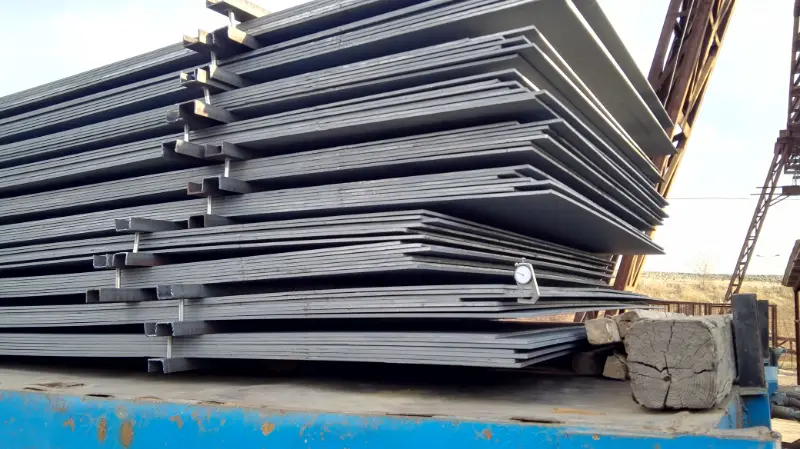
ASTM A514 Grade H (A514GRH) High-Strength Quenched and Tempered Carbon Steel Plate
ASTM A514 Grade H Carbon Steel Plate: High-Strength Quenched & Tempered Alloy for Heavy-Duty Structures
Explore the comprehensive properties of ASTM A514 Grade H (A514GRH) steel plate, including chemical composition, mechanical strength, thermal conductivity, and equivalent grades for global sourcing.
Hot rolling, quenching and tempering, stress relieving (after welding), cutting, bending, welding, machining
- Phone : +8618037372205
- Email : [email protected]
- WhatsApp: Contact via Whtsapp
- WeChat: +8618037372205
ASTM A514 Grade H High-Strength Quenched and Tempered Carbon Steel Plate Introduction
ASTM A514 Grade H (A514GRH) is a quenched and tempered high-strength low-alloy (HSLA) carbon steel plate under the standard ASTM A514/A514M. It combines excellent strength, toughness, and weldability, making it ideal for demanding structural applications. The alloy design includes chromium, nickel, molybdenum, vanadium, and boron for deep hardenability and superior mechanical properties.
- Yield strength of min 690 MPa (100 ksi) in plates up to 2.5 in. thickness
- Good notch toughness and fatigue resistance
- Formable and readily welded with appropriate procedures
- Commonly used in pressure vessels, bridges, construction equipment, and offshore structures
ASTM A514 Grade H High-Strength Quenched and Tempered Carbon Steel Plate Chemical Composition
The chemical limits for Grade H are designed to achieve high strength, toughness, and weldability. The balanced addition of chromium, nickel, molybdenum, and vanadium, along with a small amount of boron, enhances hardenability and mechanical performance after quenching and tempering. Silicon is controlled for deoxidation, while phosphorus and sulfur are kept low for cleanliness.
| Chemical Element | Standard Value | Remarks |
|---|---|---|
| Carbon (C) | 0.12 – 0.21 | Weldable with low carbon equivalent |
| Manganese (Mn) | 0.95 – 1.30 | Deoxidizer and strength enhancer |
| Phosphorus (P) | ≤ 0.035 | Max limit for toughness |
| Sulfur (S) | ≤ 0.040 | Max limit for cleanliness |
| Silicon (Si) | 0.20 – 0.35 | Deoxidizer |
| Chromium (Cr) | 0.40 – 0.65 | Improves hardenability and corrosion resistance |
| Nickel (Ni) | 0.30 – 0.70 | Enhances toughness and hardenability |
| Molybdenum (Mo) | 0.20 – 0.30 | Prevents temper embrittlement and increases high-temperature strength |
| Vanadium (V) | 0.03 – 0.08 | Grain refiner and carbide former |
| Boron (B) | 0.0005 – 0.005 | Remarkably improves hardenability in small amounts |
ASTM A514 Grade H High-Strength Quenched and Tempered Carbon Steel Plate Thermal and Electrical Physical Properties
These values are representative for quenched and tempered low-alloy steel of this type. Actual values may vary slightly depending on exact heat treatment and composition. Properties are measured at ambient temperature unless otherwise noted.
| Property | Typical Value | Unit | Test Condition |
|---|---|---|---|
| Density (ρ) | 7.85 | g/cm³ | 20 °C |
| Modulus of Elasticity (E) | 205 | GPa | Room temperature |
| Shear Modulus (G) | 80 | GPa | Room temperature |
| Poisson's Ratio (ν) | 0.30 | — | Room temperature |
| Thermal Expansion Coefficient (α) | 11.7 | 10⁻⁶/K | 20 – 100 °C |
| Thermal Conductivity (λ) | 42 | W/(m·K) | 20 °C |
| Specific Heat Capacity | 475 | J/(kg·K) | 20 °C |
| Electrical Resistivity (ρ_e) | 0.23 | µΩ·m | Room temperature |
ASTM A514 Grade H High-Strength Quenched and Tempered Carbon Steel Plate Mechanical Properties
Mechanical requirements are specified according to plate thickness. Test specimens are taken from the final heat-treated plate. For plates ordered without specifying thickness, the standard values for thickness ≤ 2.5 in. (63.5 mm) apply. The bending test is a guided bend test with a 180° angle. Elongation is measured on gauge lengths of 2 in. (50 mm) or 8 in. (200 mm) depending on plate thickness.
| Property | Required Value | Unit | Test Condition |
|---|---|---|---|
| Yield Strength (ReH) | 690 min | MPa | Transverse, thickness ≤ 2.5 in. (63.5 mm) |
| Tensile Strength (Rm) | 760 – 895 | MPa | Transverse, thickness ≤ 2.5 in. (63.5 mm) |
| Elongation (A) in 2 in. | 18 min | % | Thickness ≤ ¾ in. (19.05 mm), gauge length 2 in. (50 mm) |
| Elongation (A) in 8 in. | 14 min | % | Thickness ¾ in. to 2.5 in. (19.05–63.5 mm), gauge length 8 in. (200 mm) |
| Bend Test (180°) | No cracks | - | Bend diameter = 2t for t ≤ ¾ in., 2½t for ¾ < t ≤ 1¼ in., 3t for 1¼ < t ≤ 2 in. |
| Charpy V-Notch Impact (Optional) | Typically 27 J @ -40°C to 20°C | J | When supplementary requirement S5 is specified |
ASTM A514 Grade H High-Strength Quenched and Tempered Carbon Steel Plate Fully Equivalent Standards & Replaceable Grades
| Country/Region | Standard | Grade | Remarks |
|---|---|---|---|
| USA | ASTM A514/A514M | Grade H | Original standard – fully compliant |
| Europe | EN 10025-6 | S690QL / S690QL1 | Close equivalent with similar yield class; verify boron and vanadium content for hardenability matching |
| Japan | JIS G 3128 | SHY685 | High yield stress steel plate; similar strength and chemistry, check minor element tolerances |
| International | ISO 4950-2 | E690DD | Quenched and tempered steels with minimum yield of 690 MPa; compare carbon and alloy ranges |
ASTM A514 Grade H High-Strength Quenched and Tempered Carbon Steel Plate Application Introduction
ASTM A514 Grade H steel plates are widely used in heavy engineering where a combination of high strength, weldability, and toughness is required. The material performs well under both static and dynamic loading, and can be formed and machined with standard equipment. Post-weld heat treatment is often applied to relieve stress without significant loss of properties.
Product Applications: Bridges, bridge girders, and structural frameworks, Pressure vessels and storage tanks (ASME code applications), Excavator buckets, bulldozer blades, dump truck bodies, Drilling rigs and offshore platform components, Rail cars and heavy-duty truck chassis, Pipe and piping components for high-pressure service
Processed into products: Welded beams and columns for buildings, Reinforcement plates and gussets, Cutting edges for mining equipment, Stiffeners and nodes for offshore structures, Heavy-duty gears and shafts, Support brackets and boom sections for cranes, Flanges and manway covers for pressure vessels
Application industries: Construction and civil engineering, Mining and earthmoving equipment, Pressure vessel and boiler fabrication, Offshore and marine structures, Transportation and heavy vehicle manufacturing, Crane, lifting, and structural frames
ASTM A514 Grade H High-Strength Quenched and Tempered Carbon Steel Plate Similar/Alternative Materials for Substitution
| Country/Region | Standard | Grade | Remarks |
|---|---|---|---|
| USA | ASTM A514 | Other Grades (B, E, F, Q, etc.) | May have different alloying for specific thickness or toughness; same strength class but possible variations in carbon or nickel content |
| USA | ASTM A517 | Grade H | Pressure vessel plate with identical chemical limits and similar properties; often used interchangeably |
| Europe | EN 10025-6 | S690Q / S690QL | Without copper/nickel addition; similar strength, but verify notch toughness requirements |
| Germany | DIN EN 10025-6 | S690QL | Identical to EN grade; common in European structural engineering |
Notes:
Welding must follow AWS D1.1 or similar codes, using low-hydrogen practices and appropriate preheat/interpass temperatures to prevent cracking. Consult the steel manufacturer for specific heat treatment and bending radius recommendations when working with thick sections. Supplementary requirements such as impact testing (S5), ultrasonic examination (S8), or restricted chemistry may be specified per project needs.
- Thickness availability typically up to 65 mm (2.5 in.) under the standard; heavier plates may be produced by agreement.
- Surface condition: as-rolled, blast cleaned, or coated as per purchaser's request.
- Share



