
ASTM A514 Grade F (A514GRF) High-Strength Quenched & Tempered Alloy Steel Plate
ASTM A514 Grade F (A514GRF) High-Strength Quenched & Tempered Alloy Steel Plate
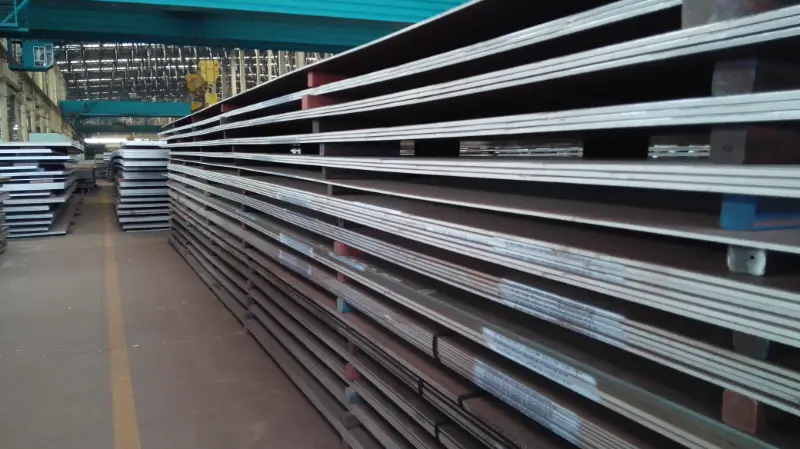
ASTM A514 Grade F is a high-yield, quenched and tempered alloy steel plate intended for structural applications requiring high strength and good weldability. It is characterized by a minimum yield strength of 690 MPa and excellent notch toughness at low temperatures.
Suitable for welding, bending, machining, and flame cutting; cold forming should be carried out with caution and preheating may be required
- Phone : +8618037372205
- Email : [email protected]
- WhatsApp: Contact via Whtsapp
- WeChat: +8618037372205
ASTM A514 Grade F High-Strength Quenched & Tempered Alloy Steel Plate Introduction
ASTM A514 Grade F (also designated A514GRF) is a high-strength, low-alloy structural steel plate produced under the ASTM A514/A514M specification. It is supplied in the quenched and tempered (Q&T) condition to achieve a minimum yield strength of 690 MPa (100 ksi) and tensile strength in the range of 760–895 MPa (110–130 ksi). The steel is characterized by a carefully controlled chemistry containing nickel, chromium, molybdenum, vanadium, and boron, which ensures deep hardenability and superior mechanical properties.
- Excellent combination of high strength, good toughness, and weldability
- Specially designed for heavy-duty structural components subjected to extreme loads
- Available in plate form with good flatness and surface quality
- Often used as a substitute for higher alloyed quenched and tempered grades in demanding applications
ASTM A514 Grade F High-Strength Quenched & Tempered Alloy Steel Plate Chemical Composition
The chemical composition according to ASTM A514/A514M for Grade F ensures consistent hardenability and mechanical properties after quenching and tempering. The microalloying with vanadium and controlled boron addition refines the grain structure and enhances toughness. All values are in weight percent.
- Heat analysis limits are mandatory; product analysis tolerances per ASTM A6/A6M apply.
- Boron content is carefully controlled to improve hardenability without impairing weldability.
| Element | Value (wt%) | Remarks |
|---|---|---|
| Carbon (C) | 0.10 – 0.20 | |
| Manganese (Mn) | 0.60 – 1.00 | |
| Phosphorus (P) | ≤ 0.035 | |
| Sulfur (S) | ≤ 0.040 | |
| Silicon (Si) | 0.15 – 0.35 | |
| Nickel (Ni) | 0.70 – 1.00 | |
| Chromium (Cr) | 0.40 – 0.65 | |
| Molybdenum (Mo) | 0.40 – 0.60 | |
| Vanadium (V) | 0.03 – 0.08 | |
| Boron (B) | 0.0005 – 0.005 | |
| Copper (Cu) | 0.15 – 0.50 |
ASTM A514 Grade F High-Strength Quenched & Tempered Alloy Steel Plate Typical Physical Properties
The following physical properties are typical for quenched and tempered alloy steels of this class, and are not part of the ASTM A514 specification. These values are provided for engineering calculations and should be verified when critical. Properties are measured at room temperature unless otherwise noted.
- Density is essentially constant across the grade.
- Thermal expansion and conductivity are representative of low-alloy steels.
| Property | Typical Value | Unit | Test Condition |
|---|---|---|---|
| Density (ρ) | 7.85 | g/cm³ | 20 °C |
| Modulus of Elasticity (E) | 205 | GPa | 20 °C |
| Shear Modulus (G) | 80 | GPa | 20 °C (calculated) |
| Poisson's Ratio (ν) | 0.30 | 20 °C | |
| Thermal Expansion Coefficient (α) | 11.7 | 10⁻⁶/K | 20 – 100 °C |
| Thermal Conductivity (λ) | ~30 | W/(m·K) | 100 °C |
| Specific Heat Capacity | ~475 | J/(kg·K) | 20 °C |
| Electrical Resistivity (ρₑ) | ~0.22 | µΩ·m | 20 °C |
ASTM A514 Grade F High-Strength Quenched & Tempered Alloy Steel Plate Mechanical Properties
Mechanical properties are determined from transverse test specimens taken from the plate in the quenched and tempered condition. Values apply to plate thicknesses up to 2 1/2 inches (63.5 mm) unless otherwise noted. Bend test and impact requirements are typical supplemental requirements.
- Yield strength determined by 0.2% offset method or 0.5% extension under load.
- Elongation measured on a 2-inch (50 mm) gauge length.
- Charpy V-notch impact testing is often required with a minimum energy of 20 ft·lbf (27 J) at −50 °F (−45 °C).
| Property | Standard Value | Unit | Test Condition |
|---|---|---|---|
| Yield Strength (ReH) | ≥ 690 (100 ksi) | MPa (ksi) | Transverse, plate thickness ≤ 63.5 mm |
| Tensile Strength (Rm) | 760 – 895 (110 – 130 ksi) | MPa (ksi) | Transverse, plate thickness ≤ 63.5 mm |
| Elongation (A) | ≥ 18 | % | 50 mm (2 in.) gauge length |
| Bend Test (Bend Diameter) | 2t | Plate thickness ≤ 19.0 mm (3/4 in.) | |
| Bend Test (Bend Diameter) | 3t | Plate thickness > 19.0 to 25.4 mm (>3/4 to 1 in.) | |
| Bend Test (Bend Diameter) | 4t | Plate thickness > 25.4 to 38.1 mm (>1 to 1 1/2 in.) | |
| Bend Test (Bend Diameter) | 5t | Plate thickness > 38.1 to 63.5 mm (>1 1/2 to 2 1/2 in.) | |
| Charpy V-Notch Impact (KV) | ≥ 27 | J (ft·lbf) | At −45 °C (−50 °F), typical supplemental requirement |
ASTM A514 Grade F High-Strength Quenched & Tempered Alloy Steel Plate Direct Equivalent Standards and Substitutes
| Country/Region | Standard | Grade | Remarks |
|---|---|---|---|
| USA | ASTM A517/A517M | Grade F | Pressure vessel quality plate; identical chemical and mechanical requirements to A514 Grade F. |
| USA | ASME SA517/SA517M | Grade F | ASME Boiler and Pressure Vessel Code version of A517 Grade F; identical to A514 Grade F. |
ASTM A514 Grade F High-Strength Quenched & Tempered Alloy Steel Plate Application Introduction
ASTM A514 Grade F is engineered for structural applications where high strength, reduced weight, and good low-temperature toughness are critical.
- Its high yield strength allows down-gauging in heavy equipment design.
- Typical fabricating processes include plasma/flame cutting, welding, bending, and machining, but strict adherence to recommended preheat and interpass temperatures is necessary to preserve mechanical properties.
- It is formable in the Q&T condition up to moderate deformation; sharp bending should be evaluated.
Product Applications: Crane booms and lattice structures, Dump truck bodies and load-haul-dump (LHD) buckets, Dragline and shovel components, Welded bridge girders and trusses, High-pressure vessels and industrial tanks, Offshore platform nodes and heavy-lift structures
Processed into products: Welded structural box sections, Boom hinge bosses and load-bearing pins, Wear plates and liner segments (where toughness is also needed), Support brackets and gussets in heavy frames, Custom-fabricated gear blanks and large-diameter shafts (after flame cutting)
Application industries: Heavy equipment and machinery manufacturing, Mining and earthmoving, Construction and infrastructure (bridges, buildings), Offshore and marine structures, Pressure vessel and storage tank fabrication, Transportation (heavy trucks, trailers, railcars)
ASTM A514 Grade F High-Strength Quenched & Tempered Alloy Steel Plate Performance-Similar Alternative Materials
| Country/Region | Standard | Grade | Remarks |
|---|---|---|---|
| European Union | EN 10025-6 | S690QL | Minimum yield strength 690 MPa, quenched & tempered. Comparable strength and toughness; chemistry differs (e.g., Cr, Mo, Ni not identical). Requires welding procedure qualification. |
| China | GB/T 16270 | Q690E | Equivalent high-strength structural steel. Impact energy at -40°C. Chemical composition slightly different; verify service conditions. |
| Japan | JIS G3128 | SHY685 | High yield strength steel plate with similar application range. Notch toughness comparable. Evaluation needed for substitution. |
Notes:
- Welding must follow a low-hydrogen practice; preheat (typically 100–200 °C) and interpass temperature control are recommended based on plate thickness and applicable welding codes (e.g., AWS D1.1).
- Post-weld heat treatment (PWHT) is not normally required but, if applied, should be performed below the original tempering temperature to avoid strength degradation.
- Thickness availability per ASTM A514: Grade F is supplied up to 2 1/2 in. (63.5 mm); consult mill for heavier sections.
- Impact test requirements, supplementary ultrasonic examination, and restrictive chemistry requirements (e.g., low sulfur for improved through-thickness properties) must be specified at the time of order when needed.
- Share



