
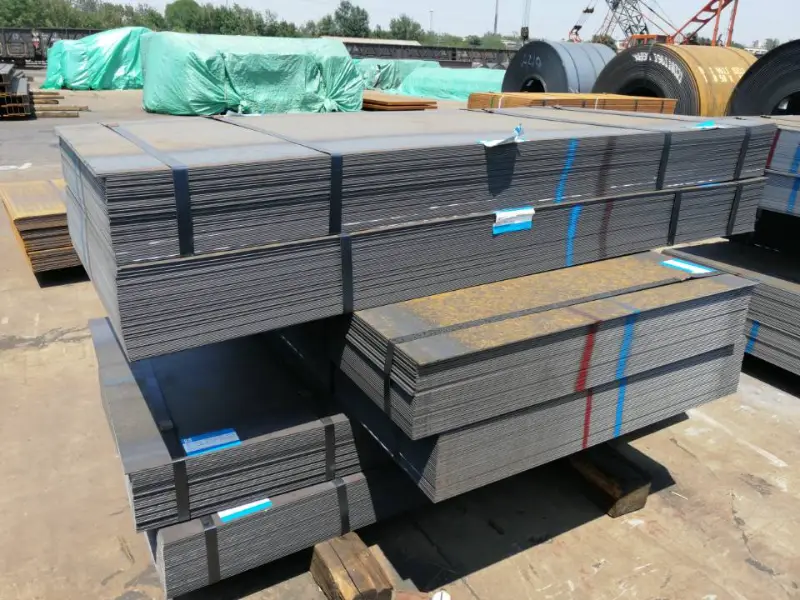
ASTM A709 Grade 36 (A709GR36) Carbon Steel Plate
ASTM A709 Grade 36 (A709GR36) Carbon Steel Plate - Bridge Structural Material Data
Comprehensive material properties for ASTM A709 Grade 36 carbon steel plate: chemical composition, mechanical and thermal properties, international equivalents, and applications in welded bridge structures.
Hot rolling, welding, bolting, cutting, cold forming, punching
- Phone : +8618037372205
- Email : [email protected]
- WhatsApp: Contact via Whtsapp
- WeChat: +8618037372205
ASTM A709 Grade 36 Carbon Steel Plate Introduction
ASTM A709 Grade 36 (A709GR36) is a carbon steel plate specified for use in bridges and other structural applications. It is essentially a bridge-quality version of ASTM A36 steel, offering reliable weldability, formability, and moderate strength.
- Minimum yield strength of 36 ksi (250 MPa) ensures structural integrity under static loads.
- Excellent notch toughness can be provided through supplementary requirements when low-temperature service is needed.
- Available in both non-weathering and weathering (with copper addition) grades for diverse environments.
Delivered in as-rolled, normalized, or stress-relieved condition, it is widely used for bolted and welded bridge components, building frames, and general structural fabrication.
ASTM A709 Grade 36 Carbon Steel Plate Chemical Composition – ASTM A709 Grade 36
The chemical composition of ASTM A709 Grade 36 follows the limits of ASTM A36, with adjustments for plate thickness to maintain weldability and strength. For thicknesses over 20 mm, carbon and manganese ranges are modified. Copper may be specified (minimum 0.20%) when weathering properties are required; otherwise it is residual. Silicon is not mandatory but is typically controlled for deoxidation.
| Element | Standard Value (≤20 mm) | Remarks |
|---|---|---|
| Carbon (C) | ≤ 0.26 % | For thickness ≤20 mm. 0.27% (20–40 mm), 0.28% (40–65 mm), 0.29% (65–100 mm), 0.29% (>100 mm). |
| Manganese (Mn) | 0.60 – 0.90 % | For thickness ≤20 mm. For >75 mm plates, min. 0.85% Mn is required with max. 1.20%. Adjusts with thickness. |
| Phosphorus (P) | ≤ 0.04 % | Maxima unchanged for all thicknesses. |
| Sulfur (S) | ≤ 0.05 % | Maxima unchanged for all thicknesses. |
| Silicon (Si) | ≤ 0.40 % | Usually 0.15–0.40% if silicon-killed. Not mandatory unless specified. |
| Copper (Cu) | ≥ 0.20 % (when specified) | Required only when Grade 36 is ordered with atmospheric corrosion resistance (weathering). Otherwise, Cu is incidental. |
ASTM A709 Grade 36 Carbon Steel Plate Thermal and Electrical Physical Properties – ASTM A709 Grade 36
Physical properties are typical for carbon structural steels and are measured at ambient temperature unless noted. These values are not part of the mandatory standard but are widely accepted for engineering calculations. Thermal conductivity and specific heat may vary with temperature; the data below represent the range from 0 to 100 °C.
| Property | Standard Value | Unit | Test Conditions |
|---|---|---|---|
| Density (ρ) | 7.85 | g/cm³ | At 20 °C (7833 kg/m³ is also acceptable). |
| Modulus of Elasticity (E) | 200 | GPa | At 20 °C, tension. |
| Shear Modulus (G) | 80 | GPa | Calculated from E and Poisson's ratio. |
| Poisson's Ratio (ν) | 0.26 | – | Elastic range. |
| Thermal Expansion Coefficient (α) | 11.7 | µm/m·°C | Mean coefficient between 0 °C and 100 °C. |
| Thermal Conductivity (λ) | 51.9 | W/m·K | At 20 °C. |
| Specific Heat Capacity | 486 | J/kg·K | At 20 °C. |
| Electrical Resistivity (ρ_e) | 0.142 | µΩ·m | At 20 °C. |
ASTM A709 Grade 36 Carbon Steel Plate Mechanical Properties – ASTM A709 Grade 36
Mechanical properties are valid for plates, bars, and shapes in the as-rolled condition. Elongation and bend test requirements vary with product thickness. Charpy V-notch impact testing is not mandatory but can be specified via supplementary requirement S5 (e.g., 20 J at -20 °C for fracture-critical applications). The values below conform to ASTM A709/A709M.
| Property | Standard Requirement | Unit | Test Conditions / Remarks |
|---|---|---|---|
| Yield Strength (ReH) | ≥ 250 (≥ 36 ksi) | MPa | Room temperature, 0.2% offset method, applicable to all thicknesses up to 100 mm. |
| Tensile Strength (Rm) | 400 – 550 (58 – 80 ksi) | MPa | Room temperature, measured on standard test specimen. |
| Elongation in 200 mm (8 in.) | ≥ 20 % | % | For plate thickness ≤20 mm; gauge length 200 mm. |
| Elongation in 50 mm (2 in.) | ≥ 23 % | % | For plate thickness ≤20 mm; gauge length 50 mm. For larger thicknesses, min. 20% typically applies. |
| Bend Test (Bend Diameter) | ≤ 1.5 × t (for t ≤ 20 mm) | – | 180° bend, mandrel diameter = 1.5 × plate thickness; for t = 20–25 mm → 2 t; t = 25–40 mm → 2.5 t; t = 40–50 mm → 3 t. |
| Charpy Impact (KV2) (if S5 specified) | ≥ 20 J at -20 °C (typical) | J | Transverse specimen, supplementary requirement S5; energy values may vary according to purchaser specification. |
ASTM A709 Grade 36 Carbon Steel Plate Materials with Identical/Equivalent Standards – ASTM A709 Grade 36 Substitutes
| Country/Region | Standard | Grade | Remarks |
|---|---|---|---|
| USA | ASTM A36/A36M | A36 | Identical chemical and mechanical requirements; not specific to bridge construction but widely used. |
| International | ISO 630 | Fe 360B | Comparable yield and tensile strength; may require verification for bridge service. |
| European Union | EN 10025-2 | S235JR | Yield 235 MPa, slightly lower; tensile range similar; suitability for bridges must be checked. |
| Japan | JIS G3101 | SS400 | General structural carbon steel; strength matches well; impact properties not guaranteed. |
| China | GB/T 700 | Q235B | Carbon structural steel with similar mechanical properties; often used in welded structures. |
ASTM A709 Grade 36 Carbon Steel Plate Application Introduction
ASTM A709 Grade 36 is a versatile carbon steel primarily used in structural applications where moderate strength and excellent welding characteristics are required. Its bridge-specific quality ensures reliable notch toughness when specified, making it safe for dynamic loads and low-temperature environments. Typical uses include:
Product Applications: Welded plate girders and box girders, Bridge decks and stringers, Building columns and beams, Support brackets and stiffeners, Trusses and space frames, Platforms and walkways
Processed into products: Flanges, webs, and splice plates in built-up sections, Base plates and anchor plates, Gusset plates and connection angles, Bracing elements for seismic and wind resistance, Crane runway beams and supports, Structural bolted connections and welded attachments
Application industries: Bridge engineering and infrastructure, Commercial and industrial building construction, Heavy equipment and machinery frames, Shipbuilding and offshore structures (with additional certifications), Railway and transportation structures
ASTM A709 Grade 36 Carbon Steel Plate Similar or Alternative Materials – Strength and Application Comparisons
| Country/Region | Standard | Grade | Remarks |
|---|---|---|---|
| USA | ASTM A572/A572M | Grade 42 | Higher yield (42 ksi) with improved strength-to-weight ratio; suitable for bridges when Grade 36 is insufficient. |
| European Union | EN 10025-2 | S275JR | Minimum yield 275 MPa, similar weldability; slightly stronger alternative for bridges and buildings. |
| International | ISO 630 | Fe 430B | Higher strength class (yield ~275 MPa); can replace Grade 36 with design adjustments. |
| USA | ASTM A709/A709M | Grade 50 | Next step up (345 MPa yield) in bridge steel; low-alloy, higher strength for primary members. |
Notes:
Supplementary requirements in ASTM A709 (such as S5 for Charpy impact testing, S18 for maximum carbon equivalent) can be invoked to tailor the material for fracture-critical bridges or demanding service conditions. Always confirm specific plate thickness and product analysis limits with the mill certificate. When welding, low-hydrogen practices are recommended to avoid cold cracking. The material is fully recyclable and meets many international environmental standards for steel construction.
- Share



