
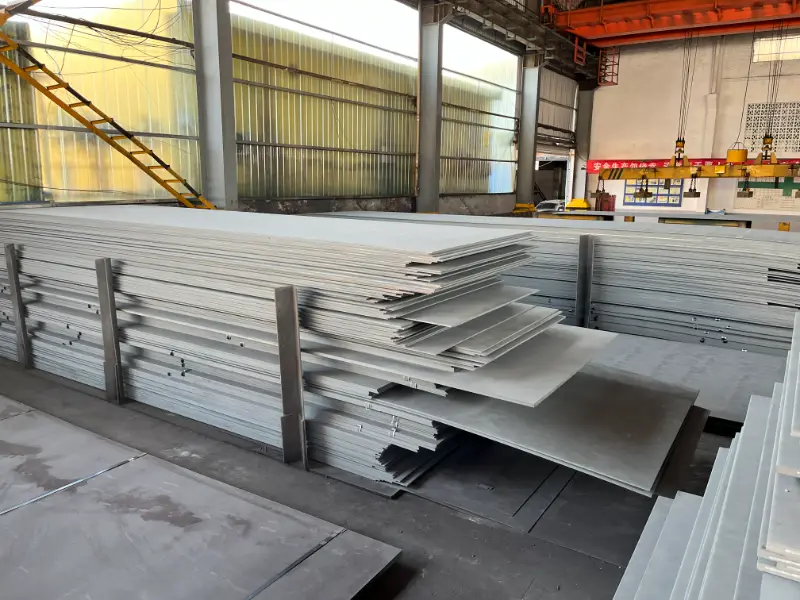
ASTM A633 Grade D (A633GRD) Normalized HSLA Steel Plate
ASTM A633 Grade D (A633GRD) Normalized HSLA Steel Plate - Properties & Equivalents
Complete technical data for ASTM A633 Grade D carbon and low-alloy high-strength steel plate: chemical composition, mechanical, thermal and electrical properties, international equivalents and application guidance.
Hot rolling followed by normalizing; also available as thermo-mechanical controlled processed (TMCP) upon agreement. Suitable for welding (all common methods), cutting, bending, machining.
- Phone : +8618037372205
- Email : [email protected]
- WhatsApp: Contact via Whtsapp
- WeChat: +8618037372205
ASTM A633 Grade D Normalized HSLA Steel Plate Introduction
ASTM A633 Grade D is a normalized high-strength low-alloy (HSLA) structural steel plate with minimum yield strength of 345 MPa (50 ksi) and excellent toughness at low temperatures. It is designed for welded structures where superior notch toughness is required. The alloy contains vanadium and niobium to refine the grain and improve strength. Typical delivery condition is normalized. It is widely used in bridges, buildings, heavy machinery and offshore components.
Key features:
- High strength combined with good ductility and weldability
- Fine-grain microstructure provides reliable Charpy V‑notch impact values down to −40 °C when specified
- Available as plates in thicknesses up to 100 mm
ASTM A633 Grade D Normalized HSLA Steel Plate Chemical Composition
The steel is fully killed and fine‑grain treated. Vanadium and niobium are the main microalloying elements. Nitrogen may be combined with vanadium. Copper, nickel, chromium and molybdenum are residual or optional elements.
The values represent ladle analysis according to ASTM A633/A633M‑18; product analysis tolerances apply as per ASTM A6.
| Element | Nominal Value (wt.%) | Remarks |
|---|---|---|
| C | ≤ 0.20 | max |
| Mn | 0.70 – 1.60 | for thickness ≤ 100 mm; product analysis margin +0.10 |
| P | ≤ 0.030 | max |
| S | ≤ 0.030 | max |
| Si | 0.15 – 0.50 | |
| Cu | ≤ 0.35 | when copper steel is specified |
| Ni | ≤ 0.25 | max, residual |
| Cr | ≤ 0.25 | max, residual |
| Mo | ≤ 0.08 | max |
| V | 0.02 – 0.15 | microalloying element |
| Nb (Cb) | 0.01 – 0.05 | microalloying element, also called columbium |
| Ti | 0.006 – 0.02 | optional for grain refinement, if agreed |
| N | 0.010 – 0.020 | optional, when vanadium‑nitrogen strengthening is used |
ASTM A633 Grade D Normalized HSLA Steel Plate Thermal and Electrical Physical Properties
These typical values are representative for normalized carbon‑manganese‑vanadium‑niobium structural steels at room temperature unless otherwise noted. They may vary slightly with actual composition and processing. Data are based on published literature for similar LSLA steels.
| Property | Typical Value | Unit | Test Conditions / Remarks |
|---|---|---|---|
| Density, ρ | 7.85 | g/cm³ (7850 kg/m³) | at 20 °C |
| Modulus of elasticity, E | 210 | GPa | room temperature |
| Shear modulus, G | 81 | GPa | calculated from E and ν |
| Poisson's ratio, ν | 0.30 | — | typical for structural steel |
| Thermal expansion coefficient, α | 11.7 | 10⁻⁶/°C | 20–100 °C range |
| Thermal conductivity, λ | 45 – 52 | W/(m·K) | decreases with increasing temperature; 45 W/m·K at 20 °C |
| Specific heat capacity, cp | 460 – 480 | J/(kg·K) | at 50–100 °C |
| Electrical resistivity, ρe | 0.16 – 0.18 | µΩ·m | at 20 °C |
ASTM A633 Grade D Normalized HSLA Steel Plate Mechanical Properties
Tensile and impact properties are determined on standard specimens taken from normalized plates. Values depend on plate thickness and orientation. The minimum Charpy energy applies when the supplementary requirement S5 is invoked (often specified for Grade D).
Bend test: conducted in accordance with ASTM A6; typically a bend diameter of 1.5 t to 2.5 t is satisfactory for the attained elongation.
| Property | Specified Value | Unit | Test Conditions / Remarks |
|---|---|---|---|
| Yield strength, ReH | ≥ 345 | MPa (50 ksi) | Plate thickness t ≤ 65 mm |
| Yield strength, ReH | ≥ 315 | MPa (45 ksi) | 65 mm < t ≤ 100 mm |
| Tensile strength, Rm | 485 – 620 | MPa (70 – 90 ksi) | t ≤ 65 mm |
| Tensile strength, Rm | 450 – 590 | MPa (65 – 85 ksi) | 65 mm < t ≤ 100 mm |
| Elongation, A (2 in. gauge) | ≥ 23 | % | t ≤ 20 mm, 50 mm gauge length, flat specimen |
| Elongation, A (8 in. gauge) | ≥ 18 | % | t ≤ 20 mm, 200 mm gauge length |
| Elongation, A (2 in. gauge) | ≥ 21 | % | 20 mm < t ≤ 40 mm |
| Elongation, A (2 in. gauge) | ≥ 19 | % | 40 mm < t ≤ 65 mm |
| Elongation, A (2 in. gauge) | ≥ 18 | % | 65 mm < t ≤ 100 mm |
| Charpy V‑notch, KV (longitudinal) | ≥ 27 | J (20 ft·lbf) | at −40 °C, supplementary requirement S5, t ≤ 65 mm |
| Charpy V‑notch, KV (transverse) | ≥ 20 | J (15 ft·lbf) | at −40 °C, S5 when transverse impact is specified |
ASTM A633 Grade D Normalized HSLA Steel Plate International Equivalent Grades – Direct or Closest Match
| Country/Region | Standard | Grade/Designation | Remarks |
|---|---|---|---|
| Europe | EN 10025-3:2019 | S355N | Normalized, min YS 355 MPa, TS 470‑630 MPa; impact at −20 °C (S355NL for −40 °C available). Fine‑grain steel, similar alloying concept. |
| International | ISO 630-2:2011 | E355DD | Normalized structural steel, min YS 355 MPa, impact at −20 °C (D), DD for −40 °C. Close chemistry and properties. |
| Japan | JIS G 3106:2015 | SM490B | YS ≥ 325 MPa for thick plates, TS 490‑610 MPa. Usually supplied as rolled or controlled‑rolled; impact at 0 °C. SM490C and SM490YB offer low‑temperature toughness. |
| China | GB/T 19879‑2015 | Q345GJD | Building structural steel, normalized. Min YS 345 MPa, TS 490‑620 MPa, impact at −20 °C (D), −40 °C (E). Close substitute for Grade D when low‑temperature toughness is required. |
| USA | ASTM A572/A572M | Grade 50 [345] | As‑rolled or controlled‑rolled HSLA steel, similar strength but without mandatory normalization and often lower toughness guarantees. Acceptable for many non‑critical applications. |
ASTM A633 Grade D Normalized HSLA Steel Plate Application Introduction
ASTM A633 Grade D is chosen for heavy structural components that must retain toughness at sub‑zero temperatures and offer good weldability. Its combination of strength and ductility makes it suitable for dynamic loading conditions.
Typical industries:
- Bridge engineering
- Building and infrastructure
- Offshore and shipbuilding (non‑coded)
- Heavy machinery and lifting equipment
- Mining and earth‑moving equipment
- Railway rolling stock
Product Applications: Bridge girders, trusses and deck plates, Structural columns and beams, Offshore flare booms and blast walls, Mining dump truck bodies and buckets, Railway underframe components, Large welded pipe piles
Processed into products: Gusset plates and splice plates, Welded built‑up sections, Lifting lugs and pad-eyes, Base plates and anchor boxes, Crane boom chords and webs, Heavy‑duty support brackets
Application industries: Bridge construction, Commercial and industrial building frames, Offshore platforms and wind tower foundations, Mining and earth-moving machinery, Railway wagons and bogies, Pressure vessel shells (non-ASME), Crane and heavy lifting equipment
ASTM A633 Grade D Normalized HSLA Steel Plate Similar Materials – Approximate Alternatives
| Country/Region | Standard | Grade | Remarks |
|---|---|---|---|
| USA | ASTM A572/A572M | Grade 50 (Type 1 or 2) | As‑rolled HSLA steel with similar strength level; may need supplementary impact test to match Grade D toughness. |
| Europe | EN 10025-2 | S355J2+N | Structural steel, normalized. Min YS 355 MPa, impact at −20 °C. Not microalloyed like A633 Grade D, but commonly substituted. |
| China | GB/T 1591‑2018 | Q345D | Hot‑rolled or normalized HSLA steel. Min YS 345 MPa, impact at −20 °C. Chemistry differs but performance is comparable for many static applications. |
| Russia | GOST 19281‑2014 | 10G2FB | Low‑alloy steel with similar strength and toughness (analogous to Fe510D). |
Notes:
Additional Remarks:
- ASTM A633 Grade D is normally supplied as fully killed, fine‑grain practice, and can be welded by all common methods (SMAW, SAW, GMAW/FCAW) with low‑hydrogen procedures and proper preheat/interpass control.
- For through‑thickness properties, supplementary requirement S17 (Z‑direction tensile test) can be specified.
- The steel is subject to the general requirements of ASTM A6/A6M including tolerances, surface quality, and repair procedures.
- When ordering, the Charpy impact requirement and test temperature must be clearly stated; unless specified, impact testing is supplementary.
- A633 Grade D is not intended for pressure vessel service under ASME code; for such applications refer to SA‑841 or SA‑516 grades with appropriate notch toughness.
- Share



