
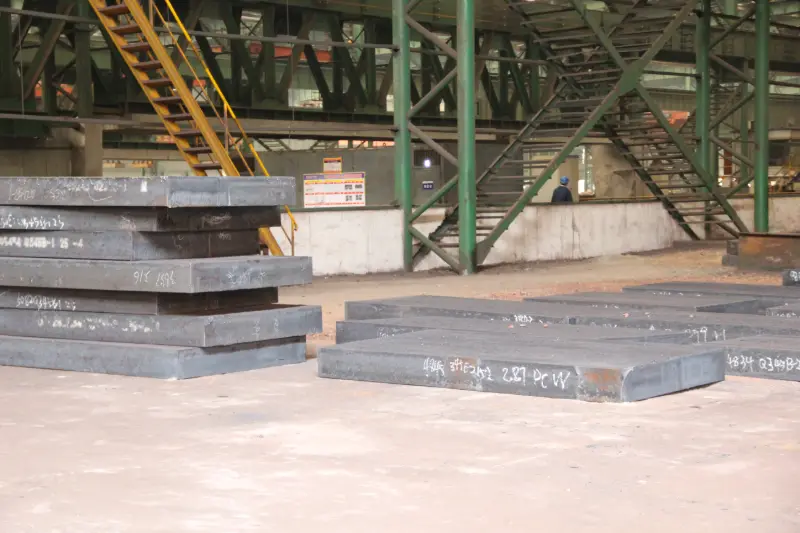
ASTM A633 Grade E Structural Steel Plate
ASTM A633 Grade E Low-Temperature High-Strength Structural Steel Plate
ASTM A633 Grade E is a normalized high-strength low-alloy steel designed for low-temperature structural applications. It offers excellent toughness and weldability.
Hot rolling followed by normalizing; suitable for welding, cold forming, machining, and hot forming with subsequent normalizing.
- Phone : +8618037372205
- Email : [email protected]
- WhatsApp: Contact via Whtsapp
- WeChat: +8618037372205
ASTM A633 Grade E Structural Steel Plate Introduction
ASTM A633 Grade E (A633 Gr. E) is a normalized high-strength low-alloy (HSLA) structural steel plate specified for low-temperature service. It is supplied in the normalized condition to ensure uniform microstructure, improved toughness, and reliable mechanical properties. This grade contains deliberate additions of copper, vanadium, and optional niobium to enhance strength and corrosion resistance while maintaining good weldability. Typical yield strength is 380 MPa (55 ksi) minimum, with tensile strength ranging from 515 to 690 MPa (75-100 ksi). Charpy V-notch impact toughness of 27 J (20 ft·lbf) at -45°C (-50°F) is mandated for applications in cold climates and cryogenic environments. The steel is widely used in welded bridges, buildings, offshore structures, pressure vessels, and heavy machinery where high strength and notch toughness at low temperatures are critical. Its balanced chemistry allows field welding with low preheat, making it suitable for large-scale fabrication.
ASTM A633 Grade E Structural Steel Plate Chemical Composition
The chemical composition of ASTM A633 Grade E is designed to provide high strength, enhanced atmospheric corrosion resistance (via copper content), and excellent impact toughness at low temperatures. Ladle analysis values are per ASTM A633/A633M. Optional elements like niobium may be added for grain refinement. Residual elements are controlled to maintain weldability.
| Element | Content (wt%) | Remarks |
|---|---|---|
| Carbon (C) | 0.22 max | Heat analysis |
| Manganese (Mn) | 1.15 – 1.50 | Heat analysis |
| Phosphorus (P) | 0.035 max | Heat analysis |
| Sulfur (S) | 0.035 max | Heat analysis |
| Silicon (Si) | 0.15 – 0.50 | Heat analysis |
| Copper (Cu) | 0.20 min | Required minimum |
| Vanadium (V) | 0.02 – 0.10 | Heat analysis |
| Niobium (Nb) | 0.01 – 0.05 | Optional, by agreement |
| Nickel (Ni) | 0.50 max | Residual element (unless otherwise agreed) |
| Chromium (Cr) | 0.25 max | Residual element |
| Molybdenum (Mo) | 0.08 max | Residual element |
| Nitrogen (N) | 0.03 max | Only if nitrogen-fixing elements are present |
ASTM A633 Grade E Structural Steel Plate Thermal and Electrical Physical Properties
These physical properties are representative for normalized low-alloy steel at room temperature. Values may vary slightly with composition and temperature. Density, elastic modulus, and thermal expansion are essential for structural design. Electrical resistivity is provided for induction heating or electrical applications.
| Property | Typical Value | Unit | Test Condition |
|---|---|---|---|
| Density (ρ) | 7.85 | g/cm³ | 20°C |
| Elastic Modulus (E) | 205 | GPa | 20°C |
| Shear Modulus (G) | 80 | GPa | 20°C |
| Poisson's Ratio (ν) | 0.29 | — | 20°C |
| Thermal Expansion Coefficient (α) | 11.7 | ×10⁻⁶/°C | 0 – 100°C |
| Thermal Expansion Coefficient (α) | 12.5 | ×10⁻⁶/°C | 0 – 200°C |
| Thermal Conductivity (λ) | 51.9 | W/(m·K) | 20°C |
| Thermal Conductivity (λ) | 48.6 | W/(m·K) | 200°C |
| Specific Heat Capacity (c) | 0.49 | J/(g·K) | 20 – 100°C |
| Electrical Resistivity (ρ_e) | 0.142 | µΩ·m | 20°C |
ASTM A633 Grade E Structural Steel Plate Mechanical Properties
Mechanical properties are determined on specimens taken from normalized plates. Yield strength, tensile strength, and elongation are measured according to ASTM A370. Charpy impact tests are conducted on longitudinal specimens at -45°C (-50°F). Bending properties are verified by cold-bend testing. Values in the table are minimum requirements unless noted.
| Property | Specified Value | Unit | Test Condition |
|---|---|---|---|
| Yield Strength (ReH) | 380 min (55 min) | MPa (ksi) | Thickness ≤ 65 mm (2.5 in.) |
| Yield Strength (ReH) | 345 min (50 min) | MPa (ksi) | Thickness > 65 to 100 mm (2.5 to 4 in.) |
| Tensile Strength (Rm) | 515 – 690 (75 – 100) | MPa (ksi) | Thickness ≤ 100 mm (4 in.) |
| Elongation in 200 mm (A) | 18 min | % | Thickness ≤ 65 mm |
| Elongation in 200 mm (A) | 16 min | % | Thickness > 65 to 100 mm |
| Elongation in 50 mm | 23 min (approx.) | % | Longitudinal, all thicknesses |
| Bend Test (Cold) | No cracks | — | Bend diameter = 2 × plate thickness (t ≤ 25.4 mm); larger for thicker |
| Charpy V-Notch (KV) | 27 min (20 min) | J (ft·lbf) | At -45°C (-50°F), longitudinal |
ASTM A633 Grade E Structural Steel Plate Full Equivalent Materials and Replaceable Grades
| Country/Region | Standard | Grade | Remarks |
|---|---|---|---|
| International (ISO) | ISO 4950-2:1995 | E420 | Same normalized condition, minimum yield 420 MPa, good low-temperature toughness. Direct substitute with slight strength overmatch. |
| European Union | EN 10025-3:2019 | S420N | Normalized fine-grain structural steel; yield 420 MPa min, impact at -20°C optionally at -50°C (S420NL). Match requires confirmation of impact temperature. |
| China | GB/T 1591-2018 | Q420D | Low-alloy high-strength structural steel; normalized delivery recommended. Impact at -20°C, min yield 420 MPa. For -50°C use, specify normalized + Q420E. |
| Japan | JIS G3106:2015 | SM520C | Welded structural steel; min yield 355 MPa, tensile 520–640 MPa, impact at 0°C. Not a full equivalent due to lower yield but often used in similar roles. |
ASTM A633 Grade E Structural Steel Plate Application Introduction
ASTM A633 Grade E is chosen for its combination of high strength, excellent low-temperature toughness, and weldability. The following industries, products, and specific components illustrate its typical usage:
Product Applications: Welded plate girders and box sections for major bridges, Offshore platform legs and nodes, Low-temperature liquid storage tank shells, Heavy-lift crane booms and undercarriages, Support frames for stadiums and airports, Railcar underframes and hopper cars
Processed into products: High-strength splice plates and gusset plates, Welded I-beams and built-up columns, Chord members of truss bridges, Stiffeners and diaphragms in tanks, Pedestal beams and bearing brackets in heavy machinery, Cold-formed angle and channel profiles (after normalizing)
Application industries: Bridge Construction – long-span bridges, pedestrian bridges, bridge girders, Offshore and Marine – platform structures, decks, modules, living quarters, Pressure Vessels and Storage Tanks – liquefied gas storage, low-temperature pipes, Heavy Machinery and Mining Equipment – frames, booms, crane structures, Building and Infrastructure – columns, trusses, transfer plates, Railway Transport – freight car bodies, bogie frames
ASTM A633 Grade E Structural Steel Plate Similar / Alternative Materials Recommendation
| Country/Region | Standard | Grade | Remarks |
|---|---|---|---|
| United States | ASTM A572/A572M | Grade 60 [415] | HSLA structural steel, yield 415 MPa min, not mandatory normalized, impact not specified. Similar strength but lower toughness requirement. |
| United States | ASTM A573/A573M | Grade 70 [485] | Normalized carbon-manganese-silicon steel for structural use at moderate and low temperatures. Higher strength, Charpy at -1 to -45°C depending on thickness. |
| European Union | EN 10025-3 | S460N | Normalized fine-grain steel, min yield 460 MPa, good toughness. Higher strength; suitable for heavier sections. |
| International (ISO) | ISO 4950-2 | E355 | Lower yield class (355 MPa) providing similar low-temperature toughness. Suitable if strength requirements are relaxed. |
Notes:
This steel is typically supplied in the normalized condition. For thicknesses above 40 mm, normalizing rolling may be agreed upon. Preheating before welding is generally not necessary for plates up to 50 mm, but low-hydrogen practices are recommended. Post-weld heat treatment (PWHT) can be applied if required by the design code without degrading toughness significantly. Copper content (0.20% min) provides approximately twice the atmospheric corrosion resistance of plain carbon steel, often eliminating the need for painting in mild environments. For critical low-temperature service, supplementary notch toughness testing (e.g., drop-weight) may be specified.
- Share



