
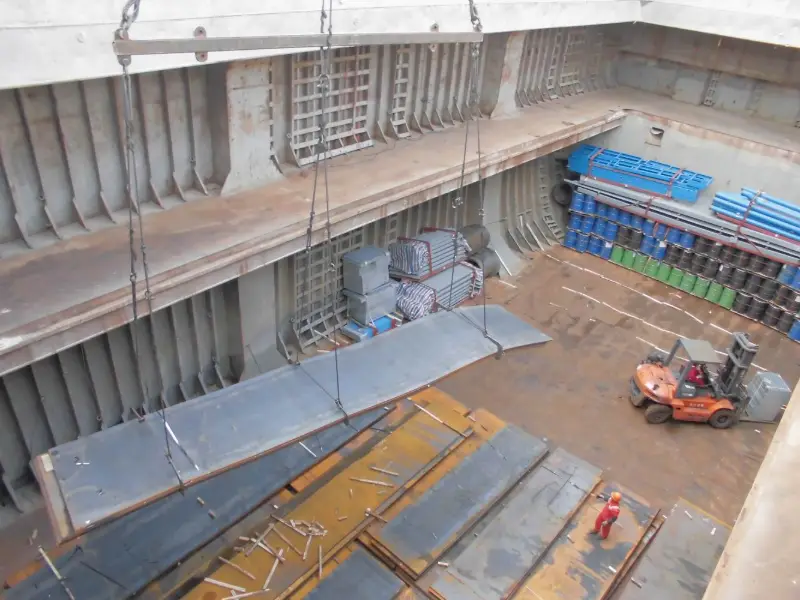
ASTM A633 Grade C High-Strength Low-Alloy Structural Steel Plate
ASTM A633 Grade C High-Strength Low-Alloy Structural Steel Plate - Normalized
Explore ASTM A633 Grade C (A633GRC), a normalized high-strength low-alloy structural steel plate with minimum yield strength 345 MPa, excellent notch toughness, and good weldability for heavy-duty applications.
Hot rolling followed by normalizing; suitable for welding, cold forming, bending, and machining
- Phone : +8618037372205
- Email : [email protected]
- WhatsApp: Contact via Whtsapp
- WeChat: +8618037372205
ASTM A633 Grade C High-Strength Low-Alloy Structural Steel Plate Introduction
ASTM A633 Grade C (A633GRC) is a normalized high-strength low-alloy structural steel plate designed for welded, riveted, or bolted construction. It offers a minimum yield strength of 345 MPa (50 ksi) and tensile strength between 485 and 620 MPa (70–90 ksi). The grade is specially formulated with micro-alloying elements such as vanadium and niobium to refine grain size and enhance toughness, particularly at low temperatures. The steel is typically supplied in the normalized condition, which ensures uniform mechanical properties and improved notch toughness. It finds extensive use in heavy structural applications where weight savings and high strength are critical, such as bridges, offshore structures, and high-rise buildings. Good weldability is maintained through controlled carbon equivalent, making it suitable for fabrication without post-weld heat treatment in many cases.
ASTM A633 Grade C High-Strength Low-Alloy Structural Steel Plate Chemical Composition
Chemical composition limits according to ASTM A633/A633M for Grade C. Values represent maximum unless a range is specified. Residual elements are controlled to ensure weldability and notch toughness.
- Carbon is limited to 0.20% max to maintain good weldability.
- Manganese increases strength and hardenability while ductility is preserved.
- Vanadium and niobium provide grain refinement and precipitation strengthening.
| Element | Standard Value | Remarks |
|---|---|---|
| Carbon (C) | 0.20% max | Maximum allowable |
| Manganese (Mn) | 1.15–1.50% | Range |
| Phosphorus (P) | 0.035% max | Maximum allowable |
| Sulfur (S) | 0.040% max | Maximum allowable |
| Silicon (Si) | 0.15–0.50% | Range |
| Copper (Cu) | 0.20% min (if specified) | Optional, minimum when required for atmospheric corrosion resistance |
| Chromium (Cr) | 0.25% max | Residual |
| Nickel (Ni) | 0.25% max | Residual |
| Molybdenum (Mo) | 0.08% max | Residual |
| Vanadium (V) | 0.01–0.05% | Microalloying range |
| Niobium (Cb) | 0.005–0.05% | Microalloying range, may also be reported as Nb |
| Aluminum (Al) | 0.02% min (if used for grain refining) | Optional minimum when employed as grain refiner |
ASTM A633 Grade C High-Strength Low-Alloy Structural Steel Plate Thermal and Electrical Physical Properties
The following physical properties are typical for structural steels of similar composition and are not part of the ASTM A633 specification. Actual values may vary slightly with processing conditions.
- Density, elastic moduli, and Poisson's ratio are valid at room temperature.
- Thermal expansion and conductivity are given for near-room-temperature ranges; they change with increasing temperature.
- Electric resistivity is influenced by alloy content.
| Property | Typical Value | Unit | Condition / Temperature |
|---|---|---|---|
| Density (ρ) | 7.85 | g/cm³ | Room temperature |
| Elastic modulus (E) | 200–210 | GPa | Room temperature, tension |
| Shear modulus (G) | 79–81 | GPa | Room temperature |
| Poisson's ratio (ν) | 0.27–0.30 | – | Room temperature |
| Thermal expansion coefficient (α) | 11.7 × 10⁻⁶ | K⁻¹ | 20 °C to 100 °C; increases to approx. 13.0 × 10⁻⁶ at 300 °C |
| Thermal conductivity (λ) | 50 | W/(m·K) | At 20 °C; decreases with temperature, approx. 42 W/(m·K) at 300 °C |
| Specific heat capacity (c) | 450 | J/(kg·K) | Room temperature; increases with temperature |
| Electrical resistivity (ρ_e) | 0.25 × 10⁻⁶ | Ω·m | Room temperature, typical for carbon-manganese steel |
ASTM A633 Grade C High-Strength Low-Alloy Structural Steel Plate Mechanical Properties
Tensile and impact properties for normalized plates as per ASTM A633 Grade C. All values are minimum unless otherwise noted. The tensile test is performed in the transverse direction.
- Yield strength (0.2% offset) and tensile strength apply to the full range of thicknesses.
- Elongation is determined on a gauge length of 200 mm (8 in) for standard specimens, or proportionally on 50 mm (2 in).
- Charpy V-notch impact toughness (longitudinal) is specified for service at different temperatures; typical requirements shown correspond to a minimum average absorbed energy of 20 J at the test temperature.
| Property | Standard Required Value | Unit | Test Condition |
|---|---|---|---|
| Yield strength (ReH) | 345 min | MPa (ksi) | All thicknesses, normalized, transverse direction, 0.2% offset; (50 ksi min) |
| Tensile strength (Rm) | 485–620 | MPa (ksi) | All thicknesses, normalized, transverse direction; (70–90 ksi range) |
| Elongation (A) | 18 min (for 200 mm gauge), 23 min (for 50 mm gauge) | % | Standard specimen, plate thickness ≤ 100 mm; values slightly vary for thicker plates; gauge length 200 mm (8 in) or 50 mm (2 in) |
| Bend test (cold bend) | No cracks or defects | – | Bend diameter varies with thickness; typically 180° bend with diameter 2t to 3t (t = plate thickness); transverse sample |
| Charpy V-notch impact (KV, longitudinal) | 20 min (average) | J (ft·lbf) | Test temperature –20°C (–4°F) or as agreed; single minimum value 16 J; typical requirement (optional in standard) |
ASTM A633 Grade C High-Strength Low-Alloy Structural Steel Plate Exact Match Standard and Substitute Grade Recommendations
| Country/Region | Standard / Specification | Grade / Designation | Remarks |
|---|---|---|---|
| International | ASTM A633/A633M | Grade C | Original specification; covers normalized high-strength low-alloy plates |
| European Union | EN 10025-3 | S355NL | Similar strength class, normalized, and with low-temperature toughness requirements (minimum impact energy 27 J at –50 °C for NL); chemical composition differs, consult producer for full equivalence |
| Japan | JIS G 3106 | SM490B | Comparable tensile properties (490–610 MPa tensile, min 325 MPa yield); not fully identical in normalizing and toughness; may be used after agreement |
| China | GB/T 1591 | Q345D | Similar yield strength (345 MPa) but with different microalloying; Q345D requires impact at –20 °C; may be cross-rolled upon customer's approval |
| International (ISO) | ISO 4950-3 | E355DD | High yield strength flat products; E355DD is delivered normalized and has similar tensile strength range; but chemical composition and impact properties may vary |
ASTM A633 Grade C High-Strength Low-Alloy Structural Steel Plate Application Introduction
ASTM A633 Grade C is designed for heavy structural applications where high strength, weldability, and notch toughness are essential. The steel is often used in normalized condition to meet impact requirements at low temperatures. Typical industries and products include:
Product Applications: Bridge girders, deck plates, and bearing assemblies, Offshore platform legs, nodes, and stiffened panels, Mining truck frames and shovel components, High-stress structural members in stadiums and airports, Industrial crane booms and gantry structures
Processed into products: Welded built-up beams and columns, Pinned or bolted connection plates, Stiffeners and web plates, Bent or cold-formed structural sections, Circular hollow sections (if fabricated from plate)
Application industries: Bridge construction (highway and railway bridges), Offshore and marine structures (jack-up rigs, platform legs), Pressure vessel manufacturing (external shells and supports), Heavy machinery (mining trucks, bulldozer frames), Building and infrastructure (high-rise columns, trusses), Railroad car manufacturing, Crane manufacturing (boom sections, turntables)
ASTM A633 Grade C High-Strength Low-Alloy Structural Steel Plate Similar or Approximate Substitute Grades
| Country/Region | Standard / Specification | Grade / Designation | Remarks |
|---|---|---|---|
| European Union | EN 10025-4 | S355ML | Thermomechanical rolled; comparable strength but different delivery condition; may be used if normalizing is not mandatory |
| USA | ASTM A572 / A572M | Grade 50 | Hot-rolled high-strength low-alloy structural steel; minimum yield 345 MPa, but not normally normalized; toughness may be lower |
| USA | ASTM A588 / A588M | Grade A | High-strength weathering steel, 345 MPa yield, but with added Cu for atmospheric corrosion resistance; not requiring normalization |
| India | IS 2062 | E350 BR / E350 C | High strength steel with similar yield strength; uses variant microalloying; comparable in static properties |
Notes:
- This material is typically ordered with supplementary requirements for Charpy V-notch testing at a specified temperature (e.g., –20 °C) and evidence of normalizing heat treatment.
- Welding procedures should consider the carbon equivalent (CE) of the plate, which is normally kept ≤ 0.45% to avoid cold cracking. Preheating may be required for thicker sections.
- The steel has limited atmospheric corrosion resistance (unless Cu is specified at 0.20% min), so protective coatings are recommended for outdoor exposure.
- Thickness range covered by the standard is up to 150 mm; mechanical property requirements are independent of thickness up to 150 mm, with reduced elongation for very thick plates.
- The data provided here is based on the ASTM A633/A633M-18 edition; always refer to the latest active standard for official requirements.
- Share



