
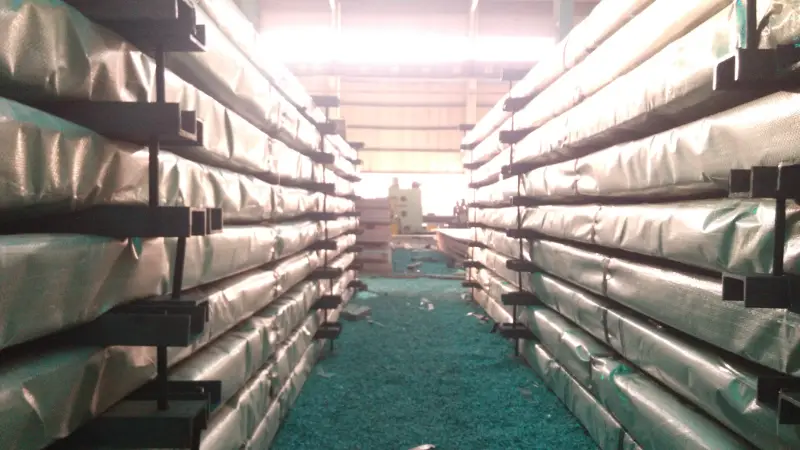
ASTM A633 Grade A Low-Alloy High-Strength Structural Steel Plate
ASTM A633 Grade A (A633GRA) High-Strength Steel Plate – Composition, Properties & Equivalents
Detailed data sheet for ASTM A633 Grade A (A633GRA) carbon and low-alloy high-strength steel plate: chemical composition, mechanical and thermal properties, international equivalents, similar materials, and application guidance.
Hot rolling, normalizing, welding, machining, cold forming (limited), flame cutting
- Phone : +8618037372205
- Email : [email protected]
- WhatsApp: Contact via Whtsapp
- WeChat: +8618037372205
ASTM A633 Grade A Low-Alloy High-Strength Structural Steel Plate Introduction
ASTM A633 Grade A (A633GRA) is a normalized, low-alloy, high-strength structural steel plate primarily used in welded, bolted, or riveted construction. It offers a minimum yield strength of 290 MPa (42 ksi) and tensile strength in the range of 430–570 MPa (62–82 ksi). The steel features a carbon-manganese chemistry with controlled silicon content, which ensures good weldability and adequate notch toughness for general structural applications. Normalizing refines the grain structure, enhancing uniformity of mechanical properties through thickness. This grade is often specified for bridges, buildings, offshore platforms, and pressure vessel components where moderate strength and reliable ductility are required.
ASTM A633 Grade A Low-Alloy High-Strength Structural Steel Plate Chemical Composition
The chemical limits for ASTM A633 Grade A are prescribed in ASTM A633/A633M. The steel is carbon-manganese based with silicon added for deoxidation. Residual elements such as copper, nickel, chromium, and molybdenum may be present but are not specifically limited for Grade A. The following maximum values apply unless supplementary requirements are specified.
| Chemical Element | Standard Value | Notes |
|---|---|---|
| Carbon, C | ≤0.18% | Heat analysis, maximum |
| Manganese, Mn | 1.00–1.35% | Range |
| Phosphorus, P | ≤0.035% | Maximum |
| Sulfur, S | ≤0.040% | Maximum |
| Silicon, Si | 0.15–0.50% | Range |
ASTM A633 Grade A Low-Alloy High-Strength Structural Steel Plate Thermal, Electrical and Physical Properties
These typical physical properties are representative of carbon-manganese low-alloy steels in the normalized condition. They are not mandatory values from ASTM A633 but are frequently used for engineering design. Slight variations may occur depending on exact composition and processing.
| Property | Typical Value | Unit | Test Condition |
|---|---|---|---|
| Density (ρ) | 7.85 | g/cm³ | Room temperature |
| Modulus of Elasticity (E) | 205 | GPa | Room temperature |
| Shear Modulus (G) | 80 | GPa | Room temperature |
| Poisson's Ratio (ν) | 0.30 | — | Room temperature |
| Thermal Expansion Coefficient (α) | 12 ×10⁻⁶ | /°C | 20–100 °C |
| Thermal Expansion Coefficient (α) | 13 ×10⁻⁶ | /°C | 20–200 °C |
| Thermal Expansion Coefficient (α) | 14 ×10⁻⁶ | /°C | 20–400 °C |
| Thermal Conductivity (λ) | 52 | W/(m·K) | at 20 °C |
| Specific Heat Capacity | 470 | J/(kg·K) | Room temperature |
| Electrical Resistivity (ρₑ) | 0.15 | µΩ·m | Room temperature |
ASTM A633 Grade A Low-Alloy High-Strength Structural Steel Plate Mechanical Properties
Mechanical testing is performed on specimens taken from normalized plates. Values listed comply with ASTM A633/A633M and the supplementary requirements of ASTM A6/A6M.
Tensile requirements: Applicable for thicknesses up to 100 mm (4 in.).
Elongation: Measured on specimens with 200 mm (8 in.) or 50 mm (2 in.) gauge length.
Bend test: 180° cold bend with mandrel diameter dependent on plate thickness.
| Property | Required Value | Unit | Test Condition |
|---|---|---|---|
| Yield Strength (ReH) | ≥290 | MPa | Thickness ≤100 mm |
| Tensile Strength (Rm) | 430–570 | MPa | Thickness ≤100 mm |
| Elongation (A) | ≥23 | % | Gauge length 200 mm; all thicknesses |
| Elongation (A) | ≥18 | % | Gauge length 50 mm; all thicknesses |
| Bend Test (Mandrel Diameter) | 1.5t (≤19 mm), 2t (>19–25 mm), 2.5t (>25–50 mm), consult standard for other thicknesses | — | 180° cold bend |
ASTM A633 Grade A Low-Alloy High-Strength Structural Steel Plate Exact Equivalent Standards & Alternative Grade Recommendations
| Country/Region | Standard | Grade | Remarks |
|---|---|---|---|
| USA | ASME SA633/SA633M | Grade A | Completely identical to ASTM A633 Grade A |
ASTM A633 Grade A Low-Alloy High-Strength Structural Steel Plate Application Introduction
ASTM A633 Grade A is widely used in heavy fabricated steelwork because of its balanced strength and ductility in the normalized condition. Typical fields and items include:
Product Applications: Structural steel plates for welding, Heavy beams and columns, Built-up box sections, Tubular structures, Piling and sheet piles (when strength governs)
Processed into products: Bridge main girders and diaphragms, Pressure vessel shells and end plates, Crane booms and lifting beams, Offshore platform legs and braces, Excavator booms and chassis, Wind turbine tower base plates, Building frame nodes and stiffeners
Application industries: Civil construction and infrastructure (bridges, stadiums, high-rise buildings), Offshore and marine engineering (platform structures, decks), Pressure vessel and tank manufacturing (shell courses, heads), Mining and earthmoving equipment (frames, booms), Wind energy (tower flanges, foundation plates)
ASTM A633 Grade A Low-Alloy High-Strength Structural Steel Plate Similar / Alternative Material Recommendations
| Country/Region | Standard | Grade | Remarks |
|---|---|---|---|
| Europe | EN 10025-3 | S275N | Normalized; min. yield 275 MPa, tensile 370–510 MPa; slightly lower strength, similar weldability |
| International | ISO 4950-2 | Fe290B | Normalized high yield steel; min. yield 290 MPa, min. tensile 430 MPa; strength level very close |
| USA | ASTM A572/A572M | Grade 42 | As-rolled or controlled rolled; yield ≥290 MPa, tensile ≥415 MPa; not normalized, different delivery condition |
Notes:
- This steel is typically supplied in the normalized condition per ASTM A633. Stress relief heat treatment, if required, should be performed at temperatures below the original normalizing temperature.
- Welding should follow proven procedures for low-alloy structural steels (e.g., AWS D1.1). Preheating is generally not required for moderate thicknesses, but low-hydrogen practices are recommended.
- Charpy V-notch impact requirements are not mandatory for Grade A; if needed, supplementary requirements (e.g., S1, S2) must be specified at the time of order.
- For thicknesses above 100 mm, mechanical properties may be agreed upon between purchaser and supplier.
- Share



