
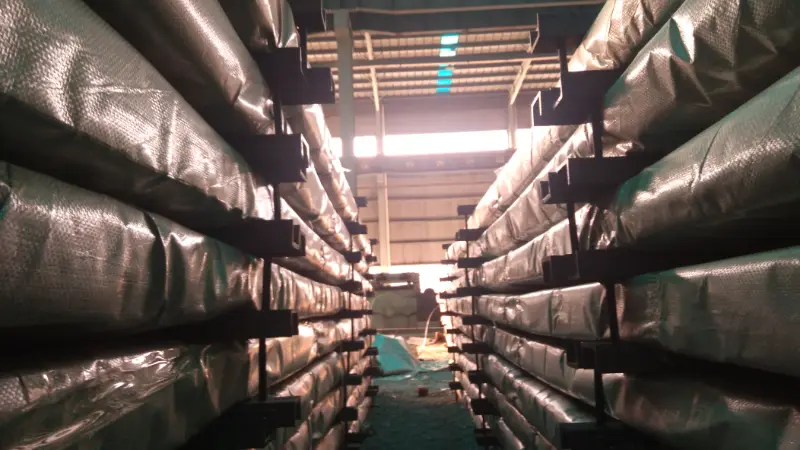
ASTM A588 Grade B Weathering Steel Plate
ASTM A588 Grade B Weathering Steel Plate - High-Strength, Corrosion-Resistant Structural Material
ASTM A588 Grade B (A588GRB) is a high-strength low-alloy structural steel with improved atmospheric corrosion resistance. It is widely used in unpainted applications where a protective oxide layer forms, reducing the need for maintenance.
Hot rolling, cold forming, welding, machining, and thermal cutting
- Phone : +8618037372205
- Email : [email protected]
- WhatsApp: Contact via Whtsapp
- WeChat: +8618037372205
ASTM A588 Grade B Weathering Steel Plate Introduction
ASTM A588 Grade B is a high-strength low-alloy (HSLA) structural steel with enhanced atmospheric corrosion resistance, specified under ASTM A588/A588M. The alloying elements, particularly copper, chromium, and nickel, promote the formation of a dense, adherent oxide layer when exposed to the environment, eliminating the need for painting in many applications. This grade exhibits minimum yield strength of 345 MPa (50 ksi) and tensile strength of 485 MPa (70 ksi) for thicknesses up to 100 mm.
- Excellent atmospheric corrosion resistance – approximately 4 times that of plain carbon steel
- Good weldability using common processes when appropriate low-hydrogen practices are followed
- Available in plate, sheet, and structural shapes
- Frequently used for bridges, buildings, transmission towers, and architectural structures exposed to outdoor environments
ASTM A588 Grade B Weathering Steel Plate Chemical Composition
The chemical composition conforms to ASTM A588/A588M Grade B requirements. All values represent the maximum allowed unless a range is indicated. The alloying elements copper, chromium, and nickel are key to achieving the enhanced atmospheric corrosion resistance.
- Carbon and manganese provide strength
- Phosphorus and sulfur are restricted to ensure weldability and toughness
- Vanadium may be added for grain refinement
| Element | Standard Requirement (wt%) | Remarks |
|---|---|---|
| Carbon (C) | 0.20 max | Max |
| Manganese (Mn) | 0.75 – 1.35 | Range per heat analysis depending on thickness |
| Phosphorus (P) | 0.040 max | Max |
| Sulfur (S) | 0.050 max | Max |
| Silicon (Si) | 0.15 – 0.50 | Range |
| Nickel (Ni) | 0.50 max | Max |
| Chromium (Cr) | 0.40 – 0.70 | Range |
| Copper (Cu) | 0.20 – 0.40 | Range |
| Vanadium (V) | 0.01 – 0.10 | Range (optional grain refiner) |
ASTM A588 Grade B Weathering Steel Plate Physical Properties
Physical properties are typical for low‑alloy carbon steels and are provided for engineering guidance. Actual values may vary slightly depending on processing and exact composition.
- Density is commonly used for weight calculations.
- Thermal expansion and conductivity are important for structural design under thermal loads.
- Electrical resistivity is typical for alloyed steels.
| Property | Typical Value | Unit | Condition / Temperature Range |
|---|---|---|---|
| Density (ρ) | 7.85 | g/cm³ | At room temperature |
| Modulus of Elasticity (E) | 200 | GPa | At room temperature |
| Shear Modulus (G) | 80 | GPa | Calculated, typical |
| Poisson's Ratio (ν) | 0.26 | – | Typical for steel |
| Coefficient of Thermal Expansion (α) | 12.0 | μm/(m·°C) | Between 20°C and 100°C |
| Thermal Conductivity (λ) | 50 | W/(m·K) | At room temperature |
| Specific Heat Capacity | 460 | J/(kg·K) | At room temperature |
| Electrical Resistivity (ρₑ) | 0.15 | μΩ·m | At room temperature |
ASTM A588 Grade B Weathering Steel Plate Mechanical Properties
The following mechanical properties are required by ASTM A588/A588M for plates ≤100 mm thick. Values may be reduced for thicker sections.
- Tensile testing is performed in the transverse direction for plates.
- Elongation is measured on either 200 mm (8 in.) or 50 mm (2 in.) gauge length depending on product and thickness.
- Bend test requirements ensure formability and soundness.
- Charpy V‑notch impact testing is not mandatory in the base specification but can be ordered as a supplementary requirement (e.g., S5).
| Property | Minimum Required Value | Unit | Test Condition / Remarks |
|---|---|---|---|
| Yield Strength (ReH) | 345 | MPa | 50 ksi; for plates ≤100 mm thickness, transverse |
| Tensile Strength (Rm) | 485 | MPa | 70 ksi; for plates ≤100 mm thickness, transverse |
| Elongation (A), 200 mm gauge | 18 | % | For plates ≤100 mm thickness, transverse, specimen width 40 mm |
| Elongation (A), 50 mm gauge | 21 | % | For plates ≤100 mm thickness, transverse, standard rectangular specimen |
| Bend Test (transverse) | 180° bend, d=2a (for t≤25.4 mm) | – | Bend diameter = 2× specimen thickness for thicknesses up to 1 in. (25.4 mm); requirements vary with thickness per ASTM A588/A588M Table 3 |
ASTM A588 Grade B Weathering Steel Plate Fully Equivalent Material Standards & Replacement Grades
| Country/Region | Standard | Grade | Remarks |
|---|---|---|---|
| European Union | EN 10025-5 | S355J2W | Equivalent weathering steel with Charpy impact at -20°C; widely used for structural applications, directly interchangeable with A588 Gr. B when impact properties are required. |
| Japan | JIS G3114 | SMA490BW | Weathering steel with similar strength and corrosion resistance; commonly used in bridge construction. |
| China | GB/T 4171 | Q355NH | High‑strength weathering steel, equivalent in strength and atmospheric corrosion performance. |
| Australia/New Zealand | AS/NZS 3678 | WR350 | Weathering grade with comparable mechanical properties, often specified for bridges and buildings. |
ASTM A588 Grade B Weathering Steel Plate Application Introduction
ASTM A588 Grade B steel is suitable for a wide range of structural applications where long‑term exposure to weather without protective painting is acceptable. Its corrosion‑resistant properties make it ideal for outdoor structures in moderately aggressive environments (not directly immersed or in contact with soil).
- Welding: Use low‑hydrogen processes (SMAW, GMAW, FCAW, SAW) with matching or slightly over‑matching strength filler metals; preheat may be required for thick sections.
- Cold forming: Good formability; minimum bend radii should follow standard structural steel practice.
- Painting: If aesthetics require a uniform appearance, a patina‑promoting surface pre‑treatment may be applied; painting is not necessary for corrosion protection in most atmospheric exposures.
Product Applications: Welded and bolted structural frameworks, Bridge girders and trusses, Transmission towers and poles, Container chassis and freight wagons, Outdoor storage tanks (non‑pressure), Facade panels and cladding
Processed into products: Main bridge beams and box girders, Column and beam connections in high‑rise buildings, Lattice structures for power line towers, Railcar side frames and bolsters, Canopies and canopy supports for fuel stations, Decorative architectural elements like sunshades and screens
Application industries: Bridge construction, Building and infrastructure, Electrical power transmission, Railway rolling stock, Port and harbor facilities, Architectural and sculpture
ASTM A588 Grade B Weathering Steel Plate Similar / Alternative Material Recommendations
| Country/Region | Standard | Grade | Remarks |
|---|---|---|---|
| USA | ASTM A588/A588M | Grade A | Very similar chemistry and properties; Grade A has slightly lower Mn range (0.80–1.25) and no V requirement, while Grade B adds vanadium for grain refinement. Often interchangeable depending on thickness and toughness needs. |
| USA | ASTM A242/A242M | Type 1 | Older weathering steel specification with similar atmospheric corrosion resistance but generally lower minimum strength (depending on thickness). Can be used where A588 Gr. B is not available, but verify strength. |
| European Union | EN 10025-5 | S355J0W | Nearly identical except for Charpy transition temperature (0°C vs. -20°C for J2). Suitable when lower temperature toughness is not critical. |
Notes:
Supplementary requirements (e.g., Charpy V‑notch impact testing at specified temperatures, ultrasonic testing, through‑thickness properties) may be added to the purchase order per ASTM A6/A6M or ASTM A588/A588M. The steel develops a protective rust‑like appearance after exposure to alternating wet/dry conditions; full color stability may take several months depending on climate. For applications involving direct contact with water (immersion) or burial in soil, a protective coating is recommended despite the improved atmospheric resistance. The material is not intended for use in chemically aggressive environments such as those containing concentrated industrial acids or chlorides.
- Share



