
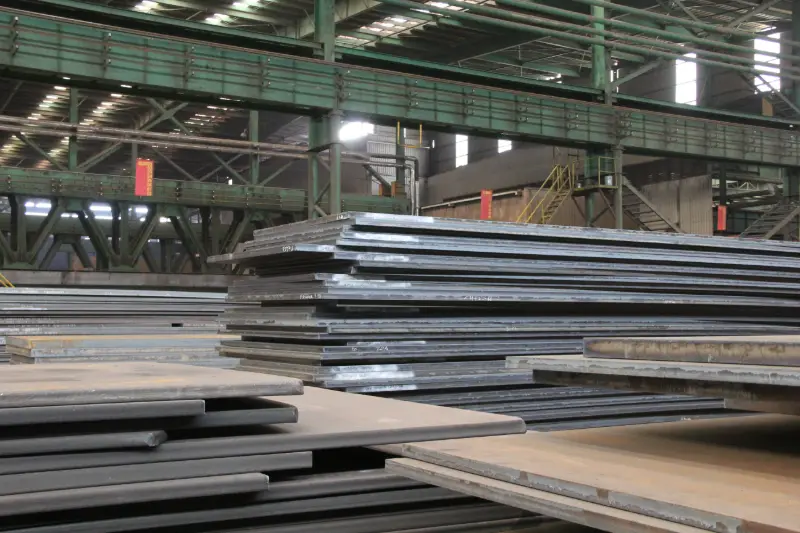
ASTM A588 Grade K Carbon Steel Plate
ASTM A588 Grade K Carbon Steel Plate - High-Strength Weathering Steel
Explore ASTM A588 Grade K carbon steel plate designed for structural applications requiring 50 ksi minimum yield strength and superior atmospheric corrosion resistance.
Cutting, welding, forming, machining, punching, drilling
- Phone : +8618037372205
- Email : [email protected]
- WhatsApp: Contact via Whtsapp
- WeChat: +8618037372205
ASTM A588 Grade K Carbon Steel Plate Introduction
ASTM A588 Grade K (A588GRK) is a high-strength low-alloy structural steel with enhanced atmospheric corrosion resistance, specified in ASTM A588/A588M. Its alloy design incorporates chromium, copper, and vanadium to develop a dense, protective oxide patina when exposed to the environment, eliminating the need for painting in many applications.
- Minimum yield strength of 50 ksi (345 MPa) for thicknesses up to 100 mm
- Excellent weldability and formability for structural fabrication
- Approximately four times the corrosion resistance of plain carbon steel under cyclic wetting and drying conditions
This grade is widely used in bridges, buildings, towers, and other load-bearing structures where long-term durability and reduced maintenance are critical.
ASTM A588 Grade K Carbon Steel Plate Chemical Composition
The chemical composition of ASTM A588 Grade K is formulated to provide high strength and atmospheric corrosion resistance. Elements such as chromium, copper, and vanadium promote the formation of a tenacious oxide layer that slows further corrosion. Phosphorus and sulfur are strictly controlled to ensure good weldability and toughness.
| Chemical Element | Content (%) | Remarks |
|---|---|---|
| Carbon (C) | 0.18 max | |
| Manganese (Mn) | 0.50 – 1.20 | |
| Phosphorus (P) | 0.025 max | |
| Sulfur (S) | 0.025 max | |
| Silicon (Si) | 0.15 – 0.50 | |
| Nickel (Ni) | 0.40 max | |
| Chromium (Cr) | 0.40 – 0.70 | |
| Copper (Cu) | 0.30 – 0.50 | |
| Vanadium (V) | 0.02 – 0.10 |
ASTM A588 Grade K Carbon Steel Plate Thermal and Electrical Physical Properties
These physical properties represent typical values for ASTM A588 Grade K steel. Actual values may vary slightly with specific heat treatment and composition. Density, elastic moduli, and thermal expansion are essential for structural design, while thermal conductivity and electrical resistivity influence heat transfer and grounding considerations.
| Property | Typical Value | Unit | Test Condition |
|---|---|---|---|
| Density (ρ) | 7.85 | g/cm³ | 20 °C |
| Modulus of Elasticity (E) | 200 | GPa | Room temperature |
| Shear Modulus (G) | 80 | GPa | Calculated from E and ν |
| Poisson's ratio (ν) | 0.3 | – | Elastic range |
| Thermal expansion coefficient (α) | 12.0 | 10⁻⁶/K | 0–100 °C |
| Thermal conductivity (λ) | 50 | W/(m·K) | 20 °C |
| Specific heat capacity | 480 | J/(kg·K) | 20 °C |
| Electrical resistivity (ρe) | 0.16 | μΩ·m | 20 °C |
ASTM A588 Grade K Carbon Steel Plate Mechanical Properties
Mechanical properties are determined in accordance with ASTM A6/A6M using test specimens taken from the plate. The values apply to material in the as-rolled or heat-treated condition as specified. For thicknesses over 100 mm, properties are subject to agreement. Charpy V-notch impact testing is not mandatory unless ordered as a supplementary requirement. The bend test ensures adequate formability.
| Property | Required Value | Unit | Test Condition |
|---|---|---|---|
| Yield Strength (ReH) | 345 (50 ksi) | MPa (ksi) | Thickness ≤ 100 mm |
| Tensile Strength (Rm) | 485 (70 ksi) | MPa (ksi) | Thickness ≤ 100 mm |
| Elongation in 200 mm (A200) | 18 | % | Thickness ≤ 100 mm |
| Elongation in 50 mm (A50) | 21 | % | Thickness ≤ 100 mm |
| Bend Test – Bend Diameter | 2.5 × t (t ≤ 25.4 mm); 3 × t (25.4 < t ≤ 50.8 mm) | – | 180° guided bend, specimen transverse |
ASTM A588 Grade K Carbon Steel Plate Fully Equivalent Grades and Recommended Replacements
| Region | Standard | Grade | Remarks |
|---|---|---|---|
| United States | ASTM A588/A588M | Grade K | Exact equivalent |
| United States | ASTM A709/A709M | Grade 50W | Bridge steel with similar weathering and strength |
| Europe | EN 10025-5 | S355J2W+N | Comparable weathering grade, 355 MPa min. yield |
| Japan | JIS G3125 | SPA-H | High atmospheric corrosion resistance, similar structural uses |
ASTM A588 Grade K Carbon Steel Plate Application Introduction
ASTM A588 Grade K is engineered for unpainted or bare atmospheric exposure in structural applications. The stable patina acts as a protective barrier, reducing maintenance costs. It is widely used in:
- Welded bridge girders and trusses
- Architectural facades
- Transmission towers and utility structures
- Marine and coastal structures
Product Applications: Welded plate girders, Transmission towers, Lighting poles and standards, Highway sign structures, Architectural exposed steel, Rolled steel sections and hollow sections
Processed into products: Bridge main beams, cross beams, and stiffeners, Column and beam sections in buildings, Tower legs and cross arms, Pole shafts and base plates, Steel truss members, Piling and sheet piling
Application industries: Bridge engineering, Building and construction, Electric power transmission, Marine and offshore structures, Railway vehicles, Mining equipment
ASTM A588 Grade K Carbon Steel Plate Similar or Near-Equivalent Material Recommendations
| Region | Standard | Grade | Remarks |
|---|---|---|---|
| United States | ASTM A588 | Grade A, B, C | Different Cu/Cr/Ni levels; same 50 ksi yield and weathering class |
| United States | ASTM A572 | Grade 50 | HSLA steel without guaranteed weathering; requires painting |
| Europe | EN 10025-5 | S355J0W | Lower toughness requirement (J0), similar corrosion resistance |
| China | GB/T 4171 | Q355NH | Weathering structural steel with min. 355 MPa yield |
Notes:
This grade is typically supplied in the as-rolled condition. When exposed to the atmosphere, a uniform, adherent oxide layer develops and should not be removed. If painting is required, special surface preparation (e.g., white metal blast) is needed. Welding procedures should follow AWS D1.1 using low-hydrogen electrodes or processes to avoid hydrogen induced cracking. Supplementary Charpy V-notch impact requirements may be specified by the purchaser (e.g., 27 J at -20 °C). For hot-dip galvanizing, silicon and phosphorus levels may influence coating thickness; consult ASTM A385.
- Share



