
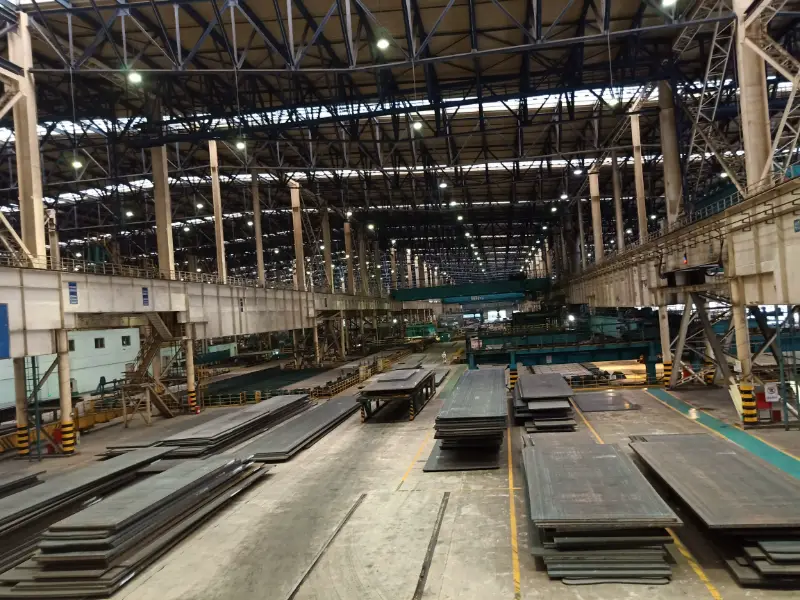
ASTM A573 Grade 70 (A573GR70) Improved Toughness Carbon Steel Plate
ASTM A573 Grade 70 (A573GR70) Improved Toughness Carbon Steel Plate - Comprehensive Data
Detailed material properties, chemical composition, mechanical and physical performance of ASTM A573 Grade 70 (A573GR70) carbon steel plate for structural applications demanding high strength and notch toughness.
Welding, cutting (flame, plasma, laser), cold forming, hot forming, machining, shearing
- Phone : +8618037372205
- Email : [email protected]
- WhatsApp: Contact via Whtsapp
- WeChat: +8618037372205
ASTM A573 Grade 70 Improved Toughness Carbon Steel Plate Introduction
ASTM A573 Grade 70 (A573GR70) is a structural carbon steel plate with enhanced notch toughness, specified under ASTM A573/A573M. The alloy achieves a minimum yield strength of 70 ksi (485 MPa) through controlled manganese content and a low carbon level that maintains weldability and formability. It is primarily intended for use in riveted, bolted, or welded construction of bridges, buildings, and industrial equipment where improved low‑temperature impact properties are required. The fine‑grain practice and moderate carbon‑manganese chemistry deliver a good balance of strength, ductility, and toughness.
Typical supply conditions include as‑rolled, normalised, or thermo‑mechanically controlled processed (TMCP) states, depending on thickness and purchaser requirements. The material is widely available in plate form and can be machined, flame‑cut, cold‑formed, and welded using common practices for carbon‑manganese steels.
ASTM A573 Grade 70 Improved Toughness Carbon Steel Plate Chemical Composition
The chemical composition of ASTM A573 Grade 70 is designed to provide high strength together with improved notch toughness. Carbon is limited to preserve weldability, while manganese acts as the primary solid‑solution strengthener. Silicon is added for deoxidation. Phosphorus and sulfur are strictly controlled to avoid embrittlement and to maintain ductility. Values below comply with ASTM A573/A573M for both thin and thick plates; permissible variations for product analysis are given in the standard.
| Element | Standard Value (wt. %) | Remarks |
|---|---|---|
| Carbon (C) | ≤0.27 (thickness ≤40 mm); ≤0.28 (thickness >40 mm) | Maximum; lower carbon enhances weldability and toughness |
| Manganese (Mn) | 0.85–1.20 | Primary strengthening and toughening element |
| Silicon (Si) | 0.15–0.40 | Deoxidiser; also contributes slightly to strength |
| Phosphorus (P) | ≤0.035 | Kept low to avoid cold shortness and improve ductility |
| Sulfur (S) | ≤0.04 | Low levels minimise hot shortness and enhance toughness |
| Aluminium (Al) | ≥0.020 (if grain refining element is specified as Al) | Grain refinement to improve notch toughness; total Al or acid soluble |
| Residual/Others | Cu ≤0.20; Ni ≤0.25; Cr ≤0.25; Mo ≤0.08; V ≤0.02; Nb ≤0.01; Ti ≤0.01 | Typical residual limits to prevent adverse effects; not added intentionally |
ASTM A573 Grade 70 Improved Toughness Carbon Steel Plate Thermal & Electrical Physical Properties
The following physical properties are typical for carbon‑manganese structural steels similar to ASTM A573 Grade 70. They are not mandatory requirements of the standard but are provided for design and engineering calculations. Values can vary slightly with chemical composition, heat treatment, and temperature.
| Property | Typical Value | Unit | Test Condition / Remarks |
|---|---|---|---|
| Density (ρ) | 7.85 | g/cm³ [kg/m³] | At room temperature |
| Modulus of Elasticity (E) | 200–210 | GPa | At 20°C; slightly decreases with temperature |
| Shear Modulus (G) | 79–81 | GPa | Calculated from E and Poisson's ratio, typically ~80 GPa |
| Poisson's Ratio (ν) | 0.27–0.30 | – | For elastic deformation; commonly 0.29 |
| Coefficient of Thermal Expansion (α) | 11.7 (10⁻⁶/K) for 20–100°C, 12.8 (10⁻⁶/K) for 20–200°C, 13.5 (10⁻⁶/K) for 20–300°C | 10⁻⁶ / °C | Mean linear coefficient |
| Thermal Conductivity (λ) | 52 at 20°C, 50 at 100°C, 46 at 200°C, 42 at 300°C | W/(m·K) | Typical values for 0.2% carbon steel |
| Specific Heat Capacity (cp) | 486 at 20°C, 519 at 100°C, 565 at 200°C | J/(kg·K) | Increases with temperature |
| Electrical Resistivity (ρₑ) | ~0.15 (at 20°C) | 10⁻⁶ Ω·m [µΩ·m] | Typical for low‑alloy structural steel |
ASTM A573 Grade 70 Improved Toughness Carbon Steel Plate Mechanical Properties
Mechanical requirements are determined on test pieces taken from the plate in the as‑delivered condition. Values meet ASTM A573 Grade 70 specifications. The yield and tensile strengths apply to all thicknesses, while elongation and bend test requirements depend on plate thickness. Charpy V‑notch impact tests are optional and can be specified at temperatures such as +20°C, 0°C, −20°C, or −40°C to confirm toughness levels.
| Property | Standard Requirement | Unit | Test Condition / Remarks |
|---|---|---|---|
| Yield Strength (ReH) | ≥485 | MPa [ksi] | All thicknesses; 0.2% offset if non‑linear |
| Tensile Strength (Rm) | 620–795 | MPa [ksi] | All thicknesses |
| Elongation (A) in 8 in. [200 mm] | ≥19 | % | Thickness ≤20 mm |
| Elongation (A) in 8 in. [200 mm] | ≥19 | % | Thickness >20 mm to 40 mm |
| Elongation (A) in 8 in. [200 mm] | ≥18 | % | Thickness >40 mm |
| Elongation (A) in 2 in. [50 mm] | ≥21 | % | Thickness ≤20 mm |
| Elongation (A) in 2 in. [50 mm] | ≥22 | % | Thickness >20 mm to 40 mm |
| Elongation (A) in 2 in. [50 mm] | ≥21 | % | Thickness >40 mm |
| Bend Test (180°) | Mandrel dia. = 2t | – | Thickness ≤20 mm; no cracks on outside of bend |
| Bend Test (180°) | Mandrel dia. = 2.5t | – | Thickness >20 mm to 40 mm |
| Bend Test (180°) | Mandrel dia. = 3t | – | Thickness >40 mm |
| Charpy V‑Notch Impact (optional) | ≥27 J (average of 3 specimens) | J [ft·lbf] | Specified temperature, e.g. +20°C, 0°C, −20°C, −40°C; as per ASTM A673 frequency |
ASTM A573 Grade 70 Improved Toughness Carbon Steel Plate Direct Equivalent Material Standards & Substitute Grades
ASTM A573 Grade 70 does not have a universally accepted direct international equivalent because of its unique combination of minimum yield strength (485 MPa) and improved notch toughness in a carbon‑manganese composition without deliberate microalloying. The table below lists grades that are often referenced as functional substitutes, but careful comparison of mechanical properties, chemical composition, and quality requirements is necessary before substitution.
| Country/Region | Standard | Grade/Designation | Remarks |
|---|---|---|---|
| Europe | EN 10025-3 | S460N / S460NL | Normalised fine‑grain structural steel; minimum yield 460 MPa, toughness down to −20°C or −50°C; higher Mn and may contain Nb, V, Ti; strength gap must be evaluated. |
| Europe | EN 10025-4 | S460M / S460ML | Thermo‑mechanically rolled fine‑grain steel; yield 460 MPa min; similar remarks as S460N. |
| Japan | JIS G3106 | SM570 | Welded structural steel; yield ≥460 MPa, tensile 570–720 MPa; toughness is optional. Slightly lower yield strength. |
| International | ISO 630-3 | E460DD / E460E | High‑strength structural steel plates; 460 MPa yield; composition differs (e.g., higher CEV). |
ASTM A573 Grade 70 Improved Toughness Carbon Steel Plate Application Introduction
ASTM A573 Grade 70 is engineered for heavy structural applications in which both high strength and resistance to brittle fracture are critical. Its improved notch toughness makes it particularly suitable for dynamically loaded components and for service at moderately low ambient temperatures. The steel offers good weldability with standard procedures (preheat may be required for thick sections) and can be cold‑formed or machined.
Typical industries and products:
Product Applications: Bridge girders, box sections, and orthotropic deck plates, Column and beam spliced structures for high‑rise buildings, Large storage tank shells and roofs (API 650 applications after appropriate re‑certification), Heavy‑duty industrial machinery frames and bases, Railway wagon sides and underframes, Tubular structures and piling
Processed into products: Welded main girders and cross beams, Flanges and webs for built‑up sections, Base plates and bearing plates for columns, Stiffeners and diaphragm plates, Crane rail supports and runway beams, Excavator boom and arm plates, Heavy‑duty gear blanks and machine bases (flame‑cut and machined), Pressure vessel end caps and shells (subject to supplementary impact tests)
Application industries: Civil engineering & infrastructure (bridges, highway structures), Building & construction (high‑rise frames, stadiums, industrial platforms), Heavy machinery & equipment (crane booms, excavator arms, presses), Energy & petrochemical (storage tanks, pressure vessel shells, wind turbine towers), Transportation (railway rolling stock, heavy‑duty trailers), Shipbuilding & offshore (deck plates, hull stiffeners when toughness is required; subject to class society approval)
ASTM A573 Grade 70 Improved Toughness Carbon Steel Plate Similar/Comparable Substitute Material Recommendations
For applications where the full 485 MPa yield strength is not mandatory, or where different toughness guarantees are required, the following steels may serve as alternatives. They share comparable weldability, formability, and general structural behaviour, though strength and impact properties can deviate from A573 Grade 70.
| Country/Region | Standard | Grade/Designation | Remarks |
|---|---|---|---|
| USA | ASTM A572/A572M | Grade 65 [450] | HSLA structural steel; minimum yield 450 MPa (65 ksi), tensile 550–690 MPa; better formability but lower yield strength than A573 Gr70. |
| USA | ASTM A709/A709M | Grade 70 [485] (unweathered) | Structural steel for bridges; very similar mechanical properties; may have supplementary requirements (e.g., fracture critical). |
| Europe | EN 10025-2 | S355K2 / S355J2+N | General structural steel; 355 MPa yield; high toughness grades (K2); suitable for many structural applications when lower strength is acceptable. |
| China | GB/T 1591 | Q460E | High‑strength low‑alloy structural steel; yield ≥460 MPa; contains microalloying elements; impact test at −40°C. |
| Russia | GOST 19281 | 17G1S (17Г1С) / 10G2S1 (10Г2С1) | Low‑alloy manganese‑silicon steel; yield ~325–390 MPa; widely used for welded structures but lower strength. |
Notes:
- Weldability: ASTM A573 Grade 70 can be welded by all common processes (SMAW, SAW, GMAW, FCAW). Preheat and interpass temperature control are recommended for thicknesses >25 mm to avoid hydrogen cracking. Low‑hydrogen electrodes are advised.
- Impact testing: When Charpy V‑notch requirements are invoked, the test temperature, minimum energy, and sampling frequency must be specified in the purchase order (often per ASTM A673, frequency H or S).
- Flatness and tolerances: Plates are typically supplied to ASTM A6/A6M general requirements; specific flatness, camber, and out‑of‑square tolerances can be ordered.
- Surface condition: As‑rolled surface with allowable imperfections per the standard. Grinding or repair welding may be permitted within limits.
- Certification: Mill test reports showing chemical analysis, tensile, bend (and impact if required) are supplied according to EN 10204 type 3.1 or as equivalent by agreement.
- Share



