
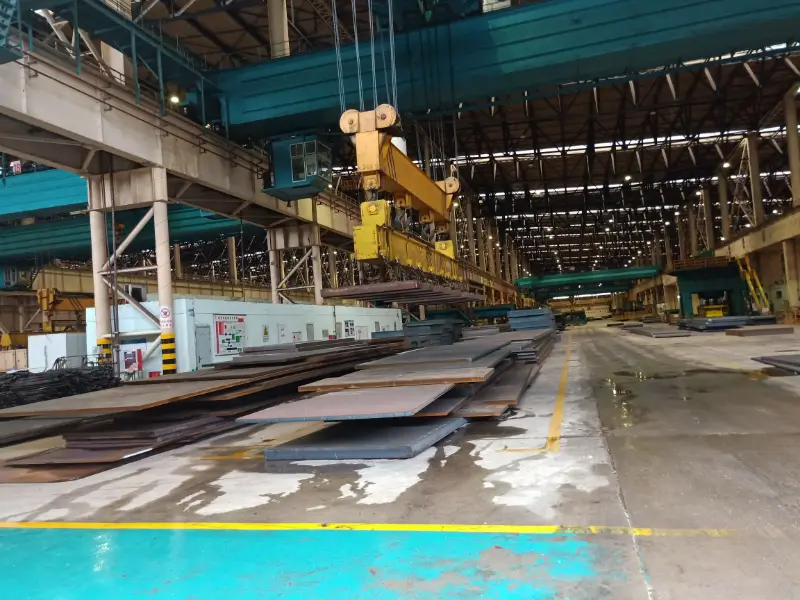
ASTM A573 Grade 65 (A573GR65) Carbon Steel Plate
ASTM A573 Grade 65 (A573GR65) Carbon Steel Plate - Complete Material Data and Equivalents
In-depth technical data for ASTM A573 Grade 65 carbon steel plate: chemical composition, mechanical & thermal properties, international equivalents, and application guide.
Welding, bending, machining, forming, shearing
- Phone : +8618037372205
- Email : [email protected]
- WhatsApp: Contact via Whtsapp
- WeChat: +8618037372205
ASTM A573 Grade 65 Carbon Steel Plate Introduction
ASTM A573 Grade 65 (A573GR65) is a carbon-silicon structural steel plate intended for general applications in bolted, riveted, or welded construction. It provides a minimum yield strength of 35 ksi [240 MPa] and tensile strength in the range 65–85 ksi [450–585 MPa], offering a balanced combination of moderate strength, good weldability, and formability.
This grade is distinguished by its controlled manganese content, which enhances toughness and strength without sacrificing ductility. It is typically supplied in the as-rolled condition but can be ordered normalized or stress-relieved to meet specific job requirements. Typical uses include bridges, buildings, storage tanks, and other structural fabrications where reliability and ease of fabrication are essential.
This comprehensive data sheet provides official chemical limits, mechanical and physical property references, international equivalent grades, and application guidance for engineers and material specifiers.
ASTM A573 Grade 65 Carbon Steel Plate Chemical Composition
The chemical requirements of ASTM A573 Grade 65 are outlined by the standard. Values vary by plate thickness to balance strength, weldability, and formability. All elements are analyzed as per ASTM A751 test methods.
- Carbon: Maximum limits depend on plate thickness to ensure weldability.
- Manganese: Ranges provided to achieve the required tensile properties while maintaining ductility.
- Phosphorus & Sulfur: Restricted to low levels for improved toughness and cleanliness.
- Silicon: Added primarily for deoxidation; contributes to strength.
Other residual elements (Cu, Ni, Cr, Mo) may be present in trace amounts but are not specified unless required by supplementary agreement.
| Chemical Element | Standard Value (wt%) | Remarks |
|---|---|---|
| Carbon (C) | 0.24 max | Plate thickness ≤ 1 in. [25 mm] |
| Carbon (C) | 0.26 max | Plate thickness > 1 in. to 2 in. [25–50 mm] |
| Carbon (C) | 0.28 max | Plate thickness > 2 in. to 4 in. [50–100 mm] |
| Manganese (Mn) | 0.80–1.20 | Plate thickness ≤ 3/4 in. [19 mm] |
| Manganese (Mn) | 0.85–1.20 | Plate thickness > 3/4 in. to 2 in. [19–50 mm] |
| Manganese (Mn) | 0.85–1.20 | Plate thickness > 2 in. to 4 in. [50–100 mm] |
| Phosphorus (P) | 0.030 max | General requirement |
| Sulfur (S) | 0.030 max | General requirement |
| Silicon (Si) | 0.15–0.40 | All thicknesses; for plates > 1 1/2 in. [40 mm], Si remains 0.15–0.40 |
ASTM A573 Grade 65 Carbon Steel Plate Thermal and Electrical Physical Properties
The following physical properties are typical for medium‑carbon structural steels and serve as general engineering guidelines. They are not mandatory requirements of ASTM A573 Grade 65 but are widely accepted values for carbon steel plates at room temperature unless otherwise noted. Actual values can vary slightly depending on precise chemical composition and processing history.
- Density, elastic moduli, and thermal expansion are essential for structural design.
- Thermal conductivity and specific heat capacity influence welding and thermal cutting procedures.
- Electrical resistivity is relevant for grounding and electrical applications.
For critical designs, verify with mill certificates or conduct specific tests.
| Property | Typical Value | Unit | Test Condition |
|---|---|---|---|
| Density (ρ) | 7.85 | g/cm³ | 20 °C |
| Elastic Modulus (E) | 200 | GPa | Tension, room temperature |
| Shear Modulus (G) | 80 | GPa | Room temperature |
| Poisson's Ratio (ν) | 0.29 | dimensionless | Room temperature |
| Thermal Expansion Coefficient (α) | 11.7 × 10⁻⁶ | /°C | 0–100 °C range |
| Thermal Conductivity (λ) | 52 | W/(m·K) | 20 °C |
| Specific Heat Capacity | 486 | J/(kg·K) | 20 °C |
| Electrical Resistivity (ρₑ) | 0.142 × 10⁻⁶ | Ω·m | 20 °C |
ASTM A573 Grade 65 Carbon Steel Plate Mechanical Properties
Mechanical properties are tested on specimens taken from the as-delivered condition according to ASTM A370. The minimum yield strength, tensile strength range, and minimum elongation ensure the material's structural integrity. These values are mandatory and apply to the full thickness of the plate.
- Yield Strength: Guarantees resistance to permanent deformation under load.
- Tensile Strength: Indicates the maximum stress before fracture.
- Elongation: Demonstrates ductility and energy absorption capacity.
Bend test is optional and may be specified by purchaser.
| Property | Standard Requirement | Unit | Test Condition |
|---|---|---|---|
| Yield Strength (ReH) | 240 minimum | MPa | Room temperature; all thicknesses |
| Tensile Strength (Rm) | 450–585 | MPa | Room temperature; all thicknesses |
| Elongation (A) | 20 min | % | Gauge length 200 mm (8 in.) |
| Elongation (A) | 23 min | % | Gauge length 50 mm (2 in.) |
ASTM A573 Grade 65 Carbon Steel Plate Completely Equivalent Materials – International Standards and Grades
| Country/Region | Standard | Grade | Remarks |
|---|---|---|---|
| Europe | EN 10025-2 | S275JR | Similar tensile strength (410–560 MPa) but higher minimum yield (275 MPa). Verify thickness ranges. |
| International | ISO 630 | Fe 430B | Tensile 430–560 MPa, yield 265 MPa. Approximate equivalent; check impact toughness if required. |
| Japan | JIS G3106 | SM400B | Tensile 400–510 MPa, yield 235 MPa. Slightly lower strength but widely cross-referenced. |
ASTM A573 Grade 65 Carbon Steel Plate Application Introduction
ASTM A573 Grade 65 plates are ideal for structural applications requiring moderate strength, good weldability, and reliable performance. The material is extensively used in stationary structures, heavy machinery, and general fabrication projects. Its balanced carbon and manganese levels facilitate conventional welding processes such as SMAW, SAW, and GMAW with minimal preheat requirements for common thicknesses.
Typical industries and products include:
Product Applications: Building columns and beams, Bridge decks and girders, Floor plates and decking, Storage tanks for low-pressure service, Machinery frames and supports, Railway wagon components
Processed into products: Gusset plates and stiffeners, Base plates and bearing plates, Web and flange plates for welded beams, Bolted connection plates, Cut and formed brackets, Weldments for heavy equipment
Application industries: Civil and Structural Engineering, Bridge Construction, Building and Infrastructure, Storage Tank Manufacturing, Machinery and Equipment Manufacturing, Shipbuilding (secondary structures)
ASTM A573 Grade 65 Carbon Steel Plate Similar or Alternative Materials for ASTM A573 Grade 65
| Country/Region | Standard | Grade | Remarks |
|---|---|---|---|
| USA | ASTM A36/A36M | A36 | Yield 250 MPa, tensile 400–550 MPa. Lower yield but comparable; often interchangeable for non-critical structures. |
| USA | ASTM A572/A572M | Grade 42 | Yield 290 MPa, tensile 415 MPa min. Higher strength, microalloyed; requires careful welding procedure. |
| Europe | EN 10025-2 | S235JR | Lower strength (yield 235 MPa, tensile 360–510 MPa). May be considered where strength reduction is acceptable. |
| China | GB/T 700 | Q235B | Yield 235 MPa, tensile 370–500 MPa. Economical alternative for general construction. |
Notes:
- Not intended for pressure vessel applications; for such use, refer to ASTM A516 grades.
- Copper addition up to 0.20 % may be specified for improved atmospheric corrosion resistance (supplementary requirement S1).
- Charpy impact testing is not mandatory; when required, it must be agreed upon at the time of order.
- All values are nominal and per ASTM A573/A573M-19. Always confirm with the latest specification revision and mill test certificates.
- Share



