
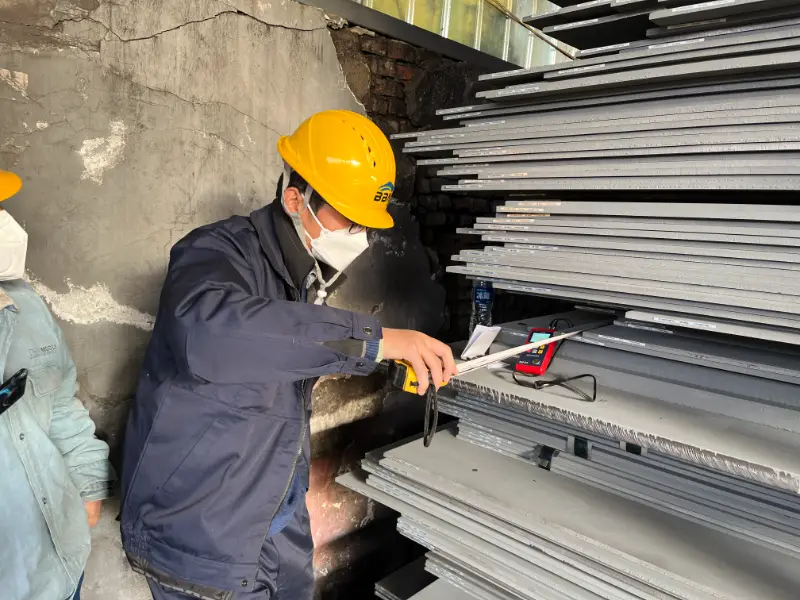
ASTM A573 Grade 58 Carbon Steel
ASTM A573 Grade 58 Steel Plate: Mechanical Properties, Chemical Composition & International Equivalents
Comprehensive overview of ASTM A573 Grade 58 (A573GR58) carbon steel plate for structural applications with improved notch toughness. Includes chemical composition, tensile and bend properties, physical data, international equivalents and application guide.
Welding, flame cutting, cold forming, machining, hot forming (with heat treatment if required)
- Phone : +8618037372205
- Email : [email protected]
- WhatsApp: Contact via Whtsapp
- WeChat: +8618037372205
ASTM A573 Grade 58 Carbon Steel Introduction
ASTM A573 Grade 58 (A573GR58) is a structural quality carbon-manganese-silicon steel plate intended for welded, bolted or riveted construction, primarily for applications where improved notch toughness is required at ambient or low temperatures. It is characterized by a minimum yield strength of 58 ksi [400 MPa] and tensile strength in the range 71–90 ksi [490–620 MPa].
The steel is produced in the as-rolled condition; controlled rolling or normalizing may be applied by agreement. The chemistry is optimized to provide a good balance between strength, weldability and toughness. The grade is well suited for storage tanks, bridges, pressure vessels (non-ASME), structural frameworks and heavy machinery. Copper-bearing variants (minimum 0.20% Cu) are available for improved atmospheric corrosion resistance. Delivery conditions typically include hot-rolled, as-rolled or normalized plates, cut to length or in coil form.
ASTM A573 Grade 58 Carbon Steel Chemical Composition
The composition is tailored for weldability and low-temperature toughness. Copper may be specified to enhance atmospheric corrosion resistance. Values are maximum unless a range is shown. Two thickness categories are defined.
| Element | Value (wt%) | Remarks |
|---|---|---|
| C | ≤0.23 | Thickness ≤40 mm (1.5 in.) |
| C | ≤0.25 | Thickness >40 to 100 mm (1.5–4 in.) |
| Mn | 0.60–1.20 | Thickness ≤40 mm |
| Mn | 0.80–1.20 | Thickness >40 mm |
| P | ≤0.035 | All thicknesses |
| S | ≤0.040 | All thicknesses |
| Si | 0.15–0.40 | Thickness ≤40 mm; 0.15–0.50 for >40 mm by agreement |
| Cu | ≥0.20 (if specified) | Optional, for improved corrosion resistance |
| Fe | balance | Remainder |
ASTM A573 Grade 58 Carbon Steel Thermal and Electrical Physical Properties
These values are representative for low-carbon structural steel and may vary slightly with actual composition and processing. They are not specified in ASTM A573 but are commonly used for design purposes.
| Property | Typical Value | Unit | Test Condition |
|---|---|---|---|
| Density (ρ) | 7.85 | g/cm³ | Ambient temperature |
| Elastic modulus (E) | 200 | GPa | Tension, ambient |
| Shear modulus (G) | 80 | GPa | Calculated |
| Poisson's ratio (ν) | 0.26–0.29 | — | Ambient |
| Thermal expansion coefficient (α) | 11.7 (20–100 °C) | 10⁻⁶/K | Temperature range as noted |
| Thermal conductivity (λ) | 51.9 (at 100 °C) | W/(m·K) | At 100 °C |
| Specific heat capacity (cp) | 486 | J/(kg·K) | Ambient |
| Electrical resistivity (ρe) | 0.18 | μΩ·m | Ambient |
ASTM A573 Grade 58 Carbon Steel Mechanical Properties
Tensile properties are determined transverse to the rolling direction. Elongation is measured on 200 mm (8 in.) and 50 mm (2 in.) gauge lengths. Bend test is required for material ≤25 mm thickness. Charpy impact values are not mandatory; supplementary requirement S1 may be invoked if notch toughness verification is needed.
| Property | Required Value | Unit | Test Condition |
|---|---|---|---|
| Yield strength (ReH, min.) | 400 [58] | MPa [ksi] | Thickness ≤100 mm |
| Tensile strength (Rm) | 490–620 [71–90] | MPa [ksi] | Thickness ≤100 mm |
| Elongation A (min.) | 18 | % | Gauge 200 mm; t ≤20 mm (0.75 in.) |
| Elongation A (min.) | 17 | % | Gauge 200 mm; 20 < t ≤40 mm |
| Elongation A (min.) | 16 | % | Gauge 200 mm; 40 < t ≤100 mm |
| Elongation A (min.) | 21 | % | Gauge 50 mm; t ≤20 mm |
| Elongation A (min.) | 21 | % | Gauge 50 mm; 20 < t ≤40 mm |
| Bend test | No cracks on tension side | — | 180° bend, mandrel diameter = 1t, t ≤25 mm |
| Charpy V-notch impact (if required by supplement S1) | As agreed (commonly ≥20 J at specified temperature) | J | Temperature and min. average to be specified on order |
ASTM A573 Grade 58 Carbon Steel Closest International Equivalent Grades
| Country/Region | Standard | Grade | Remarks |
|---|---|---|---|
| Europe | EN 10025-3 | S420N (1.8902) | Normalized fine-grain steel; minimum yield 420 MPa. Superior toughness but requires normalizing; higher cost. |
| Europe | EN 10025-2 | S355J2+N | Very common structural steel; yield 355 MPa (lower). Often used as alternative with design adjustment. |
| China | GB/T 1591 | Q390D | High-strength low-alloy structural steel; yield ≥390 MPa, tensile 490–650 MPa, –20°C impact ≥34 J. |
| Japan | JIS G3106 | SM490B / SM490C | Welded structural steel; yield ≥325 MPa, tensile 490–610 MPa. SM490C has 0°C impact. Strength somewhat lower. |
| ISO | ISO 630-2 | E355C | Fe E355 quality C; minimum yield 355 MPa. Lower strength; suitable for toughness requirements. |
ASTM A573 Grade 58 Carbon Steel Application Introduction
ASTM A573 Grade 58 is employed where a combination of 400 MPa minimum yield strength and reliable notch toughness at ambient or low temperatures is required. Its carbon-manganese chemistry ensures good weldability without preheating for moderate thicknesses, making it cost-effective for welded structures.
Typical applications include:
Product Applications: Welded bridge girders, box girders, and trusses, Above-ground storage tanks (oil, water, chemicals), Excavator booms, loader arms, truck frames, Building columns and heavy-duty floor plates, Shiplaps, bulkheads, and decks (non-marine classification), Support structures for power plants and process equipment
Processed into products: Flanges and webs of large welded beams, Tank shell courses and annular plates, Bottom plates and roof structures of storage tanks, Brackets, stiffeners, and gussets in fatigue-loaded connections, Pin-connected structural members, Skid frames and sub-bases for machinery
Application industries: Civil construction and infrastructure, Bridge fabrication (highway/railway), Storage tank and silo manufacturing, Shipbuilding (secondary structures, non-classed), Mining and earthmoving equipment, Wind tower components (non-certified sections), Heavy machinery and structural framing
ASTM A573 Grade 58 Carbon Steel Similar or Adjacent ASTM Grades
| Country/Region | Standard | Grade | Remarks |
|---|---|---|---|
| USA | ASTM A573/A573M | Grade 65 | Higher strength variant: yield ≥65 ksi [450 MPa], tensile 77–96 ksi. May be used when higher load capacity is needed. |
| USA | ASTM A572/A572M | Grade 50 [345] | High-strength low-alloy columbium-vanadium structural steel; yield 50 ksi [345 MPa]. Notch toughness not inherent; must be specified. |
| USA | ASTM A36/A36M | A36 | General structural steel; yield 36 ksi [250 MPa]. Lower strength and toughness; suitable for non-critical structures. |
| USA | ASTM A516/A516M | Grade 65 | Pressure vessel plate; yield 35 ksi [240 MPa]. Used in boilers and pressure vessels; higher toughness but lower yield. |
Notes:
Mill test certificates (EN 10204 type 3.1 or equivalent) are normally supplied with each shipment, verifying chemical composition and tensile properties.
If copper-bearing steel is ordered, the minimum copper content of 0.20% provides atmospheric corrosion resistance roughly two to three times that of plain carbon steel.
For thicknesses above 40 mm, hydrogen-induced cracking (HIC) testing may be advisable when exposed to wet sour service; this is outside the scope of ASTM A573 and must be separately negotiated.
Plates are usually furnished with mill edge but can be supplied with trimmed edges by agreement. Surface condition is as-rolled, and any special surface requirements shall be addressed at the time of enquiry and order.
- Share



