
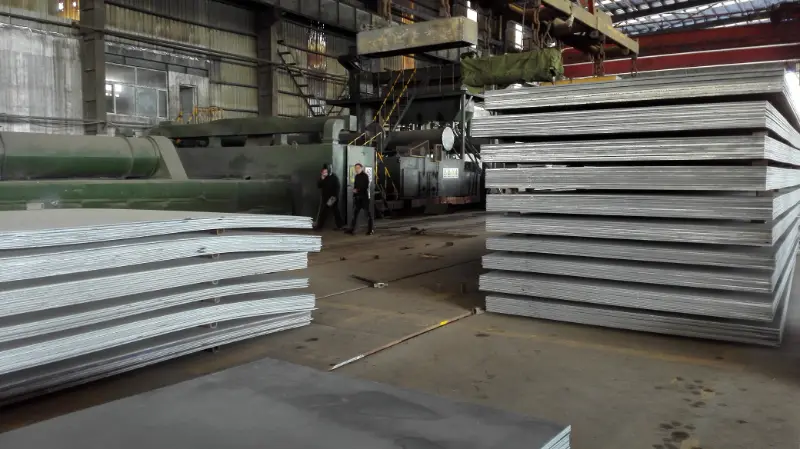
ASTM A514 Grade A (A514GRA) High-Strength Quenched & Tempered Steel Plate
ASTM A514 Grade A (A514GRA) High-Strength Quenched & Tempered Alloy Steel Plate – Composition, Properties & Equivalents
Comprehensive technical data for ASTM A514 Grade A (A514GRA) low-alloy high-strength quenched and tempered steel plate: chemical composition, mechanical properties at different thicknesses, thermal and electrical physical properties, international equivalents, and application guide.
Welding, hot forming (with temperature control), cold forming (limited to large radii), machining, oxygen/acetylene cutting, and plasma/laser cutting under preheat recommendations
- Phone : +8618037372205
- Email : [email protected]
- WhatsApp: Contact via Whtsapp
- WeChat: +8618037372205
ASTM A514 Grade A High-Strength Quenched & Tempered Steel Plate Introduction
ASTM A514 Grade A (also referred to as A514GRA) is a high-strength, quenched and tempered low-alloy structural steel plate engineered for superior mechanical properties and excellent weldability. With a minimum yield strength of 690 MPa (100 ksi) for thicknesses up to 20 mm and 620 MPa (90 ksi) for thicknesses up to 32 mm, it is designed for heavy-duty structural applications where weight reduction and high load-bearing capacity are critical. The steel exhibits good toughness at low temperatures and moderate atmospheric corrosion resistance. It is primarily supplied in the quenched and tempered condition, ensuring optimal strength and ductility. Typical uses include construction machinery, bridges, pressure vessels, and offshore structures. The alloy is characterized by its fine-grain microstructure, achieved through controlled additions of titanium and precise heat treatment, delivering consistent performance across plate thicknesses.
ASTM A514 Grade A High-Strength Quenched & Tempered Steel Plate Chemical Composition
The chemical composition complies with ASTM A514/A514M for Grade A. All values are from the standard heat analysis. Elements not listed may be present as residuals and are limited by the standard. Fine grain practice is achieved through titanium microalloying; boron may be added to improve hardenability. Phosphorus and sulfur are strictly controlled for toughness.
| Element | Standard Value (wt%) | Remarks |
|---|---|---|
| Carbon (C) | 0.15 – 0.21 | Key strengthening element |
| Manganese (Mn) | 0.80 – 1.10 | Deoxidizer, improves hardenability |
| Silicon (Si) | 0.40 – 0.80 | Deoxidizer, strength contributor |
| Phosphorus (P) | ≤ 0.025 | Low content for ductility |
| Sulfur (S) | ≤ 0.025 | Low content for toughness |
| Chromium (Cr) | 0.50 – 0.80 | Hardenability and corrosion resistance |
| Nickel (Ni) | ≤ 0.50 | Toughness and hardenability |
| Molybdenum (Mo) | 0.18 – 0.28 | Hardenability and creep strength |
| Titanium (Ti) | 0.04 – 0.10 | Grain refinement, nitrogen scavenging |
| Vanadium (V) | ≤ 0.05 | Secondary hardening, optional microalloy |
| Boron (B) | ≤ 0.0025 | Hardenability enhancer (optional) |
| Copper (Cu) | ≤ 0.20 (residual) | May be present as residual or specified for atmosphere resistance |
| Aluminum (Al) | ≥ 0.020 (if used as grain refiner) | Typically not required; Ti provides grain refinement |
ASTM A514 Grade A High-Strength Quenched & Tempered Steel Plate Physical Properties
Typical thermal and electrical properties for quenched and tempered low-alloy steel similar to ASTM A514 Grade A. These values are not mandated by the material standard but are representative for engineering calculations. Slight variations may occur due to exact composition and heat treatment.
| Property | Typical Value | Unit | Test Condition / Remarks |
|---|---|---|---|
| Density (ρ) | 7.85 | g/cm³ | Room temperature |
| Modulus of Elasticity (E) | 205 – 215 | GPa | Typical for HSLA steel, ~207 GPa |
| Shear Modulus (G) | 80 | GPa | Calculated from E and Poisson ratio |
| Poisson's Ratio (ν) | 0.30 | – | Room temperature |
| Thermal Expansion Coefficient (α) | 11.7 | µm/m·°C | 20–100 °C |
| Thermal Expansion Coefficient (α) | 12.5 | µm/m·°C | 20–200 °C |
| Thermal Expansion Coefficient (α) | 13.5 | µm/m·°C | 20–400 °C |
| Thermal Conductivity (λ) | 35 | W/m·K | At 100 °C |
| Thermal Conductivity (λ) | 38 | W/m·K | At 200 °C |
| Specific Heat Capacity (c) | 460 | J/kg·K | Room temperature |
| Electrical Resistivity (ρ_e) | 0.25 | µΩ·m | Ambient temperature |
ASTM A514 Grade A High-Strength Quenched & Tempered Steel Plate Mechanical Properties
Mechanical properties as per ASTM A514/A514M for quenched and tempered plate. Requirements vary with plate thickness. Yield strength and tensile strength are determined by tension test; elongation in 2 in. (50 mm) gauge length. All samples are tested in the longitudinal direction at room temperature.
| Property | Standard Requirement | Unit | Test Condition / Thickness Range |
|---|---|---|---|
| Yield Strength (ReH), min | 690 | MPa | Thickness ≤ 20 mm |
| Yield Strength (ReH), min | 620 | MPa | Thickness > 20 mm to 32 mm |
| Tensile Strength (Rm) | 760 – 895 | MPa | Thickness ≤ 20 mm |
| Tensile Strength (Rm) | 760 – 895 | MPa | Thickness > 20 mm to 32 mm |
| Elongation (A50), min | 18 | % | Thickness ≤ 20 mm (2 in. gauge) |
| Elongation (A50), min | 18 | % | Thickness > 20 mm to 32 mm (2 in. gauge) |
| Hardness | Not specified (typical 230–280 HBW) | HBW | Reference value for information |
ASTM A514 Grade A High-Strength Quenched & Tempered Steel Plate Exact Equivalent Standards & Substitutable Grades
| Country/Region | Standard | Grade | Remarks |
|---|---|---|---|
| USA | ASME SA514/SA514M | SA514 Grade A | Identical to ASTM A514 Grade A, approved for pressure vessel applications. |
| USA | ASTM A514/A514M | Grade A (UNS K11576) | Original specification; UNS number for Grade A. |
ASTM A514 Grade A High-Strength Quenched & Tempered Steel Plate Application Introduction
ASTM A514 Grade A is ideally suited for heavy structural applications demanding high yield strength, excellent weldability, and good low-temperature toughness. It is used where weight reduction and high load capacity are essential. The material can be welded using low-hydrogen processes with preheat and interpass controls. It is not intended for prolonged service above 315°C (600°F) as strength may deteriorate due to tempering. Cold forming must consider minimum bend radii and possible cracking risks in the tempered condition. Common fabrication includes flame cutting, shearing, and machining. Post-weld heat treatment is generally avoided, but if necessary, strict temperature/time guidelines must be followed to preserve properties.
Product Applications: Welded bridges and bridge components, Mining truck bodies and buckets, Crane booms, outriggers, and chassis, Heavy-duty trailers and low-loaders, Industrial machinery frames, Pressure vessel shells and heads, Structural platforms in offshore rigs, Armor plating (military vehicles)
Processed into products: Shear blades for scrap recycling, Rocker arms and levers in mining equipment, Telescopic boom sections, Crane turntables and slewing rings, Reinforcement ribs and gusset plates in bridge girders, Impact-resistant wear plates, Lifting lugs and attachment brackets
Application industries: Construction & Heavy Engineering, Mining & Earthmoving Equipment, Material Handling (Crane, Lift Trucks), Bridge Building, Pressure Vessel & Boiler (per ASME SA514), Offshore & Marine Structures, Military & Defense
ASTM A514 Grade A High-Strength Quenched & Tempered Steel Plate Similar / Closest Alternative Materials
| Country/Region | Standard | Grade | Remarks |
|---|---|---|---|
| Europe | EN 10025-6 | S690QL / S690QL1 | Similar strength class, quenched and tempered; chemical composition differs (higher Mn, Ni, optional Cr, Mo). Equivalent welded structural applications. |
| Japan | JIS G 3128 | SHY685 / SHY685N | High tensile strength steel for welded structures; comparable yield and tensile, but chemistry may vary slightly. |
| China | GB/T 16270 | Q690E / Q620E | High-strength quenched and tempered structural steel plates; nearest Chinese grades with careful comparison of mechanical and chemical requirements. |
| Canada | CSA G40.21 | 700Q / 700QT | Quenched and tempered structural steel with 700 MPa tensile class; similar intended use but different specified chemistry ranges. |
Notes:
Welding: Preheating (typically 150–200°C) and low-hydrogen electrodes are recommended. Interpass temperature should not exceed 230°C. Heat treatment: If stress relief is required, ensure temperature does not exceed the tempering temperature (usually 590–650°C) to avoid strength loss. Certification: Material can be ordered with optional Charpy impact testing, ultrasonic examination per ASTM A578/A578M, or specific through-thickness properties. For service in sour or hydrogen environments, additional testing is essential as this grade is not specifically designed for sour service.
- Share



