
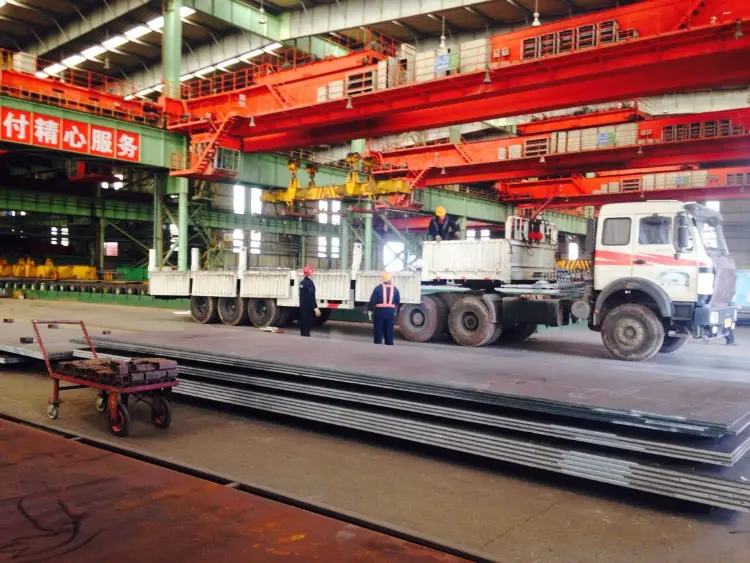
ASTM A515 Grade 60 Pressure Vessel Steel Plate
ASTM A515 Grade 60 Pressure Vessel Steel Plate - Properties, Equivalents & Applications
Comprehensive technical data for ASTM A515 Grade 60 carbon steel plate for boilers and pressure vessels. Includes chemical composition, mechanical properties, physical properties, equivalent grades, and application examples.
Hot rolling, normalizing, stress relieving, cutting, forming, welding
- Phone : +8618037372205
- Email : [email protected]
- WhatsApp: Contact via Whtsapp
- WeChat: +8618037372205
ASTM A515 Grade 60 Pressure Vessel Steel Plate Introduction
ASTM A515 Grade 60 (A515GR60) is a carbon-silicon steel plate primarily used for welded boilers and pressure vessels intended for moderate and elevated temperature service. It offers a good combination of strength, ductility, and weldability. The material is manufactured to a fully killed fine-grain practice and is typically supplied in the normalized or stress-relieved condition. The silicon content enhances oxidation resistance at elevated temperatures. Key features:
- Tensile strength range: 415–550 MPa (60–80 ksi)
- Minimum yield strength: 220 MPa (32 ksi)
- Good notch toughness (when required by supplementary specification)
- Excellent formability and machinability
- Widely accepted under ASME Boiler and Pressure Vessel Code as SA515 Grade 60
ASTM A515 Grade 60 Pressure Vessel Steel Plate Chemical Composition
The chemical composition of ASTM A515 Grade 60 is tailored for high-temperature service and weldability. Limits vary with plate thickness to maintain mechanical properties. The steel is silicon-killed to ensure fine grain structure. Key controls:
- Carbon content is restricted to improve weldability and notch toughness
- Manganese range is adjusted with thickness to ensure strength
- Strict limits on phosphorus and sulfur minimize embrittlement
- Residual elements are controlled to preserve elevated-temperature properties
| Element | Specification (%) | Remarks |
|---|---|---|
| Carbon (C) - thickness ≤ 25 mm | ≤ 0.24 | Ladle analysis, max |
| Carbon (C) - 25 < t ≤ 50 mm | ≤ 0.27 | Ladle analysis, max |
| Carbon (C) - 50 < t ≤ 100 mm | ≤ 0.29 | Ladle analysis, max |
| Carbon (C) - 100 < t ≤ 200 mm | ≤ 0.31 | Ladle analysis, max |
| Manganese (Mn) - thickness ≤ 25 mm | ≤ 0.90 | Ladle analysis |
| Manganese (Mn) - 25 < t ≤ 200 mm | 0.90 – 1.20 | Ladle analysis, range |
| Phosphorus (P) | ≤ 0.025 | Ladle analysis, max |
| Sulfur (S) | ≤ 0.025 | Ladle analysis, max |
| Silicon (Si) | 0.15 – 0.40 | All thicknesses, ladle analysis |
| Copper (Cu) | ≤ 0.35 | Residual element, max |
| Nickel (Ni) | ≤ 0.35 | Residual element, max |
| Chromium (Cr) | ≤ 0.25 | Residual element, max |
| Molybdenum (Mo) | ≤ 0.08 | Residual element, max |
ASTM A515 Grade 60 Pressure Vessel Steel Plate Thermal & Electrical Physical Properties
Physical properties are representative for carbon steel and serve as reference data for design. Actual values may vary slightly depending on exact composition and heat treatment. Key characteristics:
- Good thermal conductivity typical of carbon steels
- Moderate thermal expansion coefficient
- Density and elastic properties are standard for ferritic steels
| Property | Typical Value | Unit | Test Condition |
|---|---|---|---|
| Density (ρ) | 7.85 | g/cm³ | Room temperature |
| Modulus of Elasticity (E) | 200 | GPa | Room temperature |
| Shear Modulus (G) | 80 | GPa | Room temperature |
| Poisson's Ratio (ν) | 0.3 | – | Room temperature |
| Thermal Expansion Coefficient (α) - 20 to 100 °C | 11.8 | ×10⁻⁶ /K | Mean coefficient |
| Thermal Expansion Coefficient (α) - 20 to 200 °C | 12.4 | ×10⁻⁶ /K | Mean coefficient |
| Thermal Expansion Coefficient (α) - 20 to 300 °C | 12.8 | ×10⁻⁶ /K | Mean coefficient |
| Thermal Conductivity (λ) at 100 °C | 51.9 | W/m·K | Typical at indicated temperature |
| Specific Heat Capacity (cp) | 486 | J/kg·K | Room temperature |
| Electrical Resistivity (ρe) | 0.143 | ×10⁻⁶ Ω·m | Room temperature |
ASTM A515 Grade 60 Pressure Vessel Steel Plate Mechanical Properties
Mechanical properties are tested in accordance with ASTM A515/A515M using transverse test specimens. Values are minimum unless a range is indicated. Elongation requirements depend on gauge length and plate thickness. Bending tests are performed on full-thickness specimens. Notes:
- Tensile testing is performed on specimens taken from the as-rolled or heat-treated condition
- Impact testing is not mandatory but may be specified per Supplementary Requirement S5
| Property | Value | Unit | Test Condition |
|---|---|---|---|
| Yield Strength (ReH, min) | 220 (32) | MPa (ksi) | Room temperature, all thicknesses |
| Tensile Strength (Rm) | 415 – 550 (60 – 80) | MPa (ksi) | Room temperature, all thicknesses |
| Elongation (A50, min) - thickness ≤ 50 mm | 27 | % | 50 mm gauge length |
| Elongation (A50, min) - 50 < t ≤ 200 mm | 23 | % | 50 mm gauge length |
| Bend Test (180°) - thickness ≤ 25 mm | d = 2a | – | Mandrel diameter d, specimen thickness a |
| Bend Test (180°) - 25 < t ≤ 50 mm | d = 2.5a | – | Mandrel diameter d, specimen thickness a |
| Bend Test (180°) - 50 < t ≤ 100 mm | d = 3a | – | Mandrel diameter d, specimen thickness a |
| Bend Test (180°) - 100 < t ≤ 200 mm | d = 3.5a | – | Mandrel diameter d, specimen thickness a |
ASTM A515 Grade 60 Pressure Vessel Steel Plate Exact Equivalent Standards & Replaceable Grades
| Country/Region | Standard | Grade | Remarks |
|---|---|---|---|
| USA | ASME SA515/SA515M | Grade 60 (SA515-60) | Identical specification; accepted for ASME pressure vessel construction |
ASTM A515 Grade 60 Pressure Vessel Steel Plate Application Introduction
ASTM A515 Grade 60 is engineered for welded pressure vessels operating at moderate and elevated temperatures, typically up to about 450°C (845°F). It is suitable for applications where notch toughness at low temperatures is not the primary concern unless supplementary impact tests are specified. Fabrication advantages:
- Readily formed by rolling, pressing, and flanging
- Weldable by all common processes (SMAW, SAW, GMAW, etc.) with appropriate preheat and post-weld heat treatment
- Machinable to produce flanges, tube sheets, and nozzle components
Product Applications: Horizontal and vertical pressure vessels, Industrial boilers, Heat exchangers and condensers, Storage tanks for hot liquids and gases, Reactors and autoclaves, Separators and knock-out drums, Desuperheaters
Processed into products: Cylindrical shells and rolled courses, Formed heads (ellipsoidal, hemispherical, torispherical), Flat flanges and blind flanges, Tube sheets (drilled plates), Manway rings and cover plates, Nozzles and reinforcement pads, Skirt supports and saddles
Application industries: Oil & Gas, Petrochemical, Chemical Processing, Power Generation (fossil fuel, nuclear conventional island), Boiler & Pressure Vessel Manufacturing, Water Treatment, Pulp & Paper
ASTM A515 Grade 60 Pressure Vessel Steel Plate Similar / Alternative Materials
| Country/Region | Standard | Grade | Remarks |
|---|---|---|---|
| European Union | EN 10028-2 | P265GH | Comparable carbon steel for pressure vessels; slightly higher minimum yield (265 MPa), different composition limits; often interchangeable with design review |
| Japan | JIS G3103 | SB450 | Similar carbon-silicon steel for boilers and pressure vessels; tensile strength 450–590 MPa, yield ≥ 245 MPa |
| China | GB/T 713 | Q245R | Chinese pressure vessel plate with comparable tensile range (400–520 MPa) and yield ≥ 245 MPa; adjusted for CMn content |
| International | ISO 2604-3 | P9 | Similar grade for pressure purposes; approximate properties but may require supplemental testing |
Notes:
Supplementary requirements: The purchaser may specify additional tests such as impact testing (e.g., SA515 Gr60 with Charpy V-notch at 0°C or -20°C), ultrasonic examination per ASTM A578/A578M, or simulated post-weld heat treatment (PWHT) of test coupons. When ordering to ASME SA515, the material meets ASME Boiler and Pressure Vessel Code Section II and can be used with Section VIII Div.1 or Div.2 design rules. The steel is often supplied with a mill test report (EN 10204 Type 3.1) and can be certified for Pressure Equipment Directive (PED) 2014/68/EU on request. For elevated-temperature design, the allowable stress values are listed in ASME Section II Part D.
- Share



