
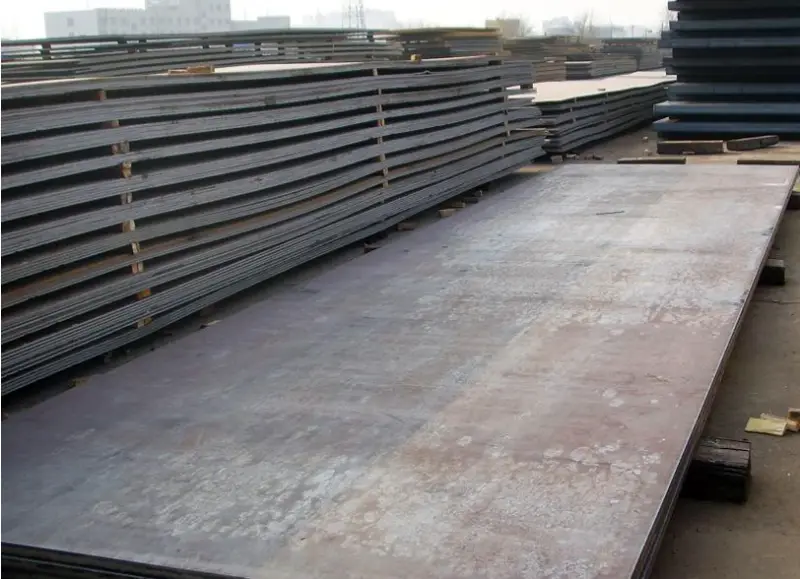
ASTM A516 Grade 55 Steel Plate
ASTM A516 Grade 55 Steel Plate: Comprehensive Technical Data for Pressure Vessels & Boilers
Complete material profile of ASTM A516 Grade 55 carbon steel plate, including chemical composition, mechanical and physical properties, international equivalents, and application guidelines for boiler and pressure vessel fabrication.
Cutting, bending, welding, forming, machining, hot rolling, normalizing
- Phone : +8618037372205
- Email : [email protected]
- WhatsApp: Contact via Whtsapp
- WeChat: +8618037372205
ASTM A516 Grade 55 Steel Plate Introduction
ASTM A516 Grade 55 is a carbon steel plate intended primarily for welded pressure vessels where improved notch toughness is important. As a moderate-strength grade within the A516 family, it provides a minimum yield strength of 205 MPa (30 ksi) and tensile strength ranging from 380 to 515 MPa. The steel is typically supplied in the as-rolled or normalized condition and exhibits excellent weldability and formability. With controlled carbon and manganese content and strict limits on phosphorus and sulfur, it ensures reliable performance in moderate- and low-temperature service. When supplementary Charpy V-notch impact testing is ordered, Grade 55 can be used at temperatures down to -29°C or lower. Major applications include storage tanks, boiler shells, heat exchangers, and reactor components in the oil & gas, chemical, and power generation industries.
ASTM A516 Grade 55 Steel Plate Chemical Composition
Chemical composition limits according to ASTM A516/A516M. Carbon and manganese depend on plate thickness. All values are maximum unless a range is shown. Residual elements are controlled to ensure good weldability and toughness.
| Element | Standard Value | Unit | Remarks |
|---|---|---|---|
| C | ≤0.18 (t≤12.5mm); ≤0.20 (12.5 | % | Heat analysis, max depending on thickness |
| Mn | 0.60 - 0.90 (t≤12.5mm); 0.85 - 1.20 (t>12.5mm) | % | Heat analysis, range |
| Si | 0.15 - 0.40 | % | Heat analysis |
| P | ≤0.025 | % | Max |
| S | ≤0.025 | % | Max |
| Cu | ≤0.35 | % | Max, residual |
| Ni | ≤0.25 | % | Max, residual |
| Cr | ≤0.25 | % | Max, residual |
| Mo | ≤0.08 | % | Max, residual |
| V | ≤0.02 | % | Max, residual |
| Nb | ≤0.01 | % | Max, residual |
| Ti | ≤0.03 | % | Max, residual |
ASTM A516 Grade 55 Steel Plate Thermal and Electrical Physical Properties
These physical properties are typical for carbon steel of similar composition and are not part of the ASTM A516 mandatory requirements. They are provided for engineering calculations. Density, elastic modulus, and thermal expansion are consistent with standard data for low-carbon pressure vessel steels at room temperature unless stated otherwise.
| Property | Typical Value | Unit | Conditions / Remarks |
|---|---|---|---|
| Density (ρ) | 7850 | kg/m³ | 20°C |
| Modulus of Elasticity (E) | 200 - 210 | GPa | Room temperature |
| Shear Modulus (G) | 80 | GPa | Typical for carbon steel |
| Poisson's Ratio (ν) | 0.3 | - | Elastic range |
| Thermal Expansion Coefficient (α) | 11.7 | 10⁻⁶/K | 20 - 100°C |
| Thermal Conductivity (λ) | 52 | W/(m·K) | 20°C |
| Specific Heat Capacity (c) | 470 | J/(kg·K) | 20°C |
| Electrical Resistivity (ρₑ) | 0.15 - 0.20 | μΩ·m | 20°C |
ASTM A516 Grade 55 Steel Plate Mechanical Properties
Tensile and bend test requirements for plates tested in the transverse direction. Elongation values depend on gauge length and plate thickness. Bend test mandrel diameter is linked to actual tensile strength. Impact test (Charpy V-notch) is optional and can be specified as per supplementary requirement S5 (commonly 20 J at -29°C).
| Property | Standard Requirement | Unit | Test Condition / Remarks |
|---|---|---|---|
| Yield Strength (ReH) | ≥205 | MPa | Transverse, as-rolled or normalized |
| Tensile Strength (Rm) | 380 - 515 | MPa | Transverse direction |
| Elongation (200 mm gauge) | ≥23 | % | Transverse, plate thickness ≤40 mm |
| Elongation (200 mm gauge) | ≥23 | % | Transverse, plate thickness >40 mm |
| Elongation (50 mm gauge) | ≥27 | % | Transverse, plate thickness ≤40 mm |
| Elongation (50 mm gauge) | ≥27 | % | Transverse, plate thickness >40 mm |
| Bend Test | d=1.5a (Rm ≤485 MPa); d=2a (Rm >485 MPa) | - | 180° bend, no cracks on outside of bent portion |
ASTM A516 Grade 55 Steel Plate Fully Equivalent Material Standards and Interchangeable Grades
| Country/Region | Standard | Grade | Remarks |
|---|---|---|---|
| USA | ASME SA516/SA516M | SA516 Grade 55 | Identical in chemical and mechanical requirements to ASTM A516 Grade 55; approved for ASME Boiler and Pressure Vessel Code construction. |
ASTM A516 Grade 55 Steel Plate Application Introduction
ASTM A516 Grade 55 is a versatile carbon steel designed for moderate-strength pressure-containing equipment. Its good weldability and notch toughness (when impact tested) make it suitable for a wide range of industrial applications, especially where cost-effective fabrication and reliable service at ambient and moderately low temperatures are required.
Product Applications: Pressure vessels (vertical & horizontal), Boilers (shells and water legs), Heat exchangers, Storage tanks (API 650 type), Reactor shells, Pipeline components (large-diameter fittings)
Processed into products: Shell plates (rolled and welded), Heads (hemispherical, ellipsoidal, torispherical), Flanges and bolted connections, Tube sheets for heat exchangers, Manways and inspection openings, Nozzles and reinforcement pads, Stiffeners and support skirts
Application industries: Oil & Gas (storage tanks, process vessels), Chemical Processing (reactors, columns), Power Generation (boiler drums, steam drums), Industrial Equipment (compressed air receivers, water tanks), Shipbuilding (pressure parts for LNG/LPG carriers)
ASTM A516 Grade 55 Steel Plate Closely Related / Similar Alternative Materials
| Country/Region | Standard | Grade | Remarks |
|---|---|---|---|
| China | GB/T 713 | Q245R | Yield ≥245 MPa, tensile 400-520 MPa; similar carbon steel for pressure vessels, slightly higher strength. |
| European Union | EN 10028-2 | P235GH | Yield ≥235 MPa, tensile 360-500 MPa; comparable carbon steel for elevated temperature pressure parts. |
| Japan | JIS G3103 | SB410 | Yield ≥235 MPa, tensile 410-550 MPa; boiler steel with similar applications. |
| Germany (historical) | DIN 17155 | HII | Obsolete standard; equivalent carbon steel for unfired pressure vessels. |
| United Kingdom | BS 1501-224 | 490A/LT | Carbon steel with comparable mechanical properties for pressure purposes. |
Notes:
This material may be ordered with supplementary requirements such as Charpy V-notch impact testing (commonly at -29°C with 20 J minimum average), ultrasonic examination, or restrictive chemistry for enhanced toughness. Normalized condition is often specified to improve mechanical properties and refine grain structure. When CEV (carbon equivalent) control is required, limits can be agreed upon at the time of inquiry and order. For high-temperature service above 400°C, the user should verify design allowable stresses against relevant codes (e.g., ASME Section II, Part D).
- Share



