
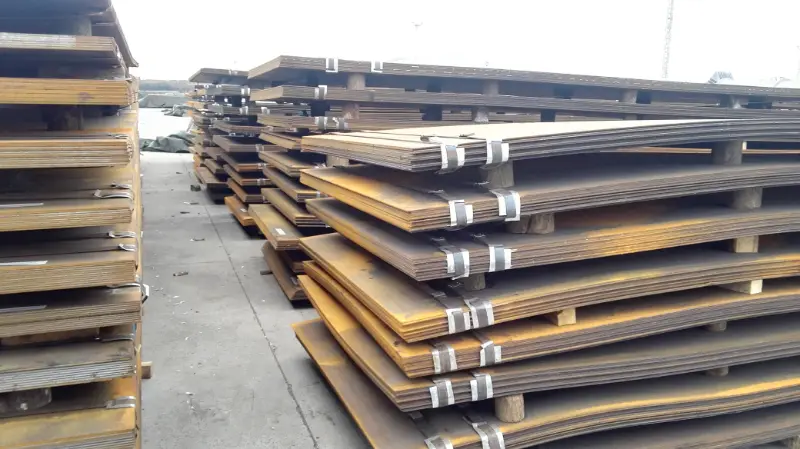
ASTM A516 Grade 60 (A516GR60) Pressure Vessel Steel
ASTM A516 Grade 60 (A516GR60) Pressure Vessel Steel - Properties and Equivalents
Complete material data for ASTM A516 Grade 60 carbon steel plate for pressure vessels and boilers: chemical composition, mechanical properties, physical data, international equivalents, and applications.
Hot rolling, normalizing, stress relieving, welding, cutting, forming, machining
- Phone : +8618037372205
- Email : [email protected]
- WhatsApp: Contact via Whtsapp
- WeChat: +8618037372205
ASTM A516 Grade 60 Pressure Vessel Steel Introduction
ASTM A516 Grade 60 (A516GR60) is a carbon steel plate intended primarily for welded pressure vessels and boilers where improved notch toughness is important. Supplied under ASTM A516/A516M, it is characterized by a minimum tensile strength of 60 ksi (415 MPa) and a minimum yield strength of 32 ksi (220 MPa). The steel is typically supplied in the normalized condition for thicknesses above 40 mm, ensuring fine grain structure and consistent mechanical properties. It offers good weldability and moderate strength, making it suitable for moderate- and lower-temperature service. The standard controls carbon content by thickness, with manganese in the range 0.60–0.90 % (or 0.80–1.20 % if made to fine-grain practice). The material can be ordered with supplementary impact testing to meet specific notch toughness requirements.
ASTM A516 Grade 60 Pressure Vessel Steel Chemical Composition
Chemical requirements according to ASTM A516/A516M-17 for Grade 60. Carbon content varies with plate thickness to ensure weldability and toughness. Manganese may be adjusted when fine-grain practice is applied. Residual elements are controlled but not tabulated individually.
| Element | Specified Value (Heat Analysis) | Remarks |
|---|---|---|
| C | ≤ 0.21 | Thickness ≤ 12.5 mm (0.5 in.) |
| C | ≤ 0.23 | 12.5 mm < thickness ≤ 50 mm (2 in.) |
| C | ≤ 0.25 | 50 mm < thickness ≤ 100 mm (4 in.) |
| C | ≤ 0.27 | 100 mm < thickness ≤ 200 mm (8 in.) |
| C | ≤ 0.29 | Thickness > 200 mm (8 in.) |
| Mn | 0.60 – 0.90 | Standard range (all thicknesses) |
| Mn | 0.80 – 1.20 | When produced to fine-grain practice and carbon equivalent is limited |
| P | ≤ 0.025 | |
| S | ≤ 0.025 | |
| Si | 0.15 – 0.40 | Provided for normalizing or silicon-killed practice |
ASTM A516 Grade 60 Pressure Vessel Steel Physical Properties
Representative physical properties for ASTM A516 Grade 60 in the normalized condition, based on published data for similar carbon steels. Values are provided for engineering design and may vary slightly with actual composition and heat treatment.
| Property | Typical Value | Unit | Test Condition |
|---|---|---|---|
| Density (ρ) | 7.85 | g/cm³ | 20°C |
| Elastic Modulus (E) | 205 | GPa | 20°C |
| Shear Modulus (G) | 80 | GPa | 20°C |
| Poisson's Ratio (ν) | 0.29 | – | 20°C |
| Thermal Expansion Coefficient (α) | 11.7 | 10⁻⁶/K | 20 – 100°C |
| Thermal Expansion Coefficient (α) | 12.2 | 10⁻⁶/K | 20 – 200°C |
| Thermal Expansion Coefficient (α) | 12.8 | 10⁻⁶/K | 20 – 300°C |
| Thermal Conductivity (λ) | 51.9 | W/(m·K) | 100°C |
| Thermal Conductivity (λ) | 48.6 | W/(m·K) | 200°C |
| Thermal Conductivity (λ) | 45.0 | W/(m·K) | 300°C |
| Specific Heat Capacity | 486 | J/(kg·K) | 20 – 100°C |
| Electrical Resistivity (ρ_e) | 0.142 | 10⁻⁶ Ω·m | 20°C |
ASTM A516 Grade 60 Pressure Vessel Steel Mechanical Properties
Mechanical property requirements from ASTM A516/A516M-17, except where noted. Tensile and yield strengths are mandatory. Elongation is measured on standard gauge lengths. Bending test requirements vary with thickness. Charpy impact values are not mandatory but are commonly specified via Supplementary Requirement S5; typical values are shown for reference.
| Property | Standard Requirement / Typical Value | Unit | Test Condition / Remarks |
|---|---|---|---|
| Tensile Strength (Rm) | 415 – 550 | MPa | Transverse specimen, ambient temperature |
| Yield Strength (ReH, min) | 220 | MPa | 0.2% offset or 0.5% extension under load |
| Elongation (A, min) | 21 | % | Gauge length 200 mm (8 in.) |
| Elongation (A, min) | 25 | % | Gauge length 50 mm (2 in.) |
| Bend Test (180°) | 1.5 × thickness | – | Thickness ≤ 19 mm (0.75 in.) |
| Bend Test (180°) | 2 × thickness | – | Thickness > 19–25 mm (0.75–1 in.) |
| Bend Test (180°) | 3 × thickness | – | Thickness > 25–50 mm (1–2 in.) |
| Bend Test (180°) | 4 × thickness | – | Thickness > 50–75 mm (2–3 in.) |
| Charpy V-notch Impact (KV) (typical S5) | ≥ 27 | J | Longitudinal, -20°C, average of 3 |
| Charpy V-notch Impact (KV) (typical S5) | ≥ 27 | J | Transverse, -20°C, average of 3 |
ASTM A516 Grade 60 Pressure Vessel Steel Fully Equivalent Material Standards and Substitute Grades
| Country/Region | Standard | Grade | Remarks |
|---|---|---|---|
| USA | ASME SA516/SA516M | Grade 60 | Identical to ASTM A516 Gr.60; same chemistry and mechanical properties; accepted in ASME pressure vessel construction. |
ASTM A516 Grade 60 Pressure Vessel Steel Application Introduction
ASTM A516 Grade 60 is used extensively in the fabrication of welded pressure vessels and boilers. Its moderate strength and good toughness at low temperatures make it a cost-effective choice for a wide range of industries, including petrochemical, power generation, and oil & gas. The material can be formed, welded, and machined using standard carbon steel practices.
Product Applications: Pressure vessels (ASME Section VIII, Div. 1 and 2), Industrial boilers, Storage spheres and tanks, Heat exchangers and condensers, Reactors and columns, Separators and knock-out drums
Processed into products: Shell plates and heads (dished, elliptical, hemispherical), Tube sheets and baffles, Flanges and manway covers, Nozzle reinforcements, Support skirts and saddles, Internal partition plates and demister pads
Application industries: Oil & Gas (onshore and offshore), Petrochemical and Chemical Processing, Power Generation (boilers, heat recovery steam generators), Pharmaceutical and Food Processing (storage tanks), Water Treatment and Desalination, Pulp and Paper
ASTM A516 Grade 60 Pressure Vessel Steel Similar/Comparable Substitute Materials
| Country/Region | Standard | Grade | Remarks |
|---|---|---|---|
| Europe | EN 10028-3 | P355GH | Tensile strength 470–630 MPa, min yield 355 MPa; slightly higher strength, good for elevated temperature service. |
| International (ISO) | ISO 9328-2 | P355GH | Equivalent to EN P355GH; widely recognized. |
| Japan | JIS G3115 | SPV315 | Tensile 490–610 MPa, yield min 315 MPa; for intermediate- and moderate-temperature pressure vessels. |
| China | GB/T 713 | Q345R | Tensile 490–620 MPa, yield min 325–345 MPa; similar application; check thickness-dependent properties. |
| Germany (former) | DIN 17155 | 19Mn6 | Comparable range; now superseded by EN standards. |
Notes:
- Welding: Readily weldable with low-hydrogen processes (SMAW, SAW, GMAW). Preheat may be required for heavier sections; typical interpass temperature ≤ 300°C.
- Post-weld heat treatment (PWHT): Often performed for stress relief according to service conditions and code requirements.
- Impact testing: When specified per ASTM A516 supplementary requirements, Charpy V-notch tests are typically conducted at -20°C, -40°C, or -50°C. Minimum average absorbed energy is usually 27 J.
- Forming: Can be cold or hot formed. For cold forming with deformation > 5%, stress relieving may be necessary.
- Corrosion resistance: This is a carbon steel with no significant alloying for corrosion resistance; coatings or cladding are required for corrosive environments.
- Share



