
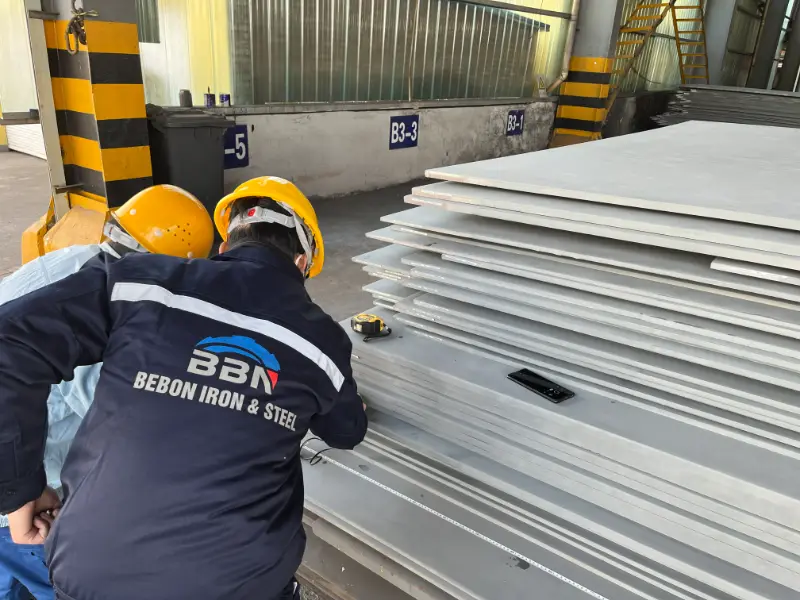
ASTM A517 Grade J (A517GRJ) Pressure Vessel Steel Plate
ASTM A517 Grade J (A517GRJ) Pressure Vessel Steel Plate - High-Strength Quenched and Tempered Alloy
Comprehensive technical data for ASTM A517 Grade J steel plate used in pressure vessels and boilers. Includes chemical composition, mechanical properties, thermal and electrical physical data, international equivalents, and application guidance.
Hot rolling, quenching, tempering; suitable for welding (preheating and post-weld heat treatment may be required), cutting, machining, and cold forming (limited due to high strength)
- Phone : +8618037372205
- Email : [email protected]
- WhatsApp: Contact via Whtsapp
- WeChat: +8618037372205
ASTM A517 Grade J Pressure Vessel Steel Plate Introduction
ASTM A517 Grade J (A517GRJ) is a high-strength quenched and tempered alloy steel plate specifically designed for pressure vessel and boiler applications. It belongs to the chromium-molybdenum (Cr-Mo) family, with controlled carbon, manganese, silicon, chromium, and molybdenum contents, plus an optional boron addition for enhanced hardenability. The material is supplied in the quenched and tempered condition, delivering a minimum yield strength of 690 MPa (100 ksi) and tensile strength between 795–930 MPa (115–135 ksi) for thicknesses up to 65 mm. Its combination of high strength, good toughness, and excellent weldability makes it suitable for demanding service environments, including elevated-temperature and high-pressure conditions. Typical applications include petrochemical reactors, heat exchangers, storage tanks, and boiler drums. The steel exhibits good notch toughness and can withstand moderate temperatures, though long-term elevated-temperature service may require consideration of creep properties.
ASTM A517 Grade J Pressure Vessel Steel Plate Chemical Composition
The chemical composition of ASTM A517 Grade J is precisely controlled to achieve the required mechanical properties after quenching and tempering. Chromium and molybdenum provide improved hardenability and elevated-temperature strength. Boron, when added, further enhances hardenability in thick sections. Sulphur and phosphorus are kept at low levels to maintain ductility and toughness. The values below are as specified in ASTM A517/A517M for Grade J.
- Single values are maximum unless otherwise noted.
- Boron is an optional element; if specified, the range applies.
| Element | Content (%) | Remarks |
|---|---|---|
| Carbon (C) | 0.13 – 0.21 | |
| Manganese (Mn) | 0.80 – 1.10 | |
| Phosphorus (P) | ≤ 0.025 | |
| Sulfur (S) | ≤ 0.025 | |
| Silicon (Si) | 0.20 – 0.35 | |
| Chromium (Cr) | 0.90 – 1.20 | |
| Molybdenum (Mo) | 0.45 – 0.60 | |
| Boron (B) | 0.001 – 0.005 | Optional; if added, this range applies |
| Nickel (Ni) | ≤ 0.40 | Residual element; not intentionally added |
| Copper (Cu) | ≤ 0.35 | Residual element; not intentionally added |
| Vanadium (V) | ≤ 0.08 | May be present as residual |
| Niobium (Nb) | ≤ 0.01 | May be present as residual |
ASTM A517 Grade J Pressure Vessel Steel Plate Thermal and Electrical Physical Properties
The following physical properties are typical for ASTM A517 Grade J (SA-517 Grade J) in the quenched and tempered condition. They are derived from ASME Boiler and Pressure Vessel Code, Section II, Part D, and other industry references. Since these properties are not mandated by the product specification, they should be used for engineering calculations and design purposes only.
- Density may vary slightly with exact composition and tempering temperature.
- Thermal expansion and conductivity values are averaged over the temperature ranges indicated.
- Electrical resistivity is approximate at room temperature.
| Property | Typical Value | Unit | Condition / Temperature |
|---|---|---|---|
| Density (ρ) | 7.85 | g/cm³ | Room temperature |
| Elastic Modulus (E) | 204 | GPa | Room temperature (tension) |
| Elastic Modulus (E) | 29.6 × 10³ | ksi | Room temperature (tension) |
| Shear Modulus (G) | 78 | GPa | Room temperature (typical for steel) |
| Poisson's Ratio (ν) | 0.29 | - | Room temperature |
| Thermal Expansion Coefficient (α) | 11.7 | 10⁻⁶/°C | 20–100°C |
| Thermal Expansion Coefficient (α) | 6.5 | 10⁻⁶/°F | 68–212°F |
| Thermal Conductivity (λ) | 42 | W/(m·K) | At 100°C |
| Thermal Conductivity (λ) | 24 | Btu/(h·ft·°F) | At 212°F |
| Specific Heat Capacity | 460 | J/(kg·K) | At 20–100°C |
| Specific Heat Capacity | 0.11 | Btu/(lb·°F) | At 68–212°F |
| Electrical Resistivity (ρₑ) | 0.22 | µΩ·m | Room temperature |
ASTM A517 Grade J Pressure Vessel Steel Plate Mechanical Properties
The mechanical properties are determined on test specimens taken from quenched and tempered plates. The values below represent the minimum or range requirements for plates up to 2.5 in. (63.5 mm) in thickness. Actual properties may exceed these values.
- Tensile testing is performed in accordance with ASTM A370.
- Charpy V-notch impact tests are supplementary and may be specified at a particular temperature (e.g., -20°F, -40°F) with minimum absorbed energy values agreed upon.
- Hardness is not a mandatory requirement but is typically controlled by the tempering process (often ≤ 250 HBW).
| Property | Required Value | Unit | Test Condition |
|---|---|---|---|
| Tensile Strength (Rm) | 795 – 930 | MPa | Room temperature, thickness ≤ 63.5 mm |
| Tensile Strength (Rm) | 115 – 135 | ksi | Room temperature, thickness ≤ 2.5 in. |
| Yield Strength (ReH, min.) | 690 | MPa | 0.2% offset, thickness ≤ 63.5 mm |
| Yield Strength (ReH, min.) | 100 | ksi | 0.2% offset, thickness ≤ 2.5 in. |
| Elongation (A, min.) | 16 | % | Gauge length 2 in. (50 mm), thickness ≤ 2.5 in. |
| Elongation (A, min.) | 16 | % | Gauge length 50 mm, thickness ≤ 63.5 mm |
| Bend Test (180°) | No cracks | - | Bend diameter 3t (t = specimen thickness) or per specification |
| Charpy V-notch Impact (KV, typical min.) | ≥ 27 | J | At -20°C, depending on supplementary requirement S5; values to be agreed |
ASTM A517 Grade J Pressure Vessel Steel Plate Directly Equivalent Materials
| Country / Region | Standard | Grade | Remarks |
|---|---|---|---|
| USA | ASME SA-517/SA-517M | Grade J | Identical material for pressure vessel construction under ASME BPVC Section II, Part A |
| International | ISO 9328-2:2011 | Grade – | No direct equivalent; ISO 9328-2 covers similar grades but with different strength/chemistry combinations |
| Europe | EN 10028-2 | 13CrMo4-5 (1.7335) | Similar chemistry (1Cr-0.5Mo) but lower yield strength (typically 275–300 MPa); not a strength-for-strength replacement |
| Japan | JIS G3115 | SPV490 | Comparable tensile strength (610–740 MPa) but different alloy design (Mn-Ni-V) and lower yield (min. 490 MPa) |
ASTM A517 Grade J Pressure Vessel Steel Plate Application Introduction
ASTM A517 Grade J is engineered for welded pressure-containing equipment where high strength and moderate temperature resistance are required. Its quenched and tempered microstructure provides a fine balance of strength and toughness. The material is widely used in the following sectors and product forms. Proper welding procedures (including preheat and post-weld heat treatment) are essential to avoid cracking and to maintain mechanical properties in the heat-affected zone.
Product Applications: Pressure vessels (drums, separators, reactors, columns), Fired and unfired boilers, Heat exchangers (shell-and-tube, plate-fin), Storage spheres and bullets, High-pressure piping and fittings (fabricated from plate), Offshore platform components (nodes, legs, decks), Penstocks and surge tanks
Processed into products: Shells and heads of pressure vessels, Tube sheets for heat exchangers, Boiler drums and steam headers, Reinforcing pads and nozzle flanges, Skirt supports and base rings, Weld-neck flanges machined from plate, Structural plates in combined pressure/stress applications
Application industries: Oil and gas (upstream and downstream), Petrochemical and chemical processing, Power generation (conventional and nuclear), Boiler and heat exchanger manufacturing, Shipbuilding (LPG/chemical tankers), Hydropower and penstock systems, Industrial gas storage and transportation
ASTM A517 Grade J Pressure Vessel Steel Plate Similar / Comparable Materials with Overlapping Performance
| Country / Region | Standard | Grade | Remarks |
|---|---|---|---|
| USA | ASTM A517/A517M | Grade A | Same specification, different chemistry (Mn-Mo), similar strength range; often used for similar applications |
| USA | ASTM A517/A517M | Grade B | Cr-Mo steel with lower Cr (0.40–0.65%), same Mo; nearly equivalent mechanical properties |
| Europe | EN 10028-2 | 10CrMo9-10 (1.7380) | Higher Cr (2.0–2.5%) and Mo (0.9–1.1%), similar tensile strength (510–690 MPa) but lower yield; better creep resistance |
| China | GB 713 | 15CrMoR | Cr-Mo pressure vessel steel with comparable chemistry but lower strength (yield ~295 MPa); used at elevated temperatures |
| Worldwide | ASTM A387/A387M | Grade 12 Class 2 | Cr-Mo plate for pressure vessels in normalized-and-tempered or Q&T; lower strength but widely used for high-temperature service |
Notes:
- Welding: Low-hydrogen processes recommended; preheat (typically 150–200°C) and interpass temperature control essential; post-weld heat treatment (PWHT) may be required per construction code (e.g., ASME Section VIII) to reduce residual stresses. Welding consumables should match the strength and chemistry (e.g., AWS ER80S-B2 or E8018-B2).
- Forming: Cold forming is possible but limited due to high yield strength; hot forming may require re-heat treatment to restore properties.
- Testing and Inspection: Ultrasonic examination (UT) is commonly specified per ASTM A578/A578M or equivalent; Charpy impact testing is often invoked as supplementary requirement S5 at a temperature agreed upon by the purchaser.
- Thickness Limitations: The standard covers plates up to 2.5 in. (63.5 mm); for greater thicknesses, properties may be agreed separately and may require adjusted chemical composition and heat treatment.
- Share



