
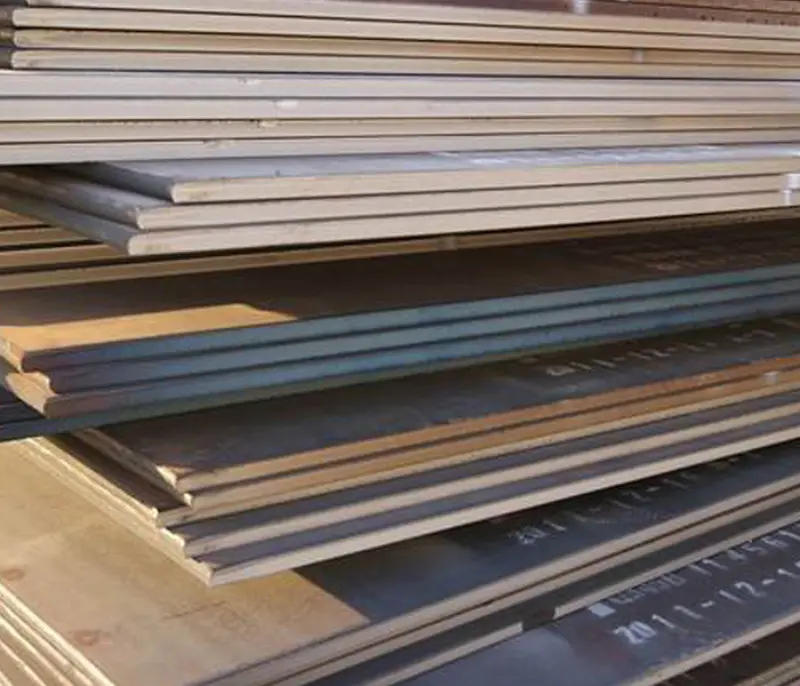
ASTM A514 Grade Q (A514GRQ) High-Strength Quenched and Tempered Alloy Steel Plate
ASTM A514 Grade Q (A514GRQ) High-Strength Quenched and Tempered Alloy Steel Plate
Detailed material data for ASTM A514 Grade Q quenched and tempered alloy steel plate, including chemical composition, mechanical properties, thermal and electrical physical properties, equivalent grades, and application guidelines.
Hot rolling followed by quenching and tempering (Q&T); can be cold formed, machined, and welded with appropriate procedures
- Phone : +8618037372205
- Email : [email protected]
- WhatsApp: Contact via Whtsapp
- WeChat: +8618037372205
ASTM A514 Grade Q High-Strength Quenched and Tempered Alloy Steel Plate Introduction
ASTM A514 Grade Q (A514GRQ) is a high-yield, quenched and tempered alloy steel plate specifically designed for structural applications requiring exceptional strength, good toughness, and weldability. With a minimum yield strength of 100 ksi (690 MPa) and tensile strength in the range 110–130 ksi (760–895 MPa), it is widely used in heavy-duty machinery, bridges, offshore platforms, and pressure vessels. The fine-grained microstructure achieved through quenching and tempering provides an excellent balance of strength and ductility. Its chemical composition, with controlled additions of nickel, chromium, molybdenum, and vanadium, ensures deep hardenability and consistent properties across plate thicknesses up to 2½ inches (63.5 mm). Grade Q demonstrates reliable performance in low-temperature environments when supplementary Charpy V-notch requirements are specified. The steel exhibits good forming and welding characteristics when proper procedures are followed, making it a cost-effective choice for highly stressed welded structures.
ASTM A514 Grade Q High-Strength Quenched and Tempered Alloy Steel Plate Chemical Composition
The chemical composition of ASTM A514 Grade Q is precisely controlled to achieve the required mechanical properties after quenching and tempering. The alloying elements nickel, chromium, molybdenum, and vanadium contribute to hardenability and strength, while low carbon content ensures good weldability. Boron is added in very small amounts to enhance hardenability. All values are as per ASTM A514/A514M standard heat analysis requirements.
| Element | Composition (Weight %) | Remarks |
|---|---|---|
| Carbon (C) | 0.14 – 0.21 | Heat analysis |
| Manganese (Mn) | 0.95 – 1.30 | Heat analysis |
| Phosphorus (P) | ≤ 0.035 | Max |
| Sulfur (S) | ≤ 0.040 | Max |
| Silicon (Si) | 0.15 – 0.35 | Heat analysis |
| Nickel (Ni) | 1.20 – 1.50 | Heat analysis |
| Chromium (Cr) | 1.00 – 1.50 | Heat analysis |
| Molybdenum (Mo) | 0.40 – 0.60 | Heat analysis |
| Vanadium (V) | 0.03 – 0.08 | Heat analysis |
| Boron (B) | 0.0005 – 0.005 | Required addition; residual limits may apply |
ASTM A514 Grade Q High-Strength Quenched and Tempered Alloy Steel Plate Thermal and Electrical Physical Properties
These physical properties are representative of quenched and tempered low-alloy steels similar to ASTM A514 Grade Q. They are provided as reference data, not as specification requirements, and may vary slightly depending on exact composition and heat treatment. Values are measured at room temperature unless noted otherwise.
| Property | Typical Value | Unit | Test Condition / Temperature |
|---|---|---|---|
| Density (ρ) | 7.85 | g/cm³ | 20 °C |
| Modulus of Elasticity (E) | 205 | GPa | 20 °C |
| Shear Modulus (G) | 80 | GPa | Estimated from E and ν; 20 °C |
| Poisson's Ratio (ν) | 0.30 | – | 20 °C |
| Thermal Expansion Coefficient (α) | 12.2 | µm/(m·K) | 20–100 °C |
| Thermal Expansion Coefficient (α) | 13.0 | µm/(m·K) | 20–200 °C |
| Thermal Conductivity (λ) | 42 | W/(m·K) | 100 °C |
| Specific Heat Capacity (c) | 475 | J/(kg·K) | 20 °C |
| Electrical Resistivity (ρe) | 0.23 | µΩ·m | 20 °C |
ASTM A514 Grade Q High-Strength Quenched and Tempered Alloy Steel Plate Mechanical Properties
The mechanical properties of Grade Q plates are guaranteed by the quenching and tempering process. The values listed below represent the minimum requirements from ASTM A514/A514M for plates in the as-delivered condition. Tension tests are conducted on transverse specimens. Charpy V-notch impact tests are not mandatory but may be specified as a supplementary requirement (e.g., at -40°F/-40°C or lower). Bending tests are performed to verify ductility with the specified bend diameter ratios.
| Property | Specified Value | Unit | Test Condition |
|---|---|---|---|
| Yield Strength (ReH) | ≥ 100 (690) | ksi (MPa) | Thickness ≤ 2.5 in. (63.5 mm) – transverse |
| Tensile Strength (Rm) | 110 – 130 (760 – 895) | ksi (MPa) | Thickness ≤ 2.5 in. (63.5 mm) – transverse |
| Elongation (A) | ≥ 18 | % | Gauge length 2 in. (50 mm), all thicknesses |
| Elongation (A) | ≥ 16 | % | Gauge length 8 in. (200 mm), thickness ≤ 3/4 in. (19 mm) |
| Elongation (A) | ≥ 15 | % | Gauge length 8 in. (200 mm), thickness > 3/4 in. to 2.5 in. |
| Bend Test (180°) | D = 2t | – | Thickness ≤ 3/4 in. (19 mm), no cracking |
| Bend Test (180°) | D = 2.5t | – | Thickness > 3/4 in. to 2.5 in. (19–63.5 mm), no cracking |
ASTM A514 Grade Q High-Strength Quenched and Tempered Alloy Steel Plate Directly Equivalent Material Standards and Substitutable Grades
| Country/Region | Standard | Grade | Remarks |
|---|---|---|---|
| Europe | EN 10025-6 | S690QL (1.8928) | Quenched and tempered; equivalent strength class; verify chemical limits – may be directly substitutable for many applications |
| China | GB/T 16270 | Q690D | High strength structural steel plate; similar yield/tensile level; check toughness and composition requirements |
| International | ISO 630-6 | S690QL | Identical to EN 10025-6 S690QL; equivalent in performance |
ASTM A514 Grade Q High-Strength Quenched and Tempered Alloy Steel Plate Application Introduction
ASTM A514 Grade Q is engineered for load-bearing steel structures where high strength-to-weight ratios are essential. Its excellent weldability and toughness under controlled conditions allow it to replace conventional structural steels in demanding environments. Proper welding procedures, including preheat and low-hydrogen electrodes, are critical to avoid hydrogen-induced cracking.
Product Applications: Mobile crane telescopic booms, chassis frames, outrigger beams, Railway and highway bridge girders, orthotropic deck plates, Large excavator buckets, dump truck bodies, bulldozer blades, Drilling platform legs, barge unloaders, ship loader structures, High-pressure water pipes (penstocks), spherical vessels, Weldable structural components in seismic zones
Processed into products: Welded I‑beams, box columns, T‑sections for heavy frameworks, Flanges and webs for crane runway girders, Cutting edges and wear plates requiring high strength and toughness, Machined pins, shafts, and connectors in heavy assemblies, Bent or formed plates for tubular structures and hydraulic cylinders
Application industries: Crane and lifting equipment manufacturing, Bridge construction (girders, arch ribs, box sections), Heavy mining and earthmoving machinery, Offshore and marine engineering (jack-up rigs, platform components), Pressure vessel and penstock fabrication, Hydroelectric power equipment
ASTM A514 Grade Q High-Strength Quenched and Tempered Alloy Steel Plate Similar or Closely Related Material Recommendations
| Country/Region | Standard | Grade | Remarks |
|---|---|---|---|
| USA | ASTM A514 | Grade E, Grade H | Other grades of A514 with slightly different chemistry; similar mechanical properties; may be used when Grade Q is unavailable |
| Japan | JIS G3128 | SHY685N | High yield strength steel for bridges; comparable tensile properties; requires chemistry and welding evaluation |
| Europe | EN 10025-6 | S690Q (1.8931) | Similar strength but different alloying concept; use after careful assessment of toughness and weldability |
| USA | ASTM A517 | Grade Q | Identical chemical and mechanical requirements but for boiler and pressure vessel applications; interchangeable in many cases |
Notes:
- Preheat is recommended during welding, typically 150–200°C (300–400°F), depending on plate thickness and hydrogen levels. Low-hydrogen electrodes or wire/flux combinations are required.
- Post-weld heat treatment (PWHT) is generally not required for thicknesses up to 2 in., but if needed, temperatures must be controlled to avoid loss of strength (usually below the tempering temperature).
- Charpy V‑notch impact requirements (e.g., 20 J at -40°C) are available as a supplementary option per ASTM A514/A514M and must be explicitly specified on the purchase order.
- Plates are ultrasonically tested in accordance with ASTM A578/A578M Level A for internal soundness unless otherwise agreed.
- When cold forming, the minimum recommended bend radius is 3t transverse to the rolling direction and 4t parallel to avoid cracking.
- This grade has limited corrosion resistance; protective coatings or paints are recommended for outdoor exposure.
- Share



