
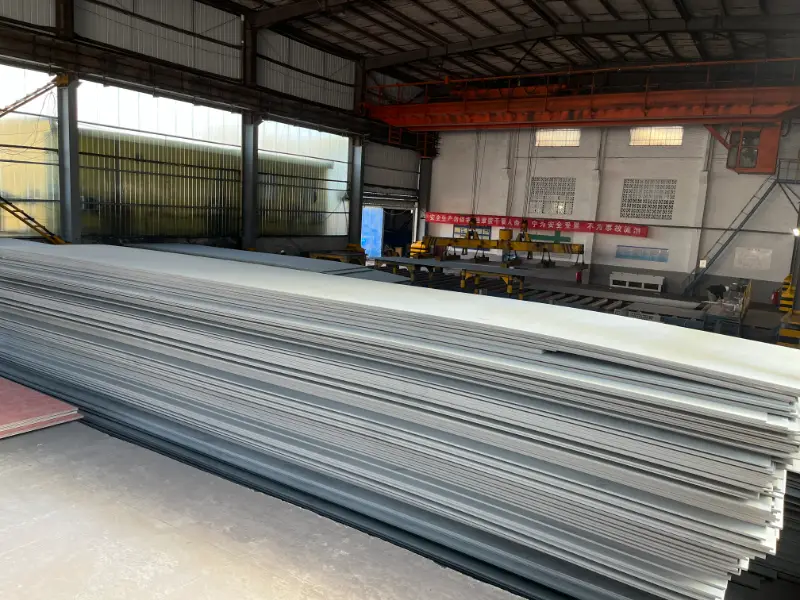
ASTM A36 Carbon Steel Plate
ASTM A36 Carbon Steel Plate: Versatile Structural Steel for General Construction & Welding Applications
Explore the properties, chemical composition, mechanical strength, and international equivalents of ASTM A36 carbon steel plate, widely used in bridges, buildings, and structural fabrications.
Welding, hot forming, machining, cold forming (limited), galvanizing
- Phone : +8618037372205
- Email : [email protected]
- WhatsApp: Contact via Whtsapp
- WeChat: +8618037372205
ASTM A36 Carbon Steel Plate Introduction
ASTM A36 is a common structural carbon steel grade widely used in construction and engineering. It exhibits a minimum yield strength of 250 MPa (36 ksi) and tensile strength ranging from 400 to 550 MPa.
- Excellent weldability and good machinability in normalized or hot-rolled condition.
- Suitable for bolted, riveted, and welded structures.
- Density around 7.85 g/cm³, ensuring predictable structural weight.
- Available as plates, bars, shapes, and sheets in hot-rolled delivery condition, often without further heat treatment.
ASTM A36 Carbon Steel Plate Chemical Composition
Chemical composition limits according to ASTM A36/A36M for plates up to 100 mm thickness. Note: When copper is specified (copper steel), minimum copper content is 0.20%. Other elements may be present at residual levels.
| Chemical Element | Standard Value (wt%) | Remarks |
|---|---|---|
| Carbon (C) | ≤ 0.25 | Maximum |
| Manganese (Mn) | 0.80 – 1.20 | For plates ≤ 20 mm; Mn may be lower for other sections |
| Phosphorus (P) | ≤ 0.04 | Maximum |
| Sulfur (S) | ≤ 0.05 | Maximum |
| Silicon (Si) | 0.15 – 0.40 | For plates; may vary for shapes |
| Copper (Cu) | ≥ 0.20 (if specified) | Minimum when copper steel is ordered |
| Iron (Fe) | Balance | Remainder |
ASTM A36 Carbon Steel Plate Thermal and Electrical Physical Properties
Typical physical properties for ASTM A36 carbon steel at room temperature. These values are based on general engineering references and are not mandatory in ASTM A36/A36M.
- Density 7.85 g/cm³.
- Thermal expansion coefficient approx. 11.7 × 10⁻⁶ /°C between 20°C and 100°C.
- Thermal conductivity about 51.9 W/(m·K) at 20°C.
| Property | Typical Value | Unit | Test Conditions |
|---|---|---|---|
| Density (ρ) | 7.85 | g/cm³ | Room temperature |
| Elastic Modulus (E) | 200 | GPa | Tension, room temperature |
| Shear Modulus (G) | 77.2 | GPa | Based on E and Poisson's ratio |
| Poisson's Ratio (ν) | 0.29 | – | Elastic range |
| Thermal Expansion Coefficient (α) | 11.7 | 10⁻⁶/°C | 20–100°C |
| Thermal Conductivity (λ) | 51.9 | W/(m·K) | At 20°C |
| Specific Heat Capacity (c) | 486 | J/(kg·K) | Typical value at room temperature |
| Electrical Resistivity (ρ_e) | 1.5 × 10⁻⁷ | Ω·m | At 20°C, approx. |
ASTM A36 Carbon Steel Plate Mechanical Properties
Mechanical properties for ASTM A36 steel plates, shapes, and bars, based on ASTM A36/A36M.
- Yield strength minimum 250 MPa (36 ksi).
- Tensile strength range 400–550 MPa (58–80 ksi) for plates and bars.
- Elongation varies with specimen type: 20% in 8-inch gage or 23% in 2-inch gage.
- Bend test requirements depend on thickness and specimen orientation.
| Property | Standard Required Value | Unit | Test Conditions |
|---|---|---|---|
| Yield Strength (ReH) | ≥ 250 | MPa | Plates, shapes, bars; all thicknesses |
| Tensile Strength (Rm) | 400 – 550 | MPa | Plates ≤ 200 mm; bars and shapes |
| Elongation (A) | ≥ 20 | % | 8-inch (200 mm) gage length; plates and bars |
| Elongation (A) | ≥ 23 | % | 2-inch (50 mm) gage length; plates and bars |
| Bend Test (Bend Diameter) | 1.5 × thickness | – | Plates ≤ 20 mm; 180° bend |
| Bend Test (Bend Diameter) | 2.0 × thickness | – | Plates 20–25 mm; 180° bend |
| Impact Toughness (KV) | Not specified | J | No Charpy requirements in standard A36 |
ASTM A36 Carbon Steel Plate International Equivalents – Fully Comparable Standards and Grades
| Country/Region | Standard | Grade | Remarks |
|---|---|---|---|
| European Union | EN 10025-2 | S235JR | Comparable chemistry and mechanical properties; widely used as direct substitute |
| Japan | JIS G3101 | SS400 | Similar tensile strength class; minor differences in Si and Mn limits |
| China | GB/T 700 | Q235B | Equivalent to A36; often used with same yield/tensile requirements |
| International | ISO 630-2 | E235B | Structural quality, similar strength and weldability |
| India | IS 2062 | E250 (Fe 410WA) | Comparable yield and tensile strength |
| Brazil | ABNT NBR 7007 | MR-250 (ASTM A36) | Direct adoption of A36 grade |
ASTM A36 Carbon Steel Plate Application Introduction
ASTM A36 is a fundamental carbon structural steel used extensively in welded, bolted, and riveted constructions. Key application areas include:
- Building and bridge frameworks requiring dependable strength and ductility.
- Industrial structures, mezzanines, and support columns where cost-effectiveness is critical.
- Heavy machinery bases, agricultural equipment, and general fabrication.
- Components subjected to static loads; not recommended for low-temperature impact service without qualification.
Product Applications: Structural beams, channels, and angles, Welded frames and trusses, Steel plates for bridges and buildings, Machine bases and frames, Agricultural implements, Riveted and bolted structures, Railway car components (non-critical)
Processed into products: Base plates, Gusset plates, Column stiffeners, Bracket supports, Flitch plates, Vehicle body frames, Tank shells (non-pressure, atmospheric), Conveyor frames
Application industries: Construction and Civil Engineering, Structural Steel Fabrication, Bridge Building, Heavy Machinery Manufacturing, Shipbuilding (secondary structures), Transmission Towers and Poles, General Engineering and Manufacturing
ASTM A36 Carbon Steel Plate Similar or Closely Related Alternative Materials
| Country/Region | Standard | Grade | Remarks |
|---|---|---|---|
| United States | ASTM A283 | Grade C (A283C) | Slightly lower tensile strength (380–515 MPa), similar carbon steel for structural plates |
| United States | ASTM A572 | Grade 50 | Higher strength (yield 345 MPa); better strength-to-weight ratio, used as upgrade |
| European Union | EN 10025-2 | S275JR | Higher yield (275 MPa) than A36; moderate increase in strength |
| China | GB/T 700 | Q275B | Higher strength, suitable when A36's 250 MPa yield is insufficient |
| Japan | JIS G3106 | SM400A | Weldable structural steel with similar tensile range but stricter impact requirements |
Notes:
- ASTM A36 does not mandate impact testing unless supplementary requirements are specified (e.g., S1 to S5 for Charpy).
- For thicknesses above 100 mm, mechanical properties may be negotiated; typically, strength values are slightly reduced.
- Hot-dip galvanizing of A36 is common; silicon content between 0.15–0.40% gives a typical galvanized coating appearance.
- When equivalent international grades are substituted, confirm exact chemical and mechanical limits per the relevant standard to maintain design integrity.
- Share



