
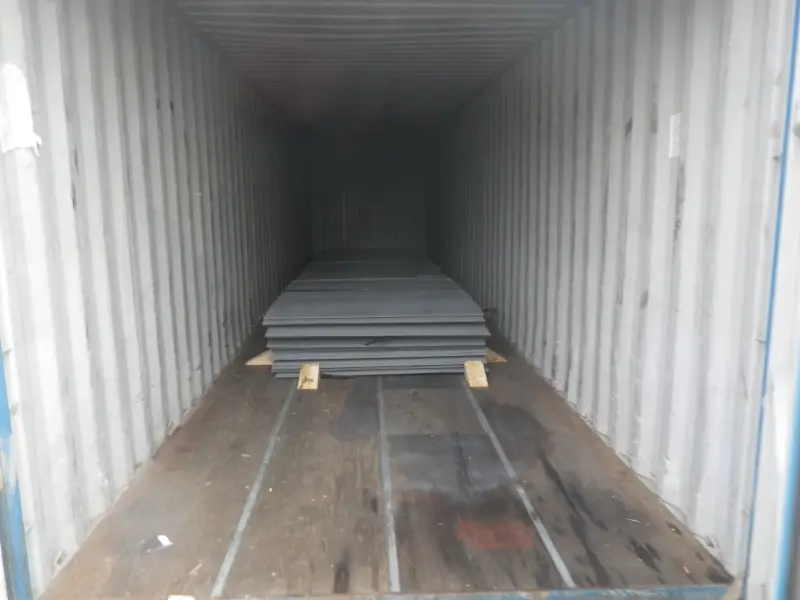
DIN 17155 HI Steel
DIN 17155 HI Pressure Vessel & Boiler Steel Plate: Full Analysis & International Equivalents
Comprehensive data sheet for DIN 17155 HI (H I, 1.0345) boiler and pressure vessel steel: chemical composition, mechanical properties, physical properties, fully equivalent grades (EN P235GH), similar alternatives, and detailed application guide.
Hot rolling, normalizing, cold forming, welding, cutting, machining
- Phone : +8618037372205
- Email : [email protected]
- WhatsApp: Contact via Whtsapp
- WeChat: +8618037372205
DIN 17155 HI Steel Introduction
DIN 17155 HI (material number 1.0345) is a carbon–manganese steel plate primarily intended for the construction of fusion-welded boilers and pressure vessels that operate at elevated temperatures. It exhibits good weldability, moderate strength, and reliable ductility. The steel is typically supplied in the hot-rolled or normalized condition. This grade is the predecessor of the European standard EN 10028-2 P235GH and remains widely referenced in existing installations and international trade. Its balanced composition ensures satisfactory toughness and formability, making it suitable for shells, heads, and other pressure-retaining components in power generation, petrochemical, and process industries.
DIN 17155 HI Steel Chemical Composition
The chemical composition of DIN 17155 HI (H I) is governed by the ladle analysis limits shown below. The steel is fully killed with aluminum, and residual elements are carefully controlled to ensure good weldability and resistance to embrittlement during long-term elevated-temperature service. Values are maximum unless a range is given.
| Element | Specified Value (wt. %) | Remarks |
|---|---|---|
| Carbon, C | ≤ 0.16 | |
| Silicon, Si | 0.10 – 0.35 | |
| Manganese, Mn | 0.40 – 1.20 | |
| Phosphorus, P | ≤ 0.025 | |
| Sulfur, S | ≤ 0.025 | |
| Aluminum (total), Al | ≥ 0.020 | Normally required for fully killed practice; may be omitted if another deoxidation method is agreed |
| Chromium, Cr | ≤ 0.30 | Residual |
| Copper, Cu | ≤ 0.30 | Residual |
| Nickel, Ni | ≤ 0.30 | Residual |
| Molybdenum, Mo | ≤ 0.08 | Residual |
| Niobium, Nb | ≤ 0.01 | Residual |
| Titanium, Ti | ≤ 0.03 | Residual |
| Vanadium, V | ≤ 0.02 | Residual |
| Total of Cr+Cu+Ni+Mo | ≤ 0.70 | Residual element sum; may be subject to additional agreement |
DIN 17155 HI Steel Thermal and Electrical Physical Properties
The following physical properties are typical for carbon steel grades similar to DIN 17155 HI at room temperature and elevated temperatures. They are not mandatory specification values but serve as design reference data. Actual values may vary slightly depending on the exact heat analysis and heat treatment condition.
| Property | Typical Value | Unit | Test Condition / Remarks |
|---|---|---|---|
| Density, ρ | 7.85 | g/cm³ | At 20 °C |
| Modulus of elasticity, E | 210 | GPa | At 20 °C |
| Shear modulus, G | 81 | GPa | At 20 °C |
| Poisson's ratio, ν | 0.3 | - | At 20 °C, within elastic range |
| Thermal expansion coefficient, α | 11.1 × 10⁻⁶ | K⁻¹ | Between 20 °C and 100 °C |
| Thermal expansion coefficient, α | 12.1 × 10⁻⁶ | K⁻¹ | Between 20 °C and 200 °C |
| Thermal expansion coefficient, α | 12.9 × 10⁻⁶ | K⁻¹ | Between 20 °C and 300 °C |
| Thermal expansion coefficient, α | 13.6 × 10⁻⁶ | K⁻¹ | Between 20 °C and 400 °C |
| Thermal conductivity, λ | 53 | W/(m·K) | At 20 °C |
| Thermal conductivity, λ | 51 | W/(m·K) | At 100 °C |
| Thermal conductivity, λ | 48 | W/(m·K) | At 200 °C |
| Specific heat capacity, cp | 460 | J/(kg·K) | Approximate at 20 °C |
| Electrical resistivity, ρe | 0.13 × 10⁻⁶ | Ω·m | At 20 °C |
DIN 17155 HI Steel Mechanical Properties
Mechanical properties are determined on transverse test pieces taken from the as-delivered condition. The values depend on product thickness. Yield strength (ReH), tensile strength (Rm), elongation (A), and bend test requirements are listed below. Impact energy (KV) may be agreed upon at the time of ordering; typical specified values are shown for reference.
| Property | Required Value | Unit | Test Condition |
|---|---|---|---|
| Yield strength, ReH | ≥ 235 | MPa | Product thickness t ≤ 16 mm |
| Yield strength, ReH | ≥ 225 | MPa | 16 < t ≤ 40 mm |
| Yield strength, ReH | ≥ 215 | MPa | 40 < t ≤ 60 mm |
| Yield strength, ReH | ≥ 200 | MPa | 60 < t ≤ 100 mm |
| Tensile strength, Rm | 350 – 480 | MPa | All thicknesses t ≤ 100 mm |
| Elongation after fracture, A (L0 = 5.65√S0) | ≥ 25 | % | t ≤ 40 mm (longitudinal) |
| Elongation after fracture, A (L0 = 5.65√S0) | ≥ 24 | % | 40 < t ≤ 60 mm (longitudinal) |
| Elongation after fracture, A (L0 = 5.65√S0) | ≥ 23 | % | 60 < t ≤ 100 mm (longitudinal) |
| Bend test (180°), ratio of mandrel diameter to specimen thickness | d = 0.5 a | - | t ≤ 30 mm |
| Bend test (180°), ratio of mandrel diameter to specimen thickness | d = 1.5 a | - | 30 < t ≤ 60 mm |
| Bend test (180°), ratio of mandrel diameter to specimen thickness | To be agreed | - | t > 60 mm |
| Impact energy (KV), Charpy-V, room temperature | ≥ 27 | J | Optional; agreed upon ordering (transverse test piece) |
| Impact energy (KV), Charpy-V, 0 °C | ≥ 27 | J | Optional; for some thickness ranges, by agreement |
| Impact energy (KV), Charpy-V, -20 °C | ≥ 27 | J | Optional; may be specified for low-temperature applications |
DIN 17155 HI Steel Fully Equivalent Material Standards and Substitute Grades
| Country / Region | Standard | Grade Designation | Remarks |
|---|---|---|---|
| Europe | EN 10028-2 | P235GH (1.0345) | Direct successor of DIN 17155 HI; identical chemical and mechanical requirements. |
| International | ISO 9328-2 | P235 | Technically equivalent to P235GH and DIN HI; suitable for boilers and pressure vessels. |
| France | NF A36-205 | P235GH | Same as EN 10028-2; fully interchangeable. |
| United Kingdom | BS EN 10028-2 | P235GH | Adopted EN standard; replaces BS 1501 corresponding grades. |
| Italy | UNI EN 10028-2 | P235GH | Harmonized European grade. |
DIN 17155 HI Steel Application Introduction
DIN 17155 HI (H I) is a well-established carbon steel for welded pressure parts that operate at temperatures typically not exceeding 400–450 °C. It is appreciated for its ease of fabrication and reliable service performance in the boiler and process industries. The following lists illustrate the main fields of use and typical fabricated components.
Product Applications: Stationary fire-tube and water-tube boilers, Steam drums and mud drums, Pressure vessels for medium-pressure service, Heat exchangers (shell and tube type), Reactor vessels (low to moderate temperature range), Air receivers and compressed gas storages, Distillation columns and separators
Processed into products: Cylindrical shells and course rings, Formed heads (ellipsoidal, hemispherical, torispherical), Bend pipes and branches for boiler piping, Tube sheets and baffles, Flanges (welding neck, blind, slip-on) machined from plates, Reinforcing pads and lifting lugs, Stiffening rings and saddles
Application industries: Power generation (fossil fuel and nuclear conventional islands), Petrochemical and refining, Chemical processing, Industrial boiler manufacturing, Oil & gas pressure equipment, Storage and transport of pressurized fluids, Food and pharmaceutical (moderate-temperature vessels)
DIN 17155 HI Steel Similar or Comparable Alternative Materials
| Country / Region | Standard | Grade Designation | Remarks |
|---|---|---|---|
| USA | ASTM A285 / A285M | Grade C | Carbon steel plate for pressure vessels; Rm 380–515 MPa, ReH min 205 MPa. Not identical; requires careful comparison of thickness-dependent properties. |
| China | GB 713 | Q245R | Carbon steel for boilers and pressure vessels; ReH ≥ 245 MPa (t≤16mm), Rm 400–520 MPa. Similar service conditions, but slightly higher strength. |
| Japan | JIS G3103 | SB410 | Boiler and pressure vessel steel; Rm 410–550 MPa, ReH ≥ 225 MPa. Used in similar applications; chemical composition differs. |
| Russia | GOST 5520 | St2kp or St3sp | Depending on the semikilled/killed practice, comparable mechanical range; verification of specific grade is required. |
| India | IS 2041 | R220/350 | Grade with Rm 350–480 MPa; parallel to DIN HI but with different Mn limits. |
Notes:
Note: The original DIN 17155 standard has been withdrawn and replaced by EN 10028-2. For new construction, the preferred designation is P235GH (1.0345). When substituting with other international grades, a full review of the design code, strength calculation at design temperature, and welding compatibility is strongly recommended. Unless otherwise agreed, the impact energy values mentioned are not mandatory but are commonly specified to ensure adequate toughness for safety-critical components.
- Share



