
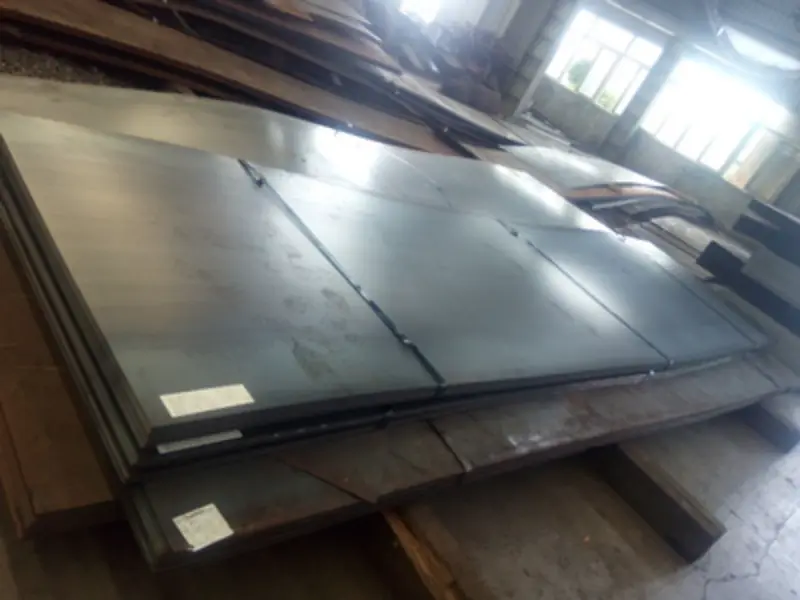
ASTM A204 Grade B (A204GRB) Alloy Steel Plate for Pressure Vessels & Boilers
ASTM A204 Grade B (A204GRB) Alloy Steel Plate for Pressure Vessels & Boilers
Complete data sheet for ASTM A204 Grade B chromium-molybdenum alloy steel plate used in welded pressure vessels and boilers, including chemical, mechanical, thermal properties, and worldwide equivalents.
Hot rolling, normalizing, stress relieving, welding
- Phone : +8618037372205
- Email : [email protected]
- WhatsApp: Contact via Whtsapp
- WeChat: +8618037372205
ASTM A204 Grade B Alloy Steel Plate for Pressure Vessels & Boilers Introduction
ASTM A204 Grade B is a chromium-molybdenum (Cr-Mo) alloy steel plate designed for welded pressure vessels and boilers operating at moderate and elevated temperatures. The addition of chromium (approx. 1%) and molybdenum (approx. 0.5%) enhances tensile strength, creep resistance, and resistance to hydrogen attack. Key features: good weldability with proper preheat and post-weld heat treatment, reliable performance up to 500-550°C, and availability in a wide range of thicknesses. It is commonly supplied in the normalized or stress-relieved condition and is used in the fabrication of reactors, heat exchangers, and storage tanks in the chemical, petrochemical, and power generation industries.
ASTM A204 Grade B Alloy Steel Plate for Pressure Vessels & Boilers Chemical Composition
The chemical requirements for ASTM A204 Grade B are controlled to ensure the necessary mechanical properties and weldability. Carbon content is limited based on plate thickness to maintain toughness. Chromium and molybdenum provide high-temperature strength and resistance to hydrogen damage. Phosphorus and sulfur are restricted to minimize embrittlement.
| Chemical Element | Specified Value (wt%) | Remarks |
|---|---|---|
| Carbon (C) | ≤0.20 | For plate thickness ≤50 mm |
| Carbon (C) | ≤0.23 | For plate thickness >50 mm |
| Manganese (Mn) | ≤0.90 | Applies to all thicknesses |
| Phosphorus (P) | ≤0.025 | Applies to all thicknesses |
| Sulfur (S) | ≤0.025 | Applies to all thicknesses |
| Silicon (Si) | 0.15 – 0.40 | Applies to all thicknesses |
| Chromium (Cr) | 0.90 – 1.20 | Applies to all thicknesses |
| Molybdenum (Mo) | 0.45 – 0.60 | Applies to all thicknesses |
ASTM A204 Grade B Alloy Steel Plate for Pressure Vessels & Boilers Thermal & Electrical Physical Properties
These values are representative of 1%Cr-0.5%Mo alloy steel plate in the normalized and tempered condition. Data are sourced from standard engineering handbooks and may vary with specific heat treatment and composition within the grade limits.
| Property | Typical Value | Unit | Test Condition |
|---|---|---|---|
| Density (ρ) | 7.85 | g/cm³ | At 20 °C |
| Elastic Modulus (E) | 200 | GPa | At room temperature |
| Shear Modulus (G) | 79 | GPa | At room temperature |
| Poisson's Ratio (ν) | 0.29 | – | At room temperature |
| Thermal Expansion (α) | 11.2 | ×10⁻⁶ /K | 20 – 100 °C |
| Thermal Expansion (α) | 12.0 | ×10⁻⁶ /K | 20 – 200 °C |
| Thermal Expansion (α) | 12.6 | ×10⁻⁶ /K | 20 – 300 °C |
| Thermal Expansion (α) | 13.0 | ×10⁻⁶ /K | 20 – 400 °C |
| Thermal Expansion (α) | 13.4 | ×10⁻⁶ /K | 20 – 500 °C |
| Thermal Conductivity (λ) | 37 | W/(m·K) | At 20 °C |
| Thermal Conductivity (λ) | 36 | W/(m·K) | At 100 °C |
| Thermal Conductivity (λ) | 34 | W/(m·K) | At 200 °C |
| Thermal Conductivity (λ) | 33 | W/(m·K) | At 300 °C |
| Thermal Conductivity (λ) | 31 | W/(m·K) | At 400 °C |
| Thermal Conductivity (λ) | 29 | W/(m·K) | At 500 °C |
| Specific Heat Capacity (c) | 460 | J/(kg·K) | At 20 °C |
| Specific Heat Capacity (c) | 500 | J/(kg·K) | At 100 °C |
| Specific Heat Capacity (c) | 530 | J/(kg·K) | At 200 °C |
| Specific Heat Capacity (c) | 550 | J/(kg·K) | At 300 °C |
| Specific Heat Capacity (c) | 570 | J/(kg·K) | At 400 °C |
| Specific Heat Capacity (c) | 590 | J/(kg·K) | At 500 °C |
| Electrical Resistivity (ρₑ) | 0.25 | µΩ·m | At 20 °C |
ASTM A204 Grade B Alloy Steel Plate for Pressure Vessels & Boilers Mechanical Properties
Tensile requirements are determined at room temperature in accordance with ASTM A370. The plate is normally tested in the as-supplied condition (normalized or stress relieved). Impact testing is not mandatory unless specified by supplementary requirements.
| Property | Specified Value | Unit | Test Condition |
|---|---|---|---|
| Yield Strength (ReH) | ≥ 40 (275) | ksi (MPa) | Room temperature |
| Tensile Strength (Rm) | 70 – 90 (485 – 620) | ksi (MPa) | Room temperature |
| Elongation (A) | ≥ 20 | % | 2 in. (50 mm) gauge length |
ASTM A204 Grade B Alloy Steel Plate for Pressure Vessels & Boilers Direct Equivalent Material Standards & Replaceable Grades
| Country/Region | Standard | Grade | Remarks |
|---|---|---|---|
| USA | ASME SA-204/SA-204M | Grade B | Identical to ASTM A204 Grade B; accepted for ASME Boiler & Pressure Vessel Code construction. |
ASTM A204 Grade B Alloy Steel Plate for Pressure Vessels & Boilers Application Introduction
ASTM A204 Grade B plates are utilized in welded pressure vessels and boilers that operate at elevated temperatures up to approximately 500-550°C. The chromium-molybdenum composition provides improved oxidation resistance and strength retention, making it suitable for steam, process gas, and hydrogen containing environments. Processing notes: Preheat to 150-200°C is recommended before welding to avoid cold cracking. Post-weld heat treatment (PWHT) in accordance with applicable codes (e.g., ASME Section VIII) is normally required to relieve residual stresses and reduce hardenability. Care should be taken to minimize exposure to the 370-575°C temperature range for prolonged periods to avoid temper embrittlement.
Product Applications: Pressure vessels, Boilers, Heat exchangers, Reactors, Storage tanks, Separators
Processed into products: Shell plates, Heads (dished ends), Tube sheets, Flanges, Reinforcement pads, Manways and nozzles
Application industries: Oil & Gas, Power Generation, Chemical Processing, Petrochemical, Fertilizer Manufacturing
ASTM A204 Grade B Alloy Steel Plate for Pressure Vessels & Boilers Similar / Comparable Material Recommendations
| Country/Region | Standard | Grade | Remarks |
|---|---|---|---|
| China | GB/T 713 | 15CrMoR | Similar Cr-Mo alloy with C 0.12-0.18, Cr 0.80-1.20, Mo 0.45-0.60; widely used for pressure vessels. |
| European Union | EN 10028-2 | 13CrMo4-5 (1.7335) | Slightly lower Cr range (0.70-1.15); comparable high-temperature strength. |
| Japan | JIS G3109 | SCMV 3 | Very close composition: C ≤0.17, Cr 0.90-1.20, Mo 0.45-0.65. Used for similar applications. |
| Germany (former) | DIN 17155 | 15CrMo3 | Historical standard, now replaced by EN 10028-2 13CrMo4-5. |
Notes:
Supplementary requirements (e.g., impact testing, additional heat treatment) may be agreed upon at the time of purchase. Welding consumables should match the chemical and mechanical properties of the base metal. For hydrogen service, a post-weld hydrogen release treatment may be specified. The material can be susceptible to temper embrittlement if impurity elements are not tightly controlled; maintain low P, Sn, Sb, and As levels to mitigate this risk.
- Share



