
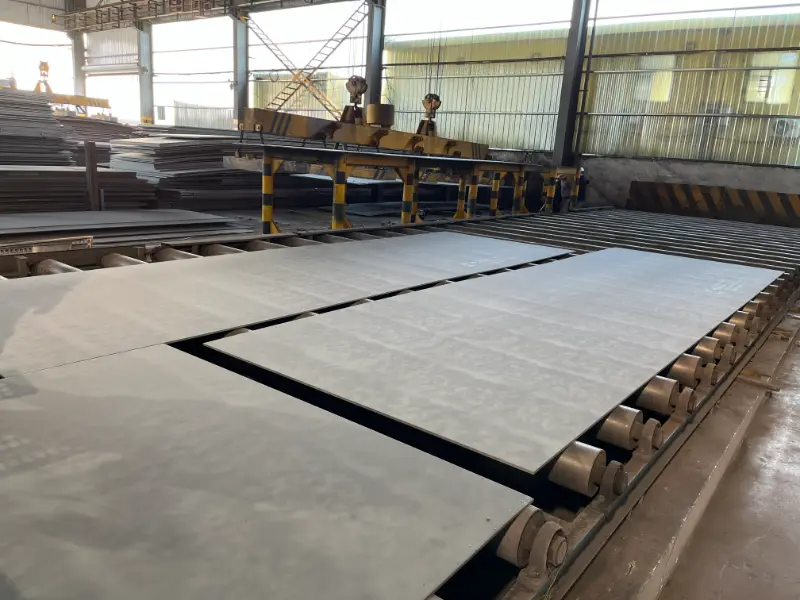
ASTM A204 Grade C (A204GRC) Mo
ASTM A204 Grade C (A204GRC) Mo-Alloy Steel Plate for Pressure Vessels & Boilers
Complete material data sheet for ASTM A204 Grade C (A204GRC) molybdenum-alloy steel plate widely used in welded boilers and pressure vessels. Includes chemical, mechanical, and physical properties with equivalent grades.
Hot rolling, normalizing, tempering, stress relieving, welding (with preheat and PWHT), cutting, forming
- Phone : +8618037372205
- Email : [email protected]
- WhatsApp: Contact via Whtsapp
- WeChat: +8618037372205
ASTM A204 Grade C Mo Introduction
ASTM A204 Grade C (A204GRC) is a molybdenum-alloy steel plate specifically designed for welded pressure vessels and boilers operating at moderate temperatures. It offers improved strength and superior resistance to creep compared to plain carbon steel, making it suitable for elevated-temperature service. The alloy is readily weldable with proper preheat and post-weld heat treatment. This grade is part of the ASTM A204/A204M specification, characterized by a nominal molybdenum content of 0.45–0.60%, which enhances hardenability and high-temperature mechanical properties.
ASTM A204 Grade C Mo Chemical Composition of ASTM A204 Grade C
The chemical composition is in accordance with ASTM A204/A204M. The steel relies on molybdenum for elevated-temperature strength and creep resistance. Maximum limits are shown unless a range is specified. Sulfur and phosphorus are strictly controlled to ensure weldability and toughness.
| Element | Standard Value (wt%) | Remarks |
|---|---|---|
| Carbon (C) | max 0.25 | If C > 0.25, max Mo increases to 0.60 |
| Manganese (Mn) | max 0.90 | Heat analysis, max 0.98 for product analysis |
| Phosphorus (P) | max 0.025 | |
| Sulfur (S) | max 0.025 | |
| Silicon (Si) | 0.15 – 0.50 | Product analysis range 0.13–0.55 |
| Molybdenum (Mo) | 0.45 – 0.60 | Key alloying element for creep strength |
ASTM A204 Grade C Mo Typical Thermal & Electrical Physical Properties of ASTM A204 Grade C
These physical data are typical for molybdenum-alloy steel plates at room temperature, unless a temperature range is specified. Values are not part of the ASTM specification but are compiled from reliable engineering sources for design reference. Properties may vary slightly with heat treatment and composition.
| Property | Typical Value | Unit | Test Condition |
|---|---|---|---|
| Density (ρ) | 7.85 | g/cm³ | Room temperature |
| Elastic Modulus (E) | 200 – 210 | GPa | Room temperature |
| Shear Modulus (G) | 80 | GPa | Estimated from E and ν |
| Poisson's Ratio (ν) | 0.27 – 0.30 | – | Room temperature |
| Thermal Expansion Coefficient (α) | 11.7 | µm/(m·°C) | 20 – 100 °C |
| Thermal Expansion Coefficient (α) | 12.6 | µm/(m·°C) | 20 – 300 °C |
| Thermal Conductivity (λ) | 42 – 50 | W/(m·K) | At 20 °C |
| Specific Heat Capacity (cp) | 460 – 500 | J/(kg·K) | At 20 °C |
| Electrical Resistivity (ρe) | 0.20 – 0.25 | µΩ·m | Room temperature |
ASTM A204 Grade C Mo Mechanical Properties of ASTM A204 Grade C
Tensile and yield strength requirements specified in ASTM A204/A204M. Values are minimum unless otherwise noted. Elongation is measured on standard gauge lengths. The bend test (2T) is required for plates up to 25 mm thickness to verify ductility. No impact test is mandated in the base specification.
| Property | Standard Required Value | Unit | Test Condition / Remarks |
|---|---|---|---|
| Tensile Strength (Rm) | 75 – 95 | ksi | Transverse specimen, applies to all thicknesses |
| Tensile Strength (Rm) | 515 – 655 | MPa | Metric equivalent |
| Yield Strength (ReH) | min 45 | ksi | 0.2% offset or 0.5% extension under load |
| Yield Strength (ReH) | min 310 | MPa | Metric equivalent |
| Elongation in 200 mm (A200) | min 19 | % | Plate ≤ 50 mm thick |
| Elongation in 50 mm (A50) | min 23 | % | Plate ≤ 50 mm thick |
| Bend Test (Bend Diameter) | 2T (with T = plate thickness) | – | 180° bend, no cracks outside; applicable for plates ≤ 25 mm |
ASTM A204 Grade C Mo Completely Equivalent Material Standards & Replaceable Grades
| Country/Region | Standard | Grade | Remarks |
|---|---|---|---|
| USA | ASME SA204/SA204M | Grade C | Identical chemical and mechanical requirements; ASME adoption of ASTM. |
| International | ISO 9328-2 | None directly; may reference 16Mo3 but Mo content differs | No exact ISO equivalent. Closest is ISO 9328-2:2004 Grade 16Mo3 (0.25-0.35% Mo). |
ASTM A204 Grade C Mo Application Introduction
ASTM A204 Grade C is primarily used in the fabrication of welded boilers and pressure vessels requiring moderate elevated-temperature strength and good creep resistance. It is suitable for service up to approximately 500°C (932°F). Proper welding procedures (preheat, low-hydrogen electrodes, post-weld heat treatment) are essential to avoid cracking. Typical applications include:
- Boiler drums and steam drums in power plants
- Shell and head plates for pressure vessels in petrochemical plants
- Heat exchangers and reactors
- High-temperature piping components
- Storage tanks for hot liquids and gases
Product Applications: Boiler Drums, Steam Separators, Reactor Pressure Vessels, Heat Exchanger Shells, Hot Process Piping, LNG Vaporizers, Deaerator Tanks
Processed into products: Vessel cylindrical shells and formed heads, Tube sheets and flanges, Support skirts and saddles, Baffle plates, Nozzle reinforcements, Manway covers and girth flanges
Application industries: Power Generation (Conventional & Thermal), Oil & Gas (Refineries, Petrochemical), Chemical Process Industry, Nuclear (secondary side components), Fabricated Pressure Equipment Manufacturing
ASTM A204 Grade C Mo Similar/Alternative Materials with Comparable Performance
| Country/Region | Standard | Grade | Remarks |
|---|---|---|---|
| Europe | EN 10028-2 | 16Mo3 | Lower Mo (0.25-0.35%); typical tensile 440-590 MPa, yield ≥ 275 MPa. Widely used for similar pressure vessel applications; engineering assessment for substitution required. |
| USA | ASTM A204/A204M | Grade B | Mo 0.45-0.60% (same as Grade C) but max C 0.27% and tensile 70-90 ksi. Lower strength, may be used in less demanding conditions. |
| USA | ASTM A204/A204M | Grade A | Mo 0.45-0.60%, max C 0.25%, tensile 65-85 ksi. Lower strength variant. |
| Japan | JIS G3103 | SB450M | Mn-Si steel with nominal Mo 0.45-0.60%, tensile 450-590 MPa, yield ≥ 245 MPa. Close in strength, but not identical specification; verify design codes. |
Notes:
Supplementary requirements (e.g., impact testing, ultrasonic examination, restricted chemistry for welding) may be specified by purchase order under ASTM A204/A204M. For hydrogen service or low-temperature conditions, additional testing (HIC, SSC) is required. Heat treatment (normalizing, tempering) is often beneficial for homogenizing microstructure and improving toughness. The data provided are based on the ASTM A204/A204M-18 edition. Always refer to the latest standard revision for current requirements.
Weldability: Preheating (150-200°C) and post-weld heat treatment (620-680°C) are recommended, especially for thick sections. Filler metal with matching Mo content (e.g., ER80S-B2 or E8018-B2) is suitable.
- Share



