
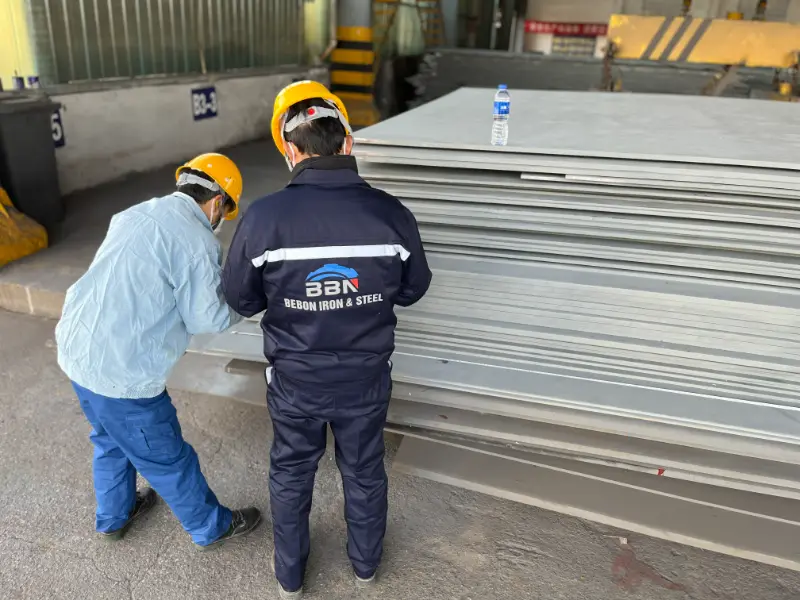
ASTM A204 Grade A (A204GRA) Pressure Vessel Steel Plate
ASTM A204 Grade A (A204GRA) Pressure Vessel Steel Plate: Properties & Global Equivalents
Comprehensive data sheet for ASTM A204 Grade A (A204GRA) steel plate. Includes chemical composition, mechanical and thermal properties, international equivalent grades, and application guide for pressure vessels and boilers.
Hot rolling, normalizing, stress relieving, tempering (as required by specification)
- Phone : +8618037372205
- Email : [email protected]
- WhatsApp: Contact via Whtsapp
- WeChat: +8618037372205
ASTM A204 Grade A Pressure Vessel Steel Plate Introduction
ASTM A204 Grade A (A204GRA) is a molybdenum-alloy steel plate intended for welded pressure vessels and boilers. It is produced under the ASTM A204/A204M standard. This grade belongs to the family of C-0.5Mo low alloy steels, offering improved high-temperature strength compared to plain carbon steels. Key characteristics include:
- Good tensile strength and yield strength at elevated temperatures up to approximately 500°C
- Excellent weldability when proper preheating and post-weld heat treatment are applied
- Uniformity of properties through normalized or stress-relieved delivery conditions
- Balanced carbon content (maximum 0.25%) to maintain toughness while providing strength
Supplied primarily as hot-rolled or normalized plates, A204 Grade A is widely used in the fabrication of boilers, pressure vessels, heat exchangers, and similar equipment in the power generation and petrochemical industries. Its moderate hardenability and good machinability facilitate forming and welding operations.
ASTM A204 Grade A Pressure Vessel Steel Plate Chemical Composition
Chemical composition limits for ASTM A204 Grade A steel as per ASTM A204/A204M. Elements not listed (such as copper, nickel, chromium) may be present as residual but are not specified. Molybdenum is the main alloying element providing elevated temperature strength.
- Single values are maximum unless a range is shown.
- The steel is fully killed and made to fine grain practice.
| Chemical Element | Standard Value (wt%) | Remarks/Notes |
|---|---|---|
| Carbon (C) | 0.25 max | For thickness ≤50 mm; 0.27 max for thickness >50-100 mm; 0.29 max for thickness >100 mm |
| Manganese (Mn) | 0.80 max | Not exceeding. For plates ≤50 mm, typically 0.50-0.80 |
| Silicon (Si) | 0.15-0.40 | Killing element, ensures soundness |
| Phosphorus (P) | 0.035 max | |
| Sulfur (S) | 0.035 max | |
| Molybdenum (Mo) | 0.45-0.60 | Principal strengthening element for high-temperature service |
ASTM A204 Grade A Pressure Vessel Steel Plate Physical and Thermal Properties
Typical physical and thermal properties for C-0.5Mo low alloy steel comparable to ASTM A204 Grade A. These values are indicative and based on published data for similar materials. Actual properties may vary depending on heat treatment and specific composition.
- Properties are measured at room temperature unless otherwise noted.
- Thermal conductivity and specific heat capacity vary with temperature; values for ambient conditions are given.
| Property | Typical Value | Unit | Test Condition |
|---|---|---|---|
| Density (ρ) | 7.85 | g/cm³ | Room temperature |
| Elastic Modulus (E) | 200 | GPa | Room temperature |
| Shear Modulus (G) | 80 | GPa | Room temperature (approximate) |
| Poisson's Ratio (ν) | 0.29 | — | Room temperature |
| Thermal Expansion Coefficient (α) | 11.5 | 10⁻⁶/°C | 20-100°C |
| Thermal Expansion Coefficient (α) | 12.5 | 10⁻⁶/°C | 20-300°C |
| Thermal Conductivity (λ) | 50 | W/(m·K) | At 20°C |
| Specific Heat Capacity (cp) | 0.46 | J/(g·K) | At 20°C |
| Electrical Resistivity (ρe) | 0.20 | µΩ·m | At 20°C |
ASTM A204 Grade A Pressure Vessel Steel Plate Mechanical Properties
Mechanical property requirements for ASTM A204 Grade A steel plate at room temperature, based on the standard specification. Test samples are taken in the transverse direction. The values represent minimum requirements unless a range is indicated.
- Yield strength corresponds to 0.2% offset or 0.5% extension under load method.
- Elongation is measured on a proportional specimen.
| Property | Standard Requirement | Unit | Test Condition |
|---|---|---|---|
| Tensile Strength (Rm) | 65-85 (450-585) | ksi (MPa) | Room temperature, transverse specimen |
| Yield Strength (ReH) | 37 min (255 min) | ksi (MPa) | Room temperature, transverse specimen |
| Elongation (A) in 8 in. (200 mm) | 19 min | % | Gauge length 200 mm |
| Elongation (A) in 2 in. (50 mm) | 23 min | % | Gauge length 50 mm |
| Bend Test | No mandatory requirement in base specification | — | May be subject to supplementary requirement S5 |
ASTM A204 Grade A Pressure Vessel Steel Plate Completely Equivalent Material Standards and Substitute Grades
| Country/Region | Standard | Grade/Designation | Remarks/Notes |
|---|---|---|---|
| EU | EN 10028-2 | 16Mo3 | Approximate equivalent; Mo content typically 0.25-0.35 wt%, C ≤0.20. Often used as a substitute for A204 Gr.A in pressure vessel applications. Requires careful review of properties. |
| China | GB/T 35012 | 15MoG | Similar Mo alloy steel for boilers (C ≤0.20, Mo 0.25-0.35). Not identical but can be considered for substitution with design adjustments. |
| Japan | JIS G3103 | SB450M | C-0.5Mo steel for boilers and pressure vessels. Tensile strength 450-590 MPa, similar to A204 Gr.A. Directly comparable. |
ASTM A204 Grade A Pressure Vessel Steel Plate Application Introduction
ASTM A204 Grade A plates are widely utilized in welded pressure vessels and boilers operating at moderate temperatures (up to approximately 500°C). Their good weldability and uniformity make them suitable for components subjected to static and dynamic pressures. The following highlights typical industries, products, and specific parts made from this grade.
Product Applications: Steam boilers and boiler drums, Pressure vessels (reactors, separators, accumulators), Heat exchangers (shell-and-tube, feedwater heaters), Storage tanks for medium-temperature service, Industrial piping components (flanges, tube sheets), Autoclaves and sterilizers, Waste heat recovery systems
Processed into products: Cylindrical shells and courses, Hemispherical and elliptical heads, Tube sheets for heat exchangers, Nozzle necks and reinforcement pads, Blind flanges and manway covers, Support skirts and structural attachments for pressure vessels, Welded pads and lifting lugs
Application industries: Power generation (fossil fuel and nuclear), Petrochemical and chemical processing, Oil and gas refining, Industrial boiler manufacturing, Heat exchanger and condenser fabrication, Pulp and paper industry (digesters, recovery boilers), Water treatment plants (pressure vessels)
ASTM A204 Grade A Pressure Vessel Steel Plate Similar or Closely Related Material Recommendations
| Country/Region | Standard | Grade/Designation | Remarks/Notes |
|---|---|---|---|
| Germany (historical) | DIN 17155 | 15Mo3 | Old standard, comparable Mo content (0.25-0.35). Widely used in legacy equipment. |
| USA | ASTM A204/A204M | Grade B | Higher strength grade of the same specification (tensile 70-90 ksi). Chemical composition with tighter ranges. |
| France | NF A36-211 | 15D3 (15Mo3) | Corresponds to 15Mo3 type steel, similar to A204 Gr.A. |
| UK | BS 1501 | 1501-240 | Approximate equivalent (tensile ~460 MPa), may be used in older designs. |
Notes:
Welding recommendations: Preheating to 150-200°C is recommended for thicknesses >25 mm to avoid cold cracking. Post-weld heat treatment (PWHT) is typically performed at 620-680°C depending on thickness and application code requirements. Formability: Hot and cold forming is possible; hot forming should be done above 900°C followed by normalizing if required. Inspection: Ultrasonic testing may be specified per ASTM A435 or A577. Vacuum degassing is often utilized to ensure cleanliness.
- Share



