
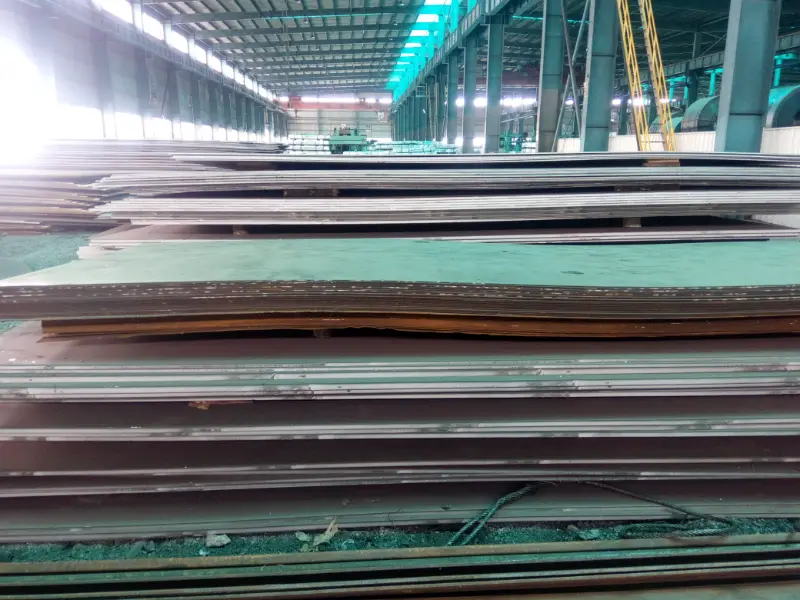
ASME SA514 Grade S (SA514GRS) High-Strength Carbon Steel Plate
ASME SA514 Grade S High-Strength Quenched & Tempered Alloy Steel Plate for Structural Applications
Comprehensive data sheet for ASME SA514 Grade S (SA514GRS) carbon steel plate covering chemical composition, mechanical properties, thermal and electrical physical properties, international equivalents, similar materials, and application guidance.
Hot rolling followed by quenching and tempering; can be cold formed, machined, and welded with proper procedures.
- Phone : +8618037372205
- Email : [email protected]
- WhatsApp: Contact via Whtsapp
- WeChat: +8618037372205
ASME SA514 Grade S High-Strength Carbon Steel Plate Introduction
ASME SA514 Grade S (SA514GRS) is a high-strength, quenched and tempered alloy steel plate primarily used for structural applications where weight savings and high strength are critical. It is covered by the ASME SA514/SA514M specification, which is identical to ASTM A514/A514M. Grade S offers a minimum yield strength of 100 ksi (690 MPa) in thicknesses up to 2.5 in. (65 mm) and excellent toughness. The material exhibits good weldability when proper procedures are followed and is often employed in welded bridges, buildings, heavy equipment, and off-highway vehicles. Its combination of high strength, notch toughness, and atmospheric corrosion resistance makes it suitable for demanding service conditions.
ASME SA514 Grade S High-Strength Carbon Steel Plate Chemical Composition
The following chemical composition limits are specified for ASME SA514 Grade S steel. These values apply to heat analysis and conform to the requirements of ASME SA514/SA514M.
- All elements are controlled to achieve high strength and good toughness after quenching and tempering.
- Boron and vanadium are microalloyed for grain refinement and hardenability.
- Carbon equivalent is typically controlled to ensure weldability.
| Element | Standard Value (max, unless range given) | Remarks |
|---|---|---|
| Carbon (C) | 0.10 - 0.20 | Range |
| Manganese (Mn) | 1.10 - 1.50 | Range |
| Phosphorus (P) | 0.035 | Maximum |
| Sulfur (S) | 0.035 | Maximum |
| Silicon (Si) | 0.15 - 0.35 | Range |
| Chromium (Cr) | 0.50 - 1.00 | Range |
| Molybdenum (Mo) | 0.25 - 0.60 | Range |
| Nickel (Ni) | 0.50 | Maximum |
| Vanadium (V) | 0.02 - 0.06 | Range |
| Copper (Cu) | 0.20 - 0.40 | Range |
| Boron (B) | 0.001 - 0.005 | Range |
ASME SA514 Grade S High-Strength Carbon Steel Plate Thermal and Electrical Physical Properties
The following physical properties are typical for SA514 Grade S steel in the quenched and tempered condition at room temperature unless otherwise noted. These values are representative for alloy steels of similar composition and may vary slightly with heat treatment.
- Density is comparable to other carbon and low-alloy steels.
- Thermal conductivity and electrical resistivity are influenced by alloy content.
- Values for Poisson's ratio and elastic modulus are standard for steel.
| Property | Typical Value | Unit | Test Condition / Remarks |
|---|---|---|---|
| Density (ρ) | 7.85 | g/cm³ | At 20°C (68°F) |
| Modulus of Elasticity (E) | 205 (29.7 × 10³) | GPa (ksi) | Tension, room temperature |
| Shear Modulus (G) | 80 (11.6 × 10³) | GPa (ksi) | Room temperature (calculated) |
| Poisson's Ratio (ν) | 0.30 | dimensionless | Room temperature, elastic range |
| Thermal Expansion Coefficient (α) | 11.7 (6.5) | 10⁻⁶/K (10⁻⁶/°F) | From 20°C to 100°C (68-212°F) |
| Thermal Expansion Coefficient (α) | 12.3 (6.8) | 10⁻⁶/K (10⁻⁶/°F) | From 20°C to 200°C (68-392°F) |
| Thermal Expansion Coefficient (α) | 13.1 (7.3) | 10⁻⁶/K (10⁻⁶/°F) | From 20°C to 400°C (68-752°F) |
| Thermal Conductivity (λ) | 42 | W/(m·K) | At 100°C (212°F) |
| Thermal Conductivity (λ) | 39 | W/(m·K) | At 200°C (392°F) |
| Thermal Conductivity (λ) | 36 | W/(m·K) | At 400°C (752°F) |
| Specific Heat Capacity (cp) | 475 | J/(kg·K) | At room temperature (approximate) |
| Electrical Resistivity (ρe) | 0.25 (25) | μΩ·m (μΩ·cm) | At room temperature |
ASME SA514 Grade S High-Strength Carbon Steel Plate Mechanical Properties
Mechanical properties as required by ASME SA514 Grade S for thicknesses ≤2.5 in. (65 mm). The material is tested in accordance with ASTM A370.
- Minimum yield strength (0.2% offset) is 100 ksi (690 MPa).
- Tensile strength range is 110-130 ksi (760-895 MPa).
- Elongation varies with gauge length; 18% in 2 in. (50 mm) and 14% in 8 in. (200 mm).
- Bend test specimens must withstand 180° bending without cracking; bend diameter depends on thickness.
- Impact toughness values are often specified in supplementary requirements (e.g., Charpy V-notch at -50°F).
| Property | Standard Value | Unit | Test Condition |
|---|---|---|---|
| Yield Strength (0.2% offset, ReH) | ≥ 100 (690) | ksi (MPa) | At room temperature, thickness ≤2.5 in. (65 mm) |
| Tensile Strength (Rm) | 110 - 130 (760 - 895) | ksi (MPa) | At room temperature, thickness ≤2.5 in. (65 mm) |
| Elongation (A) in 2 in. (50 mm) | ≥ 18 | % | Longitudinal, thickness ≤2.5 in. (65 mm) |
| Elongation (A) in 8 in. (200 mm) | ≥ 14 | % | Longitudinal, thickness ≤2.5 in. (65 mm) |
| Reduction of Area | ≥ 40 (typical) | % | Round specimen (not mandatory per base spec., often reported) |
| Bend Test (180°) - t ≤ ¾ in. (19 mm) | Bend diameter = 2t | No cracking | Transverse specimen |
| Bend Test (180°) - t > ¾ in. to 2 in. (50 mm) | Bend diameter = 2.5t | No cracking | Transverse specimen |
| Bend Test (180°) - t > 2 in. to 2.5 in. (65 mm) | Bend diameter = 3t | No cracking | Transverse specimen |
| Charpy V-Notch Impact (KV2) | Typically 20 - 40 (27 - 54) at -50°F (-46°C) | ft·lbf (J) | Longitudinal, when specified (e.g., AASHTO requirements) |
ASME SA514 Grade S High-Strength Carbon Steel Plate Fully Equivalent Material Standards and Substitute Grades
| Country / Region | Standard | Grade | Remarks |
|---|---|---|---|
| United States | ASTM A514/A514M | Grade S | Identical to ASME SA514 Grade S; both standards use the same chemical and mechanical requirements. |
| International | ISO 4950/2 | FeE690V | Comparable high yield strength structural steel with similar chemistry and tensile properties; slight variations in alloy content may exist. |
| Europe | EN 10025-6 | S690Q | Quenched and tempered structural steel with minimum 690 MPa yield strength; often used as a European counterpart, but exact chemical composition may differ. |
| Japan | JIS G 3128 | SHY 685 | High strength steel for welded structures, similar yield class, but not identical in chemistry. Suitable for many replacement applications. |
| China | GB/T 16270 | Q690D / Q690E | High strength quenched and tempered steel with minimum 690 MPa yield; requires verification of Charpy requirements and welding compatibility. |
ASME SA514 Grade S High-Strength Carbon Steel Plate Application Introduction
ASME SA514 Grade S steel is engineered for high-integrity structural applications where a combination of superior strength, good toughness, and weldability is essential. Its high yield-to-tensile ratio allows designers to reduce dead weight without compromising safety. Typical fabrication processes include thermal cutting, forming, and welding, all governed by standardized procedure qualifications to maintain the quenched and tempered properties. The material is used across a wide range of industries, and specific components include:
Product Applications: Welded steel bridge girders and trusses, Steel frames for high-rise buildings, Offshore platform legs and decks, Heavy-duty dump truck bodies and trailers, Mine haul truck chassis, Crane booms and outriggers, Excavator arms and buckets, Transportable pressure vessels (subject to additional requirements)
Processed into products: Main bridge beams and splice plates, Column and beam connections in moment-resisting frames, Welded tubular joints for offshore jackets, Stiffeners and diaphragm plates, Lifting lugs and padeyes, Wear plates and reinforcement sections in heavy machinery, Bolted structural connectors and gusset plates, Custom structural parts requiring high strength and notch toughness
Application industries: Bridge construction and infrastructure, Heavy equipment and machinery, Building and architectural structures, Offshore platforms and marine structures, Transport and trailer manufacturing, Mining and earthmoving equipment, Crane and lifting equipment, Pressure vessel and storage tank fabrication (when impact tested)
ASME SA514 Grade S High-Strength Carbon Steel Plate Similar and Analogous Substitute Materials
| Country / Region | Standard | Grade | Remarks |
|---|---|---|---|
| United States | ASTM A514/A514M | Grade E, Grade H, etc. | Other grades within the A514 family with similar minimum strength (100 ksi) but different chemical compositions and thickness limits. Grade E is a common alternative for thinner sections. |
| United States | ASTM A517/A517M | Grade S | Similar quenched and tempered alloy steel but for pressure vessel plates; same strength level but stricter requirements for pressure containment. |
| United States | ASTM A709/A709M | Grade 100 (Type Q&T) | Structural steel for bridges with 100 ksi yield strength; often overlapping in chemical and physical requirements with A514. |
| Europe | EN 10025-6 | S690QL / S690QL1 | Quenched and tempered fine-grain structural steel with enhanced notch toughness; close match for many structural applications. |
| Europe | EN 10225 | S690G1+Q | Weldable structural steel for fixed offshore structures; provides similar strength and improved through-thickness properties. |
Notes:
Welding must be performed with low-hydrogen processes and appropriate preheat/interpass temperatures to avoid hydrogen-induced cracking. Post-weld heat treatment (PWHT) is not typically required for thicknesses covered by this grade but may be applied if necessary; however, it can affect the mechanical properties, and re-tempering may be needed. Consult AWS D1.1 or ASME Boiler and Pressure Vessel Code for qualified welding procedures. The material is magnetic and can be galvanized or painted with suitable systems after surface preparation. Supplementary requirements (e.g., Charpy V-notch impact testing, ultrasonic examination, and through-thickness tensile testing) are frequently invoked in purchase specifications.
- Share



