
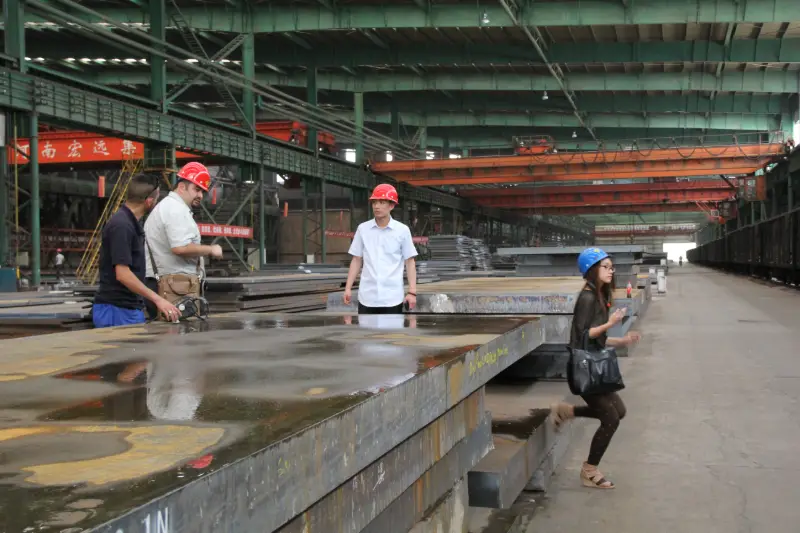
ASME SA514 Grade T
ASME SA514 Grade T: High-Strength Quenched and Tempered Carbon Steel Plate for Structural Engineering
Detailed material data for ASME SA514 Grade T carbon steel plate: chemical composition, mechanical properties, thermal and electrical performance, equivalent materials, and applications in construction, heavy equipment, and pressure vessels.
Welding, thermal cutting, cold forming, machining, drilling, punching
- Phone : +8618037372205
- Email : [email protected]
- WhatsApp: Contact via Whtsapp
- WeChat: +8618037372205
ASME SA514 Grade T Introduction
ASME SA514 Grade T (SA514GRT) is a high-strength, quenched and tempered carbon steel plate primarily used in structural applications. It is part of the ASME SA514/SA514M specification for high-yield-strength, alloy steel plates suitable for welding. Grade T is specifically a boron-treated low-carbon alloy steel designed to achieve yield strengths of at least 690 MPa (100 ksi) in thicknesses up to 50 mm. This steel offers an excellent combination of high strength, good weldability, and moderate toughness, making it ideal for heavy-duty structural components.
Key characteristics include:
- Superior strength-to-weight ratio, allowing lighter designs without sacrificing load capacity.
- Excellent weldability due to low carbon content and controlled boron addition, which enhances hardenability.
- Quenched and tempered condition ensures uniform mechanical properties throughout the plate.
- Good formability and machinability in the heat-treated state, suitable for fabrication processes.
ASME SA514 Grade T is commonly used in bridges, crane booms, earthmoving equipment, pressure vessels, and offshore structures. The steel is supplied in the quenched and tempered condition and may be ordered with supplementary requirements such as Charpy V-notch impact tests for specific low-temperature toughness.
ASME SA514 Grade T Chemical Composition
The composition of ASME SA514 Grade T is tailored to achieve high strength through martensitic transformation during quenching. Boron (0.0005–0.005%) is added in controlled amounts to dramatically increase hardenability, allowing full through-thickness hardening with relatively low carbon content. This ensures good weldability and toughness. All other elements are balanced to meet strength, ductility, and fabrication requirements as per the standard.
| Chemical Element | Standard Value (wt%) | Remarks |
|---|---|---|
| Carbon (C) | 0.10–0.20 | Low carbon for weldability |
| Manganese (Mn) | 0.60–1.00 | Deoxidizer; strength contribution |
| Phosphorus (P) | ≤ 0.025 | Impurity limit |
| Sulfur (S) | ≤ 0.025 | Impurity limit |
| Silicon (Si) | 0.15–0.35 | Deoxidizer; strength improvement |
| Nickel (Ni) | 0.70–1.20 | Toughness and hardenability |
| Chromium (Cr) | 0.40–0.80 | Hardenability and corrosion resistance |
| Molybdenum (Mo) | 0.15–0.25 | Hardenability; temper resistance |
| Vanadium (V) | 0.03–0.08 | Grain refinement; precipitation strengthening |
| Titanium (Ti) | 0.01–0.06 | Grain refinement; nitrogen fixation |
| Boron (B) | 0.0005–0.005 | Key for full hardenability in thick sections |
| Copper (Cu) | ≤ 0.50 | Residual element; can be specified for atmospheric corrosion resistance if required |
ASME SA514 Grade T Thermal and Electrical Physical Properties
Physical properties represent typical values for quenched and tempered low-alloy carbon steel grades similar to SA514 Grade T. Actual values may vary slightly with specific heat treatment and testing direction. These data are useful for engineering calculations (e.g., thermal expansion, heat transfer, and electrical grounding design). All values are at room temperature unless stated otherwise.
| Property | Typical Value | Unit | Test Condition |
|---|---|---|---|
| Density (ρ) | 7.85 | g/cm³ | Room temperature |
| Elastic Modulus (E) | 200 | GPa | Room temperature, longitudinal |
| Shear Modulus (G) | 80 | GPa | Room temperature, estimated |
| Poisson's Ratio (ν) | 0.3 | —— | Room temperature |
| Thermal Expansion Coefficient (α) | 11.7 | ×10⁻⁶ /°C | 20–100°C range |
| Thermal Conductivity (λ) | 45 | W/m·K | At 100°C |
| Specific Heat Capacity | 475 | J/kg·K | Room temperature |
| Electrical Resistivity (ρₑ) | 0.22 | µΩ·m | Room temperature |
ASME SA514 Grade T Mechanical Properties
These values apply to plates in the quenched and tempered condition. Tests are performed on transverse specimens unless otherwise specified. For thicknesses not covered, the standard may permit alternative requirements per agreement. The bend test is a measure of formability; no cracks shall appear on the outside of the bent portion. Note: Higher elongation values may be achieved with longitudinal specimens, but transverse values are standard.
| Property | Standard Required Value | Unit | Test Condition / Plate Thickness |
|---|---|---|---|
| Yield Strength (ReH) | ≥ 690 | MPa | Thickness ≤ 50 mm |
| Tensile Strength (Rm) | 760–895 | MPa | Thickness ≤ 50 mm |
| Elongation (A) in 50 mm (2 in.) | ≥ 18 | % | Thickness ≤ 20 mm, transverse specimen |
| Elongation (A) in 50 mm (2 in.) | ≥ 16 | % | Thickness > 20 mm up to 50 mm, transverse specimen |
| Bend Test (180°) - d = bend diameter, a = plate thickness | d = 2a | —— | Thickness ≤ 20 mm |
| Bend Test (180°) | d = 3a | —— | Thickness > 20 mm up to 25 mm |
| Bend Test (180°) | d = 3a | —— | Thickness > 25 mm up to 50 mm |
ASME SA514 Grade T Fully Equivalent Material Standards & Replaceable Grades
| Country/Region | Standard | Grade | Remarks |
|---|---|---|---|
| USA | ASTM A514/A514M | Grade T | Technically identical to ASME SA514 Grade T; same chemical and mechanical requirements. |
ASME SA514 Grade T Application Introduction
ASME SA514 Grade T plates are ideal for heavy structural applications where high strength, weldability, and toughness are essential. The material can be formed, welded, and machined using standard shop practices suitable for quenched and tempered steels. Typical applications include:
Product Applications: Bridge girders and truss members, Crane booms and lattice sections, Earthmoving and mining equipment buckets, High-pressure storage tanks and penstocks, Heavy-duty truck frames and chassis components
Processed into products: Welded beams, columns, and base plates, Bearing plates and stiffeners, Structural joints and connector plates, Mining shovel buckets and wear plates, Reinforcement pads for pressure vessel shells, Machinery frames, cutting edges, and lifting lugs
Application industries: Construction and civil engineering, Heavy machinery and mining equipment, Pressure vessel and storage tank manufacturing, Offshore and marine structures, Transportation and mobile equipment (e.g., trailers, rail cars)
ASME SA514 Grade T Similar / Substitute Material Recommendations
| Country/Region | Standard | Grade | Remarks |
|---|---|---|---|
| Europe | EN 10025-6 | S690Q | Comparable yield strength (690 MPa) but higher Mn, no B; weldability characteristics differ; may require preheat control. |
| Japan | JIS G3128 | SHY 685 | Similar high-strength plate; composition varies; often used in similar structural applications; verify with supplier for exact property match. |
| China | GB/T 16270 | Q690D | Yield 690 MPa, low-temperature impact option; different alloy design; possible substitution after engineering assessment. |
| International | ISO 4950-2 | S690QL | Quenched and tempered structural steel; comparable strength; not identical in chemistry; suitable for many demanding structural uses. |
Notes:
Welding: Low-hydrogen welding processes are recommended. Preheat and interpass temperatures should be controlled (typically 150–200°C) to avoid hydrogen cracking. Post-weld heat treatment is not normally required but may be specified for stress relief depending on application.
Availability: Plates are supplied in the quenched and tempered condition, cut to size or as-rolled edges. Supplementary requirements (e.g., Charpy V-notch testing, ultrasonic examination, restricted chemistry) can be specified at the time of order.
Limitations: The maximum thickness for Grade T plates is generally 50 mm (2 in.) to maintain full specified strength. For thicker sections, consult the steelmaker.
- Share



