
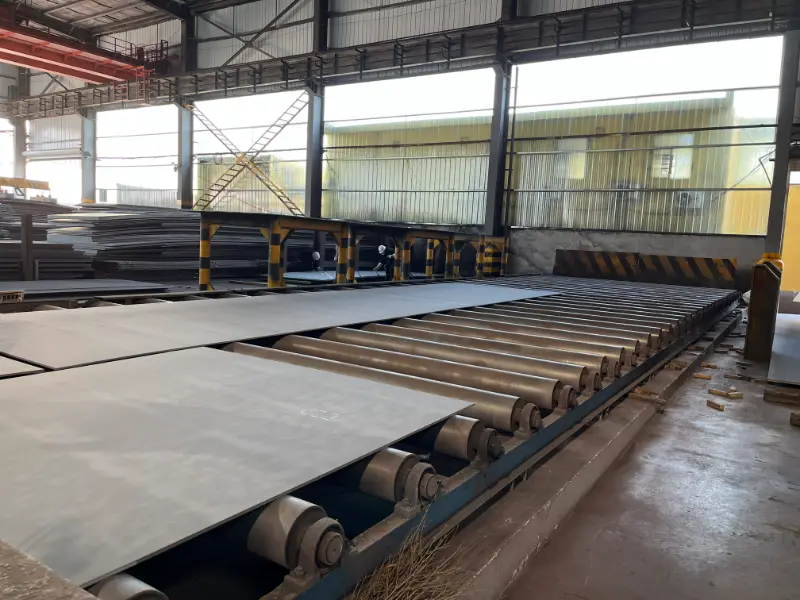
ASME SA572 Grade 42 Carbon Steel Plate
ASME SA572 Grade 42 Carbon Steel Plate: Chemistry, Mechanical & Physical Properties
Detailed material data for ASME SA572 Grade 42 (SA572GR42) carbon steel plate, including chemical composition, mechanical properties, thermal and electrical physical properties, equivalent standards, and application guide.
Hot rolling, normalizing, cutting, welding, bending, machining, cold forming
- Phone : +8618037372205
- Email : [email protected]
- WhatsApp: Contact via Whtsapp
- WeChat: +8618037372205
ASME SA572 Grade 42 Carbon Steel Plate Introduction
ASME SA572 Grade 42 (SA572GR42) is a high-strength low-alloy (HSLA) carbon steel plate primarily used in structural and pressure vessel applications. Under the ASME Boiler and Pressure Vessel Code, it adopts the chemical and mechanical requirements of ASTM A572 Grade 42, with a specified minimum yield strength of 42 ksi (290 MPa). The steel is typically supplied in the as-rolled or normalized condition and offers good weldability, formability, and notch toughness at ambient temperatures.
- Minimum yield strength: 290 MPa (42 ksi)
- Tensile strength: 415–550 MPa (60–80 ksi)
- Fine-grain practice with optional microalloying elements (Nb, V, Ti)
- Suitable for welded structures, bridges, storage tanks, and pressure-retaining components
ASME SA572 Grade 42 Carbon Steel Plate Chemical Composition
The chemical composition limits are in accordance with ASME SA572/SA572M Grade 42. The steel must be made to fine-grain practice, with one or more microalloying elements (niobium, vanadium, titanium, etc.) added to achieve grain refinement. Specific ranges for these elements are typical but not mandatory; the manufacturer ensures the required mechanical properties.
- Maximum carbon content ensures good weldability.
- Manganese level depends on plate thickness; for plates over 3/4 in. (20 mm) the manganese minimum applies.
- Sulfur and phosphorus levels are controlled for cleanliness and toughness.
| Element | Standard Value (max. unless range given) | Remarks |
|---|---|---|
| Carbon (C) | 0.21% | Heat analysis |
| Manganese (Mn) | 1.35% (max.) | For plates ≤3/4 in. (20 mm); Mn ≥0.80% for plates >3/4 in. |
| Phosphorus (P) | 0.04% | Heat analysis |
| Sulfur (S) | 0.05% | Heat analysis |
| Silicon (Si) | 0.40% | |
| Copper (Cu) | 0.20% (min.) | When copper steel is specified |
| Niobium (Nb) | 0.005–0.05% | Typical range for grain refinement; optional but common |
| Vanadium (V) | 0.01–0.15% | Typical range for grain refinement; optional but common |
| Titanium (Ti) | 0.005–0.05% | Optional microalloy; may be used singly or in combination |
| Nitrogen (N) | 0.015% (max.) | If not bound by strong nitride formers |
ASME SA572 Grade 42 Carbon Steel Plate Thermal and Electrical Physical Properties
The physical property data are typical values for carbon steel of this type at room temperature unless otherwise noted. These values are not specified in the material standard but are provided for design and engineering calculations. The properties may vary slightly depending on exact heat treatment and microalloying content.
| Property | Typical Value | Unit | Test Condition |
|---|---|---|---|
| Density (ρ) | 7.85 | g/cm³ | 20°C |
| Elastic Modulus (E) | 205 | GPa | Room temperature |
| Shear Modulus (G) | 79.3 | GPa | Room temperature |
| Poisson's Ratio (ν) | 0.26 | – | Room temperature |
| Thermal Expansion Coefficient (α) | 11.7 | 10⁻⁶/K | 20–100°C |
| Thermal Expansion Coefficient (α) | 12.5 | 10⁻⁶/K | 20–200°C |
| Thermal Conductivity (λ) | 52 | W/(m·K) | 20°C |
| Specific Heat Capacity (cp) | 486 | J/(kg·K) | 20°C |
| Electrical Resistivity (ρe) | 0.142 | μΩ·m | 20°C |
ASME SA572 Grade 42 Carbon Steel Plate Mechanical Properties
The mechanical properties are determined on test specimens taken from plates in the as-rolled or normalized condition. All values meet ASME SA572 Grade 42 requirements. Tensile and yield strength are given for longitudinal direction. Elongation is reported for both 8-inch (200 mm) and 2-inch (50 mm) gauge lengths, depending on plate thickness. Note: Impact toughness is not mandatory and is available only when supplementary requirements are specified.
| Property | Standard Requirement | Unit | Test Condition |
|---|---|---|---|
| Yield Strength (ReH) | ≥ 290 | MPa (ksi) | Plate thickness ≤ 100 mm; transverse specimen possible per agreement |
| Tensile Strength (Rm) | 415 – 550 | MPa (ksi) | Plate thickness ≤ 100 mm |
| Elongation (A) in 8 in. (200 mm) | ≥ 20% | % | Plate thickness ≤ 3/4 in. (20 mm); 8-inch gauge |
| Elongation (A) in 8 in. (200 mm) | ≥ 18% | % | Plate thickness >3/4 in. to 1.5 in. (20–40 mm) |
| Elongation (A) in 8 in. (200 mm) | ≥ 17% | % | Plate thickness >1.5 in. to 2 in. (40–50 mm) |
| Elongation (A) in 2 in. (50 mm) | ≥ 24% | % | Plate thickness ≤ 3/4 in. (20 mm); 2-inch gauge |
| Elongation (A) in 2 in. (50 mm) | ≥ 22% | % | Plate thickness >3/4 in. to 1.5 in. (20–40 mm) |
| Elongation (A) in 2 in. (50 mm) | ≥ 21% | % | Plate thickness >1.5 in. to 2 in. (40–50 mm) |
| Bend Test (180°) | No cracks on outside of bent portion | Bend diameter = 1.5 × specimen thickness (t) for plates ≤ 3/4 in.; larger radii for thicker plates per standard |
ASME SA572 Grade 42 Carbon Steel Plate Fully Equivalent Material Standards and Replaceable Grades
| Country/Region | Standard | Grade/Designation | Remarks |
|---|---|---|---|
| USA | ASTM A572/A572M | Grade 42 | Identical chemistry and mechanical properties; the source specification for ASME SA572. |
| USA | ASME SA572/SA572M | Grade 42 (SA572GR42) | The present material; equivalent to ASTM A572 Gr. 42. |
| Canada | CSA G40.20/G40.21 | 300W | Yield strength 300 MPa, tensile 450–620 MPa; closely matches but with slightly higher yield. |
| Europe | EN 10025-2:2019 | S275J2 | Yield 275 MPa, tensile 410–560 MPa; acceptable substitution for non-critical applications with design adjustment. |
| Japan | JIS G3106:2020 | SM400B | Yield 245 MPa, tensile 400–510 MPa; slightly lower strength; may be used where design allows. |
ASME SA572 Grade 42 Carbon Steel Plate Application Introduction
ASME SA572 Grade 42 is extensively used in welded structural components requiring moderate strength, good toughness, and reliable weldability. It can be fabricated into a wide range of products using conventional cutting, bending, and welding processes.
- Structural frameworks, beams, and columns
- Pressure vessel shells and heads (under ASME Section VIII Div.1)
- Storage tanks and silos
- Offshore platform topsides and substructures
- Heavy machinery frames and supports
Product Applications: Bridges and pedestrian overpasses, API 650 storage tanks, ASME U-stamped pressure vessels, Structural steel for high-rise buildings, Excavator booms and crane lattice structures, Wind turbine tower internals
Processed into products: Welded I-beams and box girders, Cylindrical shells and formed heads, Flanges and stiffeners, Support brackets and base plates, Plow and scraper blades (after hardening), Pin-connected structural links and eyebars
Application industries: Construction and civil engineering, Pressure vessel and storage tank fabrication, Shipbuilding and offshore structures, Heavy machinery and transportation equipment, Mining and material handling
ASME SA572 Grade 42 Carbon Steel Plate Similar/Comparable Alternative Materials
| Country/Region | Standard | Grade/Designation | Remarks |
|---|---|---|---|
| USA | ASTM A36/A36M | A36 | Lower yield (250 MPa), general structural steel; may substitute in less demanding strength applications. |
| Europe | EN 10025-2 | S275JR/J0/J2 | Yield 275 MPa; widely available; use with welding and toughness considerations. |
| China | GB/T 1591 | Q345B | Yield 345 MPa; higher strength; requires attention to welding procedures. |
| International | ISO 630-2 | Fe 430B | Yield 285 MPa; very similar strength level; may be used as direct substitute. |
Notes:
Supplementary requirements may apply: The base standard does not require impact testing. For low-temperature service, specify supplementary requirement S5 (Charpy V-notch test) or order SA572 Grade 42 with a letter suffix such as Grade 42S (structural quality with toughness). Weldability: Preheating is usually not necessary for thicknesses up to 1.5 in. (40 mm), but the carbon equivalent (typically CE ≤ 0.42%) should be verified. Formability: The steel can be cold-formed with a minimum bend radius of 1.5t for plates up to 3/4 in. thickness. Hot forming above 1100°C may require subsequent normalizing to restore fine grain structure.
- Share



